



 For all latest news, follow the Daily Sun's Google News channel.


Manifestos set bold economic targets, but experts call for time-bound action
Rafikul Islam, Dhaka
Published: 10 Feb 2026, 12:00 AM
As major political parties have unveiled their election manifestos outlining ambitious economic roadmaps ahead of Thursday’s parliamentary polls, economists and business leaders warn that without clear, time-bound and well-financed action plans, these promises may remain aspirational rather than achievable.
The manifestos of the Bangladesh Nationalist Party (BNP), Bangladesh Jamaat-e-Islami, National Citizen Party (NCP), and Islami Andolan Bangladesh (IAB) place strong emphasis on economic reforms, export expansion, investment promotion, energy security for industries, and job creation through technology and trade.
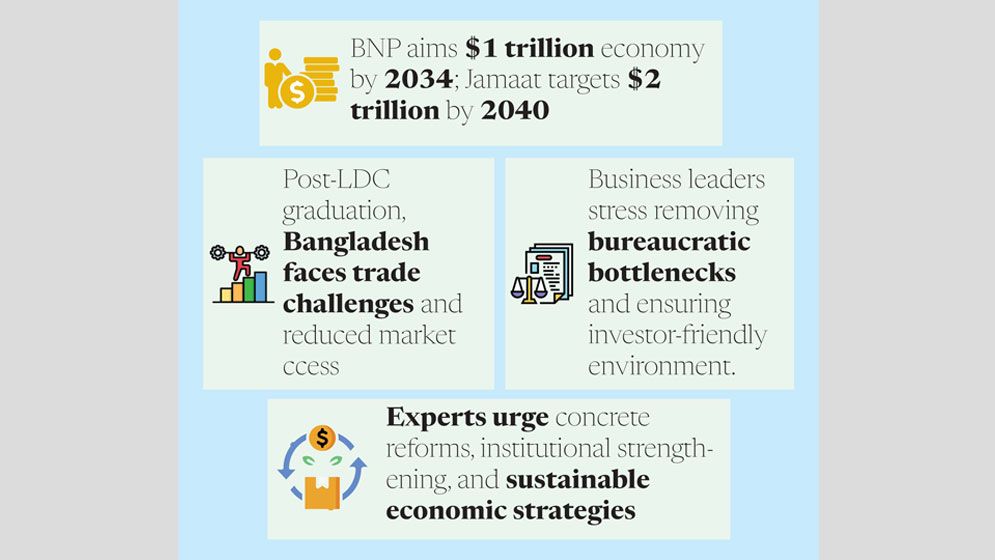
Among them, Jamaat set the most ambitious long-term target – building a $2 trillion economy by 2040 – while BNP has proposed achieving a $1 trillion economy by 2034 through what it terms the “democratisation of the economy,” supported by structural reforms, fiscal discipline, improved financial governance, and a more conducive business environment.
Experts said these manifestos will shape the policy direction of the next government at a critical time, as Bangladesh is set to graduate from Least Developed Country (LDC) status in November this year.
Following graduation, Bangladesh will gradually lose preferential market access, including duty-free and quota-free facilities in developed markets – posing serious challenges for exports, investment, and overall economic stability.
Experts expressed concern that while the manifestos are ambitious, they largely lack clear implementation strategies. Without concrete action plans, sustainable financing mechanisms, and institutional reforms, they warned the visions could remain fragile and risk pushing the country into the middle-income trap.
They also stressed that unless bureaucratic bottlenecks are removed, even well-designed strategies may fail at the implementation stage.
Bangladesh needs significant economic reforms
Speaking to the Daily Sun, Chairperson of the Economics Department at North South University (NSU) Dr Syed Mortuza Asif Ehsan said the major political parties have correctly identified the need for deep economic reforms.
“Jamaat has set very ambitious long-term goals, focusing on exports, investment, and job creation through technology and trade. In contrast, the BNP has presented a comparatively detailed framework highlighting structural reforms, fiscal discipline, improved financial governance, and the expansion of social safety programmes,” he said.
Mortuza noted that while the manifestos outline broad goals to accelerate economic growth, achieving them will require strong institutions, meticulous planning, sustained private sector participation, and stable macroeconomic conditions.
“These critical requirements are not clearly explained in either manifesto. Still, it is evident that political parties now recognise the urgency of reform to avoid the middle-income trap,” he added.
Targets alone not enough; action plans essential
Dhaka Chamber of Commerce & Industry (DCCI) President Taskeen Ahmed said while both parties have outlined Bangladesh’s future economic roadmap through job creation, expansion of investment, reforms in the revenue system, and strengthening social protection, setting targets alone is not sufficient. “Rather, having clear and concrete action plans to implement these goals is equally crucial.”
He added that once a new government takes office, the most pressing challenge will be economic recovery, which he described as “urgent and unavoidable.”
Bureaucratic bottlenecks must be removed
American Chamber of Commerce in Bangladesh (AmCham) President Syed Ershad Ahmed said while the manifestos promise governance reforms and anti-corruption measures, the proposed “business ecosystem” remains vaguely defined.
“From what has been reported in the media, commitments to curb corruption, strengthen the banking and financial sector, and expand the economy are mentioned. However, clearer commitments are needed, particularly regarding the implementation of the Customs Act-2023 and the Logistics Act-2025,” he said.
Ershad noted that these reforms are vital for improving Bangladesh’s global competitiveness. While energy security has been acknowledged as a priority, he said equal attention must be given to law and order, workplace health and safety, and enforcement of Intellectual Property Rights (IPR).
“Unless bureaucratic bottlenecks are removed, no strategy or plan – no matter how well-intentioned – will be implemented effectively,” he cautioned.
Conducive business environment key to growth
Bangladesh Chamber of Industries (BCI) President Anwar-ul Alam Chowdhury (Parvez) said the foremost demand of the business community is a favourable and hassle-free business environment.
“Regardless of manifesto promises, the new government must prioritise resolving longstanding business challenges. We need safety, security, reliable energy supply, and an investor-friendly environment,” he said.
Parvez, a former president of the Bangladesh Garment Manufacturers and Exporters Association (BGMEA), also stressed the need to lower bank interest rates, control inflation, strengthen the judiciary, and reduce the cost of doing business to enhance global competitiveness.
“There is no alternative to focusing on the ready-made garment (RMG) sector. At the same time, diversification into light engineering, halal products, and other emerging sectors is essential to overcome post-LDC trade challenges,” he added.
The BCI president further said the government must change its perception of the business community. “Businesspeople deserve respect – they create jobs and drive the country’s economic engine.”
He noted that following the signing of an Economic Partnership Agreement (EPA) with Japan, Bangladesh should actively pursue more Free Trade Agreements (FTAs) and EPAs with the European Union, North America, Australia, and other key markets.
Parvez also welcomed the interim government’s move to separate the National Board of Revenue (NBR), stressing that its institutional capacity must now be strengthened. “Post-LDC graduation will bring severe challenges for the RMG sector, and fiscal support will be critical,” he said.
Recommended Stories
Read More