


 For all latest news, follow the Daily Sun's Google News channel.


Commentary
History’s revenge: When time strikes back
Abdul Mukith
Published: 24 Feb 2026, 12:00 AM
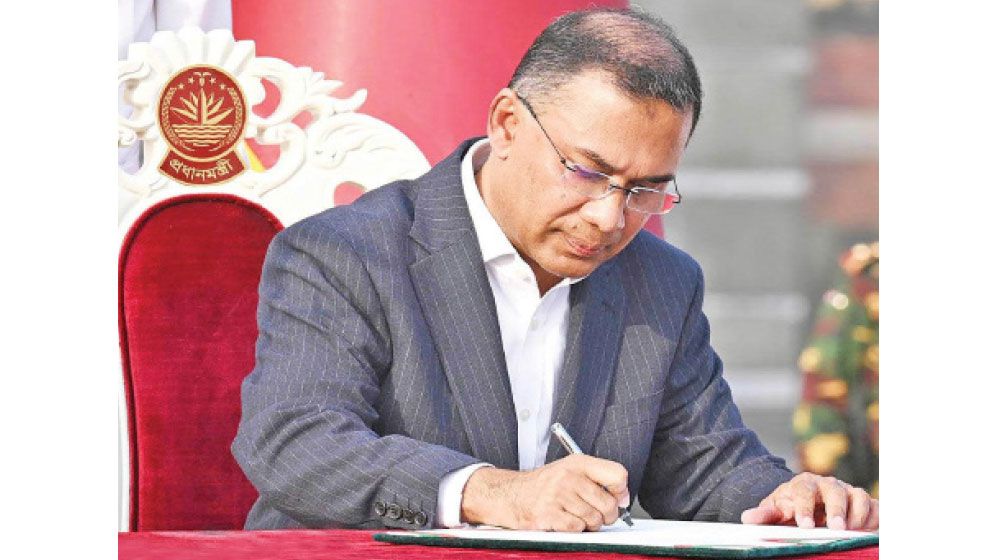
Tarique Rahman now holds the very same chair once occupied by Sheikh Hasina..
Politics often unfolds in cycles. There is rise in power, there is fall in power. Words spoken in dominance sometimes return as echoes in defeat.
In Bangladesh’s turbulent political history, few rivalries have been as intense and deeply personal as that between deposed prime minister Sheikh Hasina and the Zia family – former prime minister Khaleda Zia and her son Tarique Rahman, the current prime minister of Bangladesh and the BNP chairman.
For years, Sheikh Hasina pursued a politics marked by unyielding hostility towards the Zia family. Her speeches frequently targeted Khaleda Zia and, more sharply, Tarique Rahman. The objective was not merely a political competition but political annihilation – to remove him from the national stage entirely.
A cascade of cases followed. Over 80 cases were filed against Tarique Rahman, and he was convicted in several of them, including ones related to the 21 August grenade attack on an Awami League rally and the Zia Orphanage Trust. At last, he was acquitted in all the cases by the court, manifesting that the cases were politically motivated.
And beyond the courtroom battles, rhetoric against him had intensified. Sheikh Hasina’s public remarks often crossed into personal territory. On one occasion, she challenged Tarique Rahman using a slang word: “…if you’ve got the guts, come back to Bangladesh. Let’s see you for a bit.”
“…and her son, Tarique Zia, gave a written undertaking in 2007 that he would not engage in politics and then went to London. Where does he get so much money? He has embezzled public funds. He lives in hiding in London. From there, he orders arson attacks. Hey you, if you have the courage, then come back to Bangladesh. Lt’s see you for a bit,” she had said.
These statements reflected not only political rivalry but a deep personal antagonism. At the time, power appeared firmly consolidated. The state, the administration, and the political narrative seemed to align in one direction.
But politics is rarely static. History is rarely obedient.
The events of 2024 altered Bangladesh’s political landscape dramatically. A mass uprising, which stemmed from a movement against the quota system in government jobs, forced Sheikh Hasina to flee the country – an outcome few would have predicted during the height of her authority. In a striking twist of fate, the man once portrayed as politically finished returned to the country. Following his party’s sweeping victory in the 12 February parliamentary election, Tarique Rahman assumed the office of prime minister on 17 February.
He now holds the very same chair once occupied by Sheikh Hasina – a seat she appeared to consider permanently hers. Now in exile, she observes developments unfolding here from afar, unable to step back into the country – a powerful irony mirroring the fate she once imposed on Tarique Rahman.
This is where the theme of “the revenge of nature” emerges. Not revenge in the literal sense, but in the philosophical rhythm of cause and consequence. Power, when exercised with excess certainty, often underestimates time. Political dominance can create the illusion of permanence, yet history repeatedly demonstrates that no position is immune to change.
The challenge once thrown – “come back if you have the courage” – now resonates differently. The exile returned. The accuser departed. The chair remained.
Nature, or perhaps history itself, has a peculiar way of balancing narratives. It humbles certainty. It overturns assumptions. It reminds leaders that authority is temporary.
Today, as Tarique Rahman leads the BNP government, the broader lesson may extend beyond personal rivalry. It speaks to the impermanence of power and the inevitability of political transformation. The very system once used to corner an opponent can, in time, become the stage for that opponent’s return.
In Bangladesh’s political chronicle, this chapter will be remembered not merely as a change of government, but as a dramatic illustration of history’s quiet but relentless balance – the revenge of nature.
The writer is a Joint News Editor at the Daily Sun
Read More