


 For all latest news, follow the Daily Sun's Google News channel.


GROWING SHADOW EDUCATION (PART 2)
Coaching centres boom as admission race intensifies

For more than a decade, successive governments have pledged to shut down coaching centres, yet the shadow education system continues to expand across the country.
Efforts to curb the trend, including the introduction of a new curriculum by the previous government, have had limited impact, as coaching centres quickly adapted by offering courses aligned with revised syllabuses. After the BNP-led government assumed office, Education Minister ANM Ehsanul Hoque Milon reiterated plans to shut down coaching centres entirely.
However, the recent scrapping of the lottery system for school admissions has reignited demand for coaching, as students once again compete for places in reputed institutions.
Dense coaching network and aggressive marketing
In Motijheel, home to several leading schools including Ideal School, a dense network of coaching centres has emerged. Buildings are covered with posters and banners advertising admission coaching and subject-based classes.
Institutions such as Insight, Udoy Academic Care, Saffollo Cadet Coaching, Udvash, Unmesh and Reliance Coaching Centre are actively competing to attract students. The area is also filled with advertisements for private batch classes conducted by individual teachers.
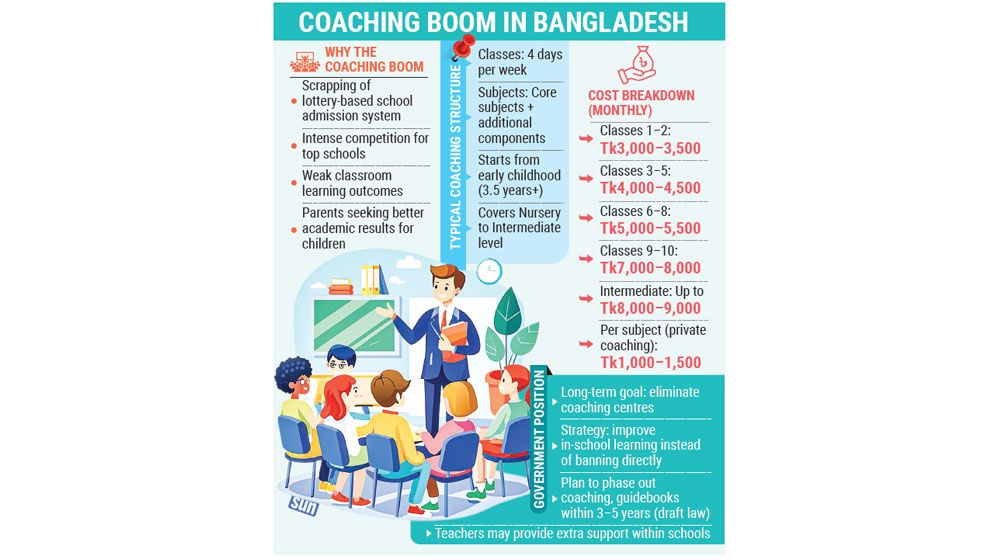
At Motijheel Government Colony, coaching centres operate in large numbers. At Eduspark Academy, classes have been running since January, according to its principal Sifat Ara Sumi. “If you enrol now, the remaining fee is Tk3,000. Classes are held four days a week, covering three core subjects, along with social science and oral components,” she said.
Nearby, Anannya Kindergarten, widely known as a coaching centre, offers both early education and admission coaching. A grade III student of Motijheel Ideal School said he pays Tk3,500 for coaching in four subjects, adding that lessons are more advanced than regular classroom teaching.
Manager Mohammad Saju said admission coaching for Class One will begin on June 1, with Tk2,000 as admission fee and Tk2,000 monthly tuition. “We ensure a 99% chance of admission,” he claimed, adding that the centre employs 34 teachers and supports students from nursery to grade IV.
Heavy financial burden on guardians
A study by the Campaign for Popular Education (CAMPE) shows that private tutoring and coaching centres account for the largest share of household education expenditure.
At Eduspark Academy, admission fees range from Tk3,000 for lower classes to Tk4,000 for higher levels. Monthly tuition also rises with grade and curriculum, with English Version courses costing Tk500 to Tk1,000 more than Bangla Version.
Fees start at Tk3,000-Tk3,500 for grade-I and grade-II and increase to Tk7,000–Tk8,000 for grade IX and grade-X.
At the intermediate level, costs can reach Tk8,000-Tk9,000 per month.
Students say coaching is often necessary to secure better results. A grade-IX science student from a private school in Banasree said he attends coaching in five subjects, paying Tk1,000-Tk1,500 per subject monthly.
Guardians describe the financial strain as severe. One parent said monthly coaching costs often match or exceed school tuition, alongside rising expenses for books, uniforms and other fees.
Thousands of centres, limited regulation
According to the Bangladesh Bureau of Statistics’ “Private Educational Institutions Survey 2024”, there are 6,587 registered coaching centres in the country. The actual number is believed to be much higher.
The education minister recently acknowledged the rapid growth of unregulated centres, including kindergartens operating informally. He said the government aims to phase out coaching centres gradually by improving in-school support.
Rather than imposing an immediate ban, the ministry plans to encourage teachers to provide additional academic support within institutions. Draft provisions in the proposed Education Act also suggest phasing out commercial coaching, guidebooks and note-based learning within three to five years.
Dhaka Education Board Chairman Professor Dr Khondoker Ehsanul Kabir said a clear policy framework was needed and would be implemented in line with government directives.
Improve classroom learning to reduce dependence
Experts say the root cause lies in weak classroom learning.
Dr Md Abdus Salam, Professor at the Institute of Education and Research, University of Dhaka, said the absence of a clear long-term vision has led to inconsistent education policies. “Coaching centres will continue to exist as long as learning gaps remain in schools,” he said, emphasising the need to improve teaching quality.
He stressed that teachers require proper training and financial security, and that strengthening classroom education would naturally reduce reliance on coaching. Dr Salam also called for a shift from exam-driven competition to continuous assessment that reflects actual learning outcomes.
“Parents turn to coaching because classroom learning is not enough,” he said, adding that lasting solutions must focus on improving the overall teaching and learning process within schools. (Concluded)