


 For all latest news, follow the Daily Sun's Google News channel.


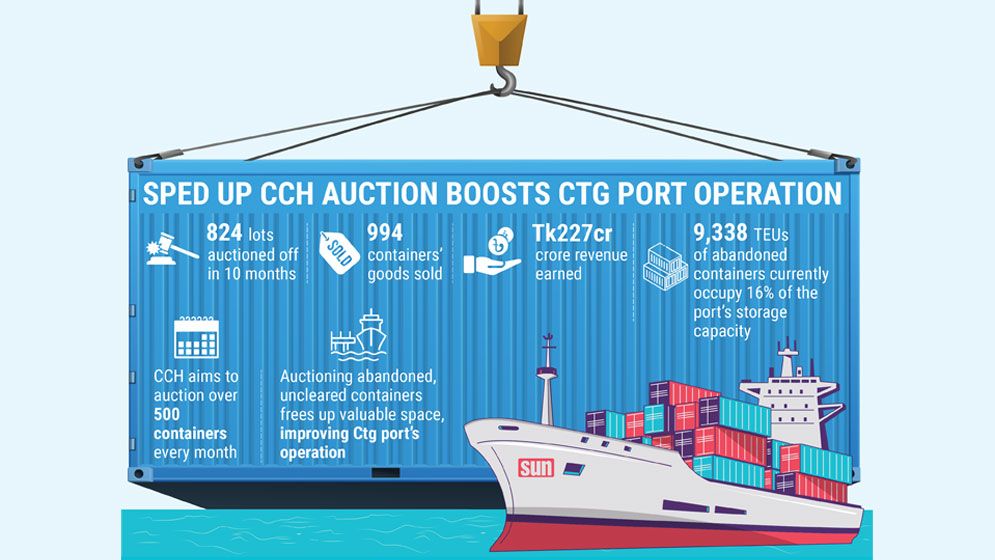
Easing years of administrative and legal deadlock, the Chattogram Customs House (CCH) has achieved a breakthrough in its auctioning process, helping reduce long-standing container congestion at Chattogram Port while boosting government revenue collection.
Following a landmark policy shift by the National Board of Revenue (NBR), the auction wing of CCH generated Tk227 crore in revenue in the first 10 months of the current fiscal year (FY26) through auctioning off 824 lots of goods.
Customs officials said that the renewed pace of auctions is gradually freeing up valuable yard space at the country’s premier seaport, improving operational efficiency and easing pressure on container handling facilities.
According to sources, as of Sunday, a total of 9,338 twenty-foot equivalent units (TEUs) of abandoned containers were lying at the port yards, occupying around 16% of the port’s storage capacity of 59,000 TEU containers.
The policy shift: Breaking the deadlock
For years, thousands of abandoned or uncleared containers remained stranded at Chattogram port due to lengthy court cases, legal complications and bureaucratic indecision.
The prolonged accumulation disrupted normal port operations and raised concerns over safety and storage capacity, as many containers contained deteriorating goods, chemicals and hazardous materials.
To address the situation, the NBR issued a special order on 14 May last year, introducing major changes to the country’s longstanding auction rules.
Under the previous system, goods could not be sold in the first auction unless bids reached at least 60% of the reserve value fixed by customs authorities.
The new order removed that restriction, allowing goods to be sold to the highest bidder in the first round regardless of the percentage offered. At the same time, the expansion of e-auction procedures eased and accelerated the disposal process.
“Many of the containers, particularly those carrying chemicals and hazardous goods, had turned into a serious safety concern,” Chattogram Customs House Assistant Commissioner (AC) Abu Sufian told the Daily Sun, adding that the impact of the new policy was now becoming visible on the ground. The NBR was now treating auctions as a “top priority” to reduce congestion at the port, he said.
“We have set a target to place more than 500 containers in auctions every month,” Sufian added.
Auctions and revenue on the rise
Since the introduction of the special order, auction activities at the CCH have increased sharply, with both regular e-auctions and special auctions drawing strong participation from bidders.
According to customs data, the CCH completed the largest-ever auction of a single consignment on 29 January this year, involving 2,800 tonnes of goods.
A total of 13 bidders took part in the auction, and the consignment was sold for Tk9.27 crore to the highest bidder.
Overall, customs authorities auctioned off 824 lots in 16 rounds, including five special auctions, during the current fiscal year.
While only one regular auction was held in FY23, the number increased to four in FY24 and 10 in FY25, before reaching 16 in the current FY.
Data from the Auction Wing of the CCH shows that over the past 10 months, customs authorities sold goods from 994 containers under the special order, from 294 containers through regular auctions and another 85 containers through open auctions.
Record response from bidders
The simplified auction process under the special order has generated unprecedented interest among bidders.
In the first special auction held last August, more than 1,500 bidders participated for 340 containers – one of the highest levels of participation in recent years.
That single auction generated nearly Tk85 crore in revenue, including VAT and taxes.
Customs officials said the revised auction mechanism has made the process more realistic and commercially viable for traders.
Previously, goods often remained unsold despite deteriorating in quality because reserve prices were set too high. As a result, the same containers remained stuck at the port for years.
Read More