



 For all latest news, follow the Daily Sun's Google News channel.


French-Japanese duo gets Chemistry Nobelfor unraveling mirror image mystery
Agencies, Stockholm
Published: 08 Oct 2026, 12:00 AM
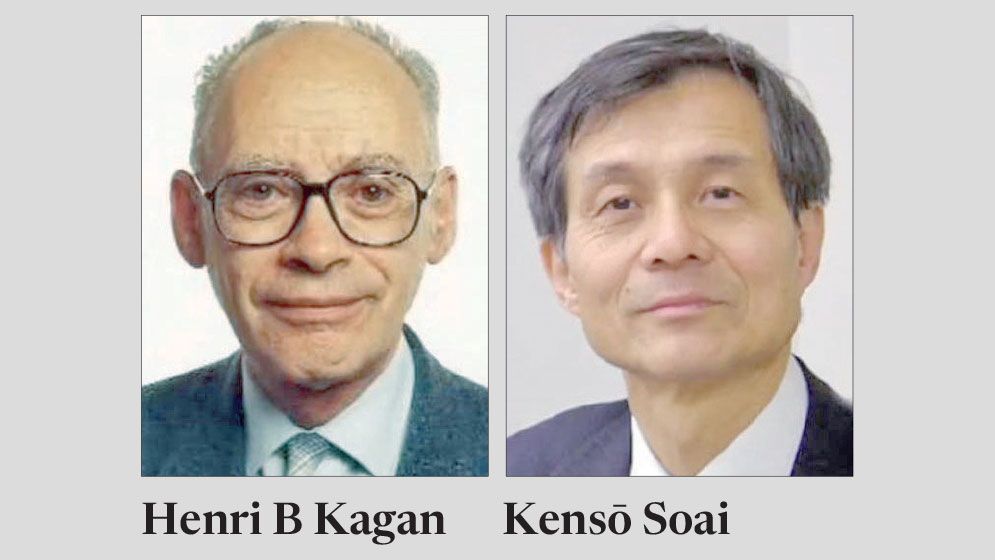
The Nobel Prize in chemistry 2026 has been awarded to two scientists for discoveries that showed how chemical reactions can produce one of two mirror image forms of a molecule.
Henri B Kagan at Paris-Sud University in France and Kensō Soai at Tokyo University of Science in Japan have been awarded the prize “for the discovery of nonlinear effects and autocatalysis in asymmetric organic synthesis”.
The Nobel assembly at the Karolinska Institute in Stockholm, Sweden, announced the winners on Wednesday. They will each receive an equal share of a prize of 12m Swedish kronor (about £900,000).
Soai, 76, is Japanese, and Kagan, 95, is French, and their work built on a discovery by the 19th-century French chemist Louis Pasteur.
"This is the most exciting day in my life, I am very glad to share this prize with professor Henri Kagan," Soai said, speaking by phone to the Nobel Prize press conference, adding he had been out shopping when receiving the news.
The Nobel committee was still trying to contact Kagan, the third-oldest person to be awarded a Nobel Prize, to inform him.
French President Emmanuel Macron congratulated the laureates on X, calling it an immense honour for the country. "A recognition suited to a lifetime of research," he said.
In fact, Kagan's work has long been seen as influential on the field and the then-French research minister complained to the Nobel Foundation in 2001 when Kagan was left out that year. The prize instead went to two American and one Japanese scientists for work in the same field.
The chemistry Nobel, always the third prize to be awarded during Nobel week, followed those for medicine and physics announced on Monday and Tuesday.
Many of the molecules essential to life exist in two forms that are mirror images of each other, like left and right hands. Yet living organisms almost exclusively use only one version, a phenomenon known as "homochirality" – from the Greek word for hand – that has puzzled chemists for more than a century.