


 For all latest news, follow the Daily Sun's Google News channel.


Nearly 300 families wiped out in road crashes since 2020: RSF
Daily Sun Report, Dhaka
Published: 09 Nov 2026, 12:00 AM
Nearly 300 families have been wiped out entirely in road crashes across Bangladesh between January 2020 and October 2026, according to an analysis by the Road Safety Foundation (RSF).
The analysis found that several members of the same family were increasingly being killed while travelling together on motorcycles, battery-run auto-rickshaws, private cars, microbuses, ambulances and buses.
RSF Executive Director Saidur Rahman said the findings drew on reports from nine national dailies, 17 online news portals and electronic media, along with the foundation’s own database.
Motorcycle crashes killed 386 people in 193 incidents in which both husband and wife died. Another 159 crashes claimed 318 lives, including fathers and their children.
Battery-run auto-rickshaws were involved in 525 accidents that left 1,728 dead. The number of family members killed per incident ranged from two, in 211 cases, to seven, in 13 cases.
Microbus crashes killed 708 people in 186 incidents. Four of them claimed 11 members of one family each, and another claimed 14. Private cars were involved in 108 crashes that killed 352 people. Ambulance crashes claimed 162 lives in 45 incidents, including three in which eight members of one family died. Bus accidents killed 85 people in 32 incidents. In a separate crash, a pickup van lost control and overturned, killing four members of one family.
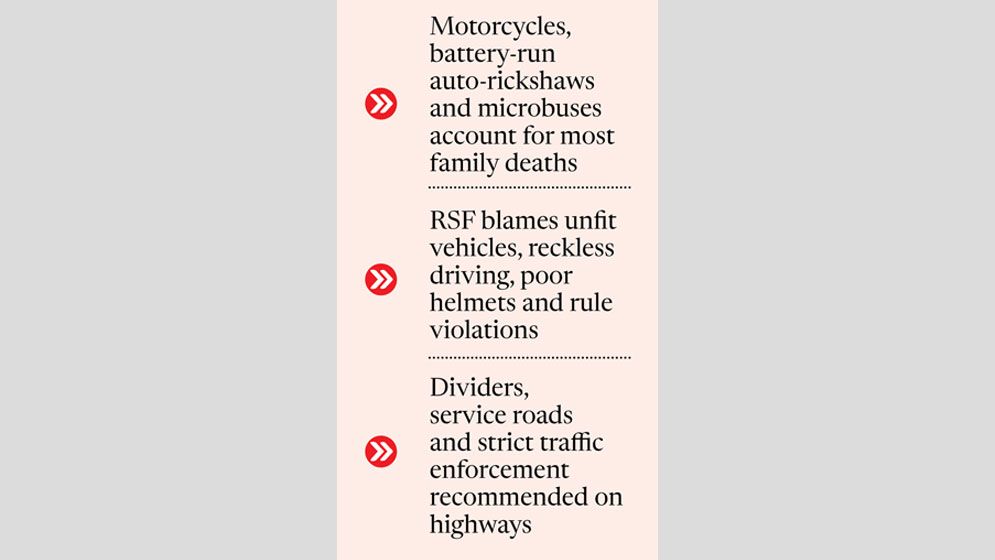
The RSF cited families travelling together, battery-run auto-rickshaws plying highways, unfit microbuses and ambulances, inadequate driving skills and long hours behind the wheel without rest. It also named reckless motorcycle riding, substandard helmets and traffic violations.
The foundation recommended high-quality helmets for riders and pillion passengers, and strict compliance with traffic laws. It also called for road dividers and service roads on all highways, safer designs to stop rural roads joining highways directly, closer monitoring of vehicle movement, and greater transparency and accountability among the institutions concerned.
Recommended Stories