



 For all latest news, follow the Daily Sun's Google News channel.


Mideast witnesses fresh rise in tensions
Agencies, Dubai
Published: 19 Nov 2026, 12:00 AM
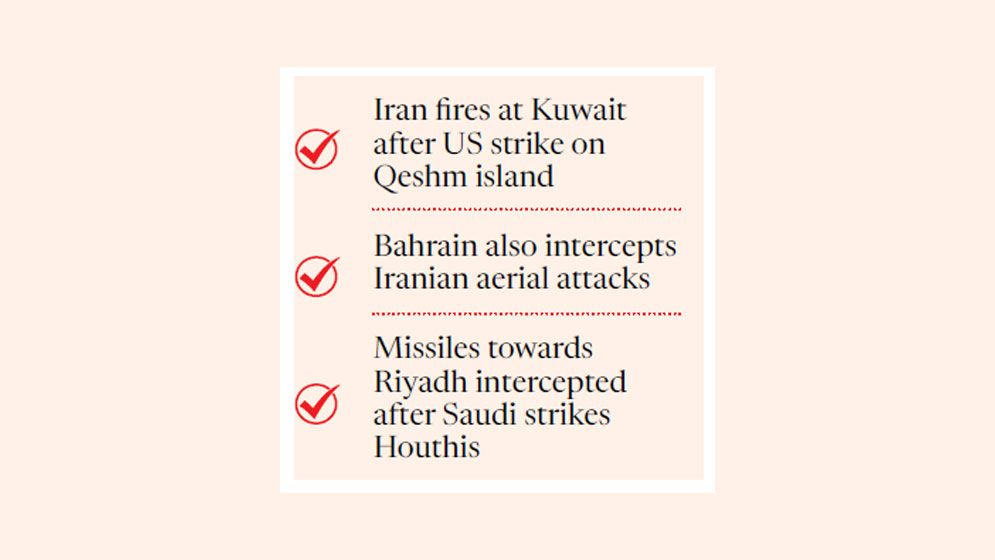
Iran widened its attacks on its Gulf neighbors on Wednesday, targeting a US air base in Kuwait and launching several attacks on Bahrain in what appeared to be retaliation for American strikes the day before.
After about two months without such attacks, Iran has repeatedly targeted US facilities in Bahrain in recent days. The small Persian Gulf island kingdom hosts the US Navy’s 5th Fleet.
The early morning attacks came after a US fighter jet struck a Revolutionary Guard missile launch site Tuesday on Qeshm Island in the Strait of Hormuz. The US strike was in retaliation for an Iranian attack on an American radar installation in Bahrain earlier Tuesday.
Iran said that its recent attacks — including those on other US facilities in Bahrain on Sunday and Friday — were in response to US drone surveillance operations and an attack on Iranian communications towers.
The uptick in fighting with the tit-for-tat attacks raises the risk of further escalation toward the resumption of all-out conflict nearly nine months into the war, and complicates negotiations for a diplomatic solution, which have stagnated despite intensified mediation efforts from Qatar.
The Iranian army said said it targeted US drone and missile sites in Kuwait's Ali Al Salem base overnight after the United States struck Qeshm Island, marking Tehran's first attack on the US-allied Gulf state since September. Kuwait said its air defences were countering hostile drone attacks.
Bahrain said it intercepted Iranian aerial attacks on Wednesday for a third time in a week, accusing Tehran of a "systematic hostile approach" towards the Gulf kingdom, where the US Navy's Fifth Fleet is headquartered.
In videos published by state media on Wednesday, Iranian Army Commander-in-Chief Amir Hatami issued a fresh warning to the United States, which launched the war against Iran alongside Israel in February.
"If the enemy repeats its mistake... we have the readiness and the plans to confront it and its supporters in a stronger, more crushing way and without geographic limitations," he said.
Hasan Al Hasan, a senior fellow for Middle East Policy at the International Institute for Strategic Studies, said Iran was undertaking a "cautious" escalation.
Iran has also fired at US forces in Jordan.
Global oil and gas prices have shot up with shipping through the Strait of Hormuz severely disrupted after Tehran declared it closed, while the US has imposed a naval blockade on Iran, hitting Iran's economy hard.
Qatari and Iranian officials met on Tuesday for talks aimed at "bridging perspectives and narrowing the gap between proposals presented on the ground," Qatari spokesperson Majed Al Ansari said.
Saudi Arabian air defenses intercepted and destroyed two cruise missiles fired toward the capital, Riyadh, by Iran-backed Houthi rebels in Yemen, according to Major General Turki al-Malki, spokesman for the Saudi-led coalition fighting the Houthis on Wednesday. Alerts also sounded in three other Saudi cities. Civil defense authorities later said that the danger had passed, but provided no further details.
The previous day, coalition forces launched a major air attack across rebel-held areas of Yemen that the Houthis said killed at least 17 people.
A surge in attacks on shipping since October has threatened to further strain global oil supplies. On Tuesday, a crew abandoned a liquefied petroleum gas tanker off Oman's Khasab.
The United Arab Emirates' ADNOC L&S said on Wednesday that one crew member was missing and 11 injured after one of its vessels was attacked in the Strait of Hormuz on Tuesday.