


 For all latest news, follow the Daily Sun's Google News channel.


Govt plans to strengthen zakat system for poverty alleviation: PM
He said there are currently around four crore families in the country, both rich and poor
UNB, Dhaka
Published: 07 Mar 2026, 07:42 PM

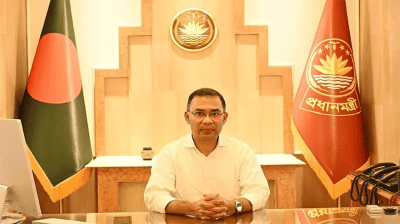
Photo: UNB
Prime Minister Tarique Rahman on Saturday said that the government has taken steps to make the zakat management system more effective and targeted, noting that zakat can play an important role in poverty alleviation if it is distributed in a planned and organised way.
“Zakat is one of the five pillars of Islam. I would
like to share with you a plan regarding zakat management in the country.
According to Islamic teachings, many wealthy people in our society pay zakat on
their own initiative. Some also pay their zakat through the government’s Zakat
Board,” he said.
If zakat is distributed in a planned and organised
manner can make a significant contribution to reducing poverty, the prime minister
said at an iftar mahfil hosted for ulema, Islamic scholars and orphans at state
guesthouse Jamuna.
“In this context, the government has taken steps to
make zakat management more effective and target-oriented,” he said.
The prime minister mentioned that various research
reports suggest the amount of zakat collected in Bangladesh exceeds Tk20,000 to
Tk25,000 crore every year and some estimates put the figure even higher.
However, he said the absence of a planned and
organised distribution system means that although wealthy individuals fulfil
their zakat obligation, questions remain about how effectively the funds help
reduce poverty.
“As far as I know, Islamic teachings encourage zakat
to be distributed in such a way that a recipient may not need to receive zakat
again the following year after receiving it once,” the prime minister observed.
He said there are currently around four crore
families in the country, both rich and poor.
If poor and extremely poor families are identified
and five lakh families are given Tk1 lakh each in zakat every year in phases,
most of those families may not need to receive zakat again the following year,
Tarique said.
“If zakat is distributed in a targeted and
well-planned manner, it could play an effective role in poverty alleviation in
the country within 10 to 15 years through zakat management alone,” he added.
The prime minister said if the idea of zakat
management for poverty alleviation is considered logical, ulema and religious
scholars can play the biggest role in raising awareness among wealthy people.
He also said the existing Zakat Board under the
Ministry of Religious Affairs can be reorganised with leading Islamic scholars,
religious experts and government officials to work more effectively for poverty
alleviation through zakat management.
“By using zakat for poverty alleviation, there is an
opportunity to present Bangladesh as a model in the Islamic world,” the prime minister
said.