


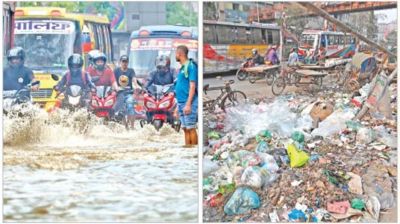
 For all latest news, follow the Daily Sun's Google News channel.


Metro above, knee-deep water below
Daily Sun Report, Dhaka
Published: 12 May 2026, 09:19 AM
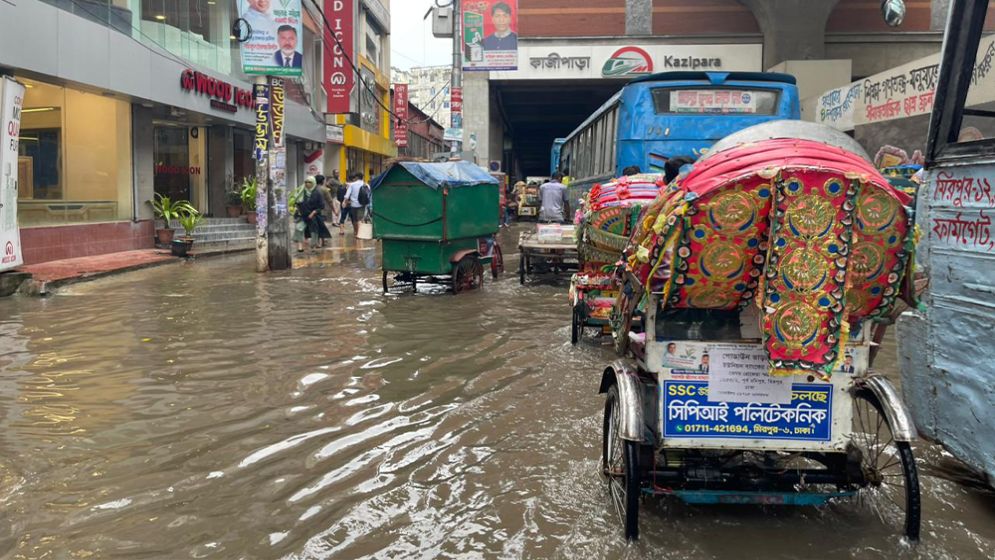
Even light rainfall causes waterlogging in many areas of Mirpur, including Kazipara. Photo: Collected
Continuous downpours are no longer needed to bring Dhaka to a standstill. Just one to one-and-a-half hours of heavy rain is enough. Roads are submerged within moments, narrow lanes turn into canals, and traffic grinds to a halt. Office-goers returning home are often seen walking barefoot or carrying their shoes through knee-deep water.
In some places, rickshaws break down in the floodwater, while elsewhere buses are left half-submerged. Waterlogging has now become a constant ordeal for residents of the capital.
Such scenes were witnessed on Monday afternoon in areas including Vatara, Nurerchala, Mirpur, Mohammadpur, Dhanmondi, Lalmatia, Uttara and Banasree after heavy rainfall. In many places, water remained stagnant for hours even after the rain had stopped. In some areas, floodwater nearly entered the ground floors of buildings.
Rain means waterlogged life in Vatara-Nurerchala
Even light rainfall causes severe waterlogging in areas such as Solmaid and Nurerchala in Vatara. The roads from Solmaid Momtaz Market to the Khondokar Bari intersection, along with surrounding lanes, become inundated, making movement extremely difficult.
A visit to Solmaid after Monday’s rain showed large sections of the roads submerged. Speaking near the Habibur Rahman Dhali Mosque, Farazitola resident Saurav Hossain said: “Drainage work goes on throughout the year, yet we still have to wade through water whenever it rains. Towards Chapra Mosque, the inner roads become waist-deep in water.”
Businessman Ahsan Habib, who runs a shop on Solmaid Road, said: “Rainwater mixes with dirty drain water, making it impossible to walk on the roads. If it rains in the morning, water remains until the afternoon. If it rains in the evening, business for the entire day is ruined.”
As Nurerchala is a low-lying area, severe waterlogging occurs there every monsoon. Roads from Nurerchala Market to the boat terminal, along with inner alleys, frequently go underwater. Even moderate rain can nearly halt traffic.
Ali Hossain, a trader at Nurerchala Market, said: “Once water accumulates, it takes a long time to drain away. Normal life across the area comes to a standstill.”
Roads in Mirpur resemble small rivers
Around 2:30pm on Monday, areas including Kazipara, Mirpur-10 and Mirpur-1 were found submerged, from the main roads to narrow alleys. Less than two hours of rain effectively paralysed urban life.
Kazipara resident Abu Yusuf said: “Rain now means fear for us. One hour of rain causes suffering for the entire day. Water remains until late at night. Drains exist, but there is no proper outlet for the water. Above us stands the beautiful Metro Rail infrastructure, while below there is severe waterlogging.”
Water had accumulated along both sides of the roads stretching from Technical intersection through Bangla College, Paikpara and Government Staff Quarters to Mirpur-10. In some places, even pavements were submerged. Passengers getting off buses were seen wading through knee-deep water to reach their destinations.
Private employee Saju Biswas said: “There is no way to get off the bus without stepping into knee-deep water. We have been seeing this situation for years, but nothing has changed.”
Pedestrian Ashikur Rahman at the Mirpur-10 roundabout said: “You realise how severe the waterlogging is when even the pavements go underwater. Yet we see no serious action from the city corporation to solve the problem.”
Knee-deep water in Dhanmondi and Lalmatia
Heavy rain also left knee-deep water in Dhanmondi, Sobhanbagh, Rajabazar and Lalmatia. Traffic slowed significantly on Mirpur Road from New Market to Asad Gate and on the stretch from Panthapath to Russell Square.
On-the-ground observations showed that after around an hour of rainfall, the eight-lane Mirpur Road resembled a narrow canal. Water even entered the footboards of many buses.
Sajjad Hossain, a passenger on Bikash Paribahan, said: “I have been travelling on this road for 15 years. Every monsoon, the same situation repeats itself. Even after all these years, the problem remains unsolved.”
Rainwater from the previous day was still seen accumulated on Zakir Hossain Road in Lalmatia G-Block of Mohammadpur. Residents complained that weak drainage systems cause waterlogging in E, F and G Blocks even after light rainfall.
Supreme Court lawyer Abdullah Al Mamun said: “Whenever it rains, water accumulates in the area. The drainage system is not very good.”
New housing areas without drainage facilities
The same crisis was observed in new residential areas along the Mohammadpur embankment, including Chandrima Housing, Bosila City Housing, West Dhanmondi Housing and Metro Housing. Rainfall leaves muddy water standing on roads, making movement difficult.
One resident said: “We have been paying holding tax for more than five years, yet the drainage system has not improved. Rainwater collects in potholes on the roads.”
University student Arpita Ami said: “Whenever it rains, the roads become filled with mud. There are no proper paved roads or drainage systems.”
Shahdat Hossain, a grocer in Kaderabad Housing, said: “The city corporation dug up the roads four or five months ago, but the work is still unfinished. Whenever it rains, the entire area goes underwater.”
Uttara submerged after even light rain
Kaler Kantho staff reporters Kamrul Islam and Sujan Mahmud visited several flooded parts of Uttara and found widespread suffering. In sectors 3, 5, 9, 13 and 17, most drains were either uncovered, broken or clogged with waste. Drains on roads 4, 5, 6, 9 and 13 in Sector 3 were found badly damaged. Even light rain now causes waterlogging as water cannot flow properly.
Residents alleged that although rubbish is regularly dumped into drains, there are no effective cleaning measures. As a result, even small amounts of rainwater overflow onto roads.
Urban expert Professor Adil Mohammad Khan said: “Despite repeated cleanliness drives, Dhaka’s canals, drains and sewerage lines remain clogged with waste. Authorities talk about projects and investment, but there is still a lack of area-based assessment and long-term planning.”
He added that instead of separate management systems for the two city corporations, an integrated sewerage master plan was urgently needed. He also stressed the importance of raising public awareness and encouraging community participation to prevent waste from being dumped into drains and canals.