



 For all latest news, follow the Daily Sun's Google News channel.


Planned Assault on the Fourth Estate
Journalism scarred by murder cases
282 journalists accused in nearly 50 cases
Daily Sun Report, Dhaka
Published: 18 May 2026, 11:19 AM
AI Image
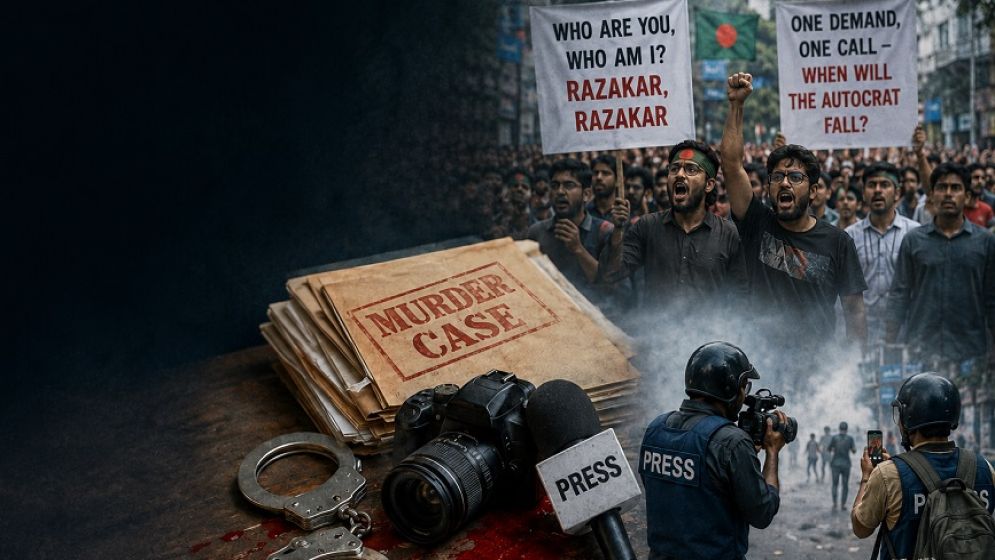
Small processions. Agitated young faces. Slogans echoed through the streets — “Who are you, who am I? Razakar, Razakar” and “One demand, one call — when will the autocrat fall?” Journalists ran alongside the rallies, some capturing the turbulent moments on camera, others sending live updates through mobile phones. Despite intense state surveillance, threats, attacks and obstruction, it was journalists who carried the news to the public.
Some reports were published, while others disappeared into the darkness of invisible censorship. Yet journalists continued their work undeterred.
Then came 5 August 2024, when the authoritarian government fell. The country’s political landscape changed dramatically.
As case after case was filed over the indiscriminate killings during the uprising, the lists of accused began to include individuals who carried neither guns nor weapons, but pens, cameras, microphones and boom mics. They were journalists — dedicated providers of information.
An examination of developments during the 18 months following 5 August 2024 reveals a grim irony: journalists who risked their lives covering the movement have themselves become accused persons. Those who documented state repression and delivered evidence to the public now find themselves standing in the dock.
Many have become victims of what observers describe as one of history’s cruellest ironies.
In a democratic state, the legislature, executive and judiciary are considered the three principal pillars of governance, while the media functions as their watchdog — the “fourth estate”. However, legal experts and public figures believe that the events surrounding the July mass uprising were used as a pretext to launch a calculated assault on that fourth pillar of the state.
An investigation found that during the 18-month tenure of the interim government led by Nobel laureate Professor Muhammad Yunus, journalists faced unprecedented levels of persecution. The media industry became entangled in what many describe as politically motivated litigation. At least 282 journalists were accused in 49 cases involving murder, attempted murder and sabotage.
Among them, 174 journalists were named in murder cases, 12 in attempted murder cases, while 37 faced sabotage allegations. Many have gone into hiding, while others have been forced into a nomadic existence to evade arrest.
Hundreds of Journalists Harassed
According to the Human Rights Culture Foundation (MSF), at least 814 journalists were subjected to attacks, harassment or abuse during the 18 months following the uprising, from August 2024 to May 2026. Most were direct victims of physical assault. The organisation reported that 585 journalists were attacked, 174 implicated in murder cases, 12 in attempted murder cases and 37 in sabotage cases, while six journalists were killed outright.
Statistics show that 2025 witnessed the highest number of incidents, with 622 journalists facing various forms of persecution. Of them, 458 were assaulted, 140 implicated in murder cases, 21 in sabotage cases and one journalist was killed.
Between August and December 2024, a total of 147 journalists reportedly faced repression. During that period, 85 were assaulted, 31 implicated in murder cases, 10 in attempted murder cases and 16 in sabotage cases. Five journalists were killed during the same period.
MSF further reported that from January to May this year, 45 journalists faced harassment, including 42 who were assaulted and three implicated in murder cases.
Another human rights organisation, Human Rights Support Society, said that during the interim government’s 17-month tenure, at least 834 journalists were victimised in 427 separate attacks. Among them, six were killed, 379 injured, 103 threatened and 33 arrested. A total of 222 journalists were named in 49 cases.
The human rights body Ain o Salish Kendra (ASK) reported that between January and July 2025, 218 journalists faced attacks and harassment.
Meanwhile, Transparency International Bangladesh (TIB) stated that 496 journalists faced harassment in the post-uprising period, while 189 reportedly lost their jobs.
On Sunday, executive committee member of the Editors’ Council and editor of The Daily Star, Mahfuz Anam, said that the council had submitted to Prime Minister Tarique Rahman a list of 282 journalists accused in various cases, including 94 named in murder cases, seeking remedies. He said the Prime Minister had responded positively.
Following a meeting with the Editors’ Council, Information Minister Zahir Uddin Swapan told reporters that the Prime Minister had already instructed him to address the issue of journalists implicated in such cases.
‘Difficult to Prove’
Senior Supreme Court lawyer Advocate Manzill Murshid told the media that most of the cases filed against journalists after the July uprising would be difficult to substantiate.
“As a result, the actual victims’ families may ultimately be deprived of justice because the legal process becomes obstructed when cases are filed against incorrect or imaginary accused persons,” he said.
Regarding the use of the label “associates of autocracy” to target journalists, he said Bangladeshi law contains no such specific criminal offence and that the term is largely being used as a political tool.
He added that although no legal steps have yet been taken regarding the harassment of journalists, a time may come when those affected will seek legal redress against the injustices committed against them.
Strange and Questionable Cases
A detailed analysis found that many of the cases appeared to be strategic attempts to position journalists as opponents of the July uprising.
In numerous instances, the families of deceased individuals reportedly had no knowledge of the cases filed in their names and were unfamiliar with both the plaintiffs and the accused.
One such case involved Ashikur Rahman of Kurigram, who had long suffered from a brain tumour. During the unrest, he reportedly travelled to Dhaka for treatment and later became falsely identified as a student protester. Following his death, he was listed as a “July martyr” and his family received government assistance.
Subsequently, a murder case was filed over his death, naming several local journalists as accused.
Those accused included Abdul Khalek Faruk, former general secretary of Kurigram Press Club and district correspondent of Kaler Kantho; Humayun Kabir Surjo of News24 Television; and Yusuf Alamgir of ATN Bangla and ATN News.
The plaintiff in the case was Ruhul Amin, a former secretary of Kurigram municipal Chhatra Shibir. Multiple sources involved in the uprising reportedly confirmed that he had not actively participated in the movement.
When contacted, Ruhul Amin refused to meet in person and became agitated over the phone, accusing the reporter of being “an associate of autocracy”.
Investigations also alleged involvement by local police officials in manipulating such cases.
Another disturbing trend uncovered by the investigation involves allegations that certain individuals exploited murder cases for financial gain.
In one case related to the death of courier service employee Rayhan Akon in Dhaka’s Rampura area, the plaintiff later claimed that he had been tricked into signing documents under the promise of financial assistance.
Audio recordings published in national media allegedly revealed discussions regarding financial transactions linked to removing names from cases.
Journalists Killed, But No Justice
Ironically, while many journalists were implicated in questionable cases, actual killings of journalists often went without justice or recognition.
Journalist Pradip Kumar Bhowmik of Sirajganj was beaten to death during the July uprising, yet his name was not included in the official list of July martyrs despite repeated applications by his family.
His son alleged that local coordinators opposed recognising him because they branded him an “associate” of the Awami League, despite his father reportedly being involved in communist politics rather than partisan activities.
Arrests, Hiding and Job Losses
Across the country, journalists accused in murder and anti-terrorism cases have faced devastating personal and professional consequences.
Several journalists from Gopalganj were arrested following clashes surrounding an NCP rally in July 2025 and spent long periods in jail before securing bail.
Former Kaler Kantho journalist and Bogura Journalists’ Union president J M Rauf has reportedly remained in hiding for nearly two years after being accused in a murder case linked to events of 4 August 2024.
Sirajganj-based BSS correspondent Shahidul Islam Philips spent more than three months in prison after being arrested in a murder case. Though later granted bail, he lost his job and incurred heavy legal expenses.
“I was only doing journalism. Is that my crime?” he asked.
Several other journalists across the country remain in hiding or continue to face legal uncertainty.
Editors Seek Government Intervention
President of the Newspaper Owners’ Association and editor-in-chief of Manabzamin, Matiur Rahman Chowdhury, told the media that the list of 282 journalists facing cases had been submitted to the Prime Minister.
He said the Prime Minister acknowledged that the cases were inherited from the previous administration and assured that murder cases would be reviewed while harassment cases would be formally withdrawn.
According to Matiur Rahman Chowdhury, the Prime Minister also stated that no journalist had faced persecution over the past three months and promised continued attention to journalists’ concerns.