


 For all latest news, follow the Daily Sun's Google News channel.


PM calls for changing revenge mindset
'Whatever happened to me in the past cannot be undone through revenge. Instead of dwelling on retaliation, we should think about what we can do for the country,' Tarique Rahman said while addressing BNP beat reporters
BSS, Dhaka
Published: 16 Jun 2026, 09:19 PM
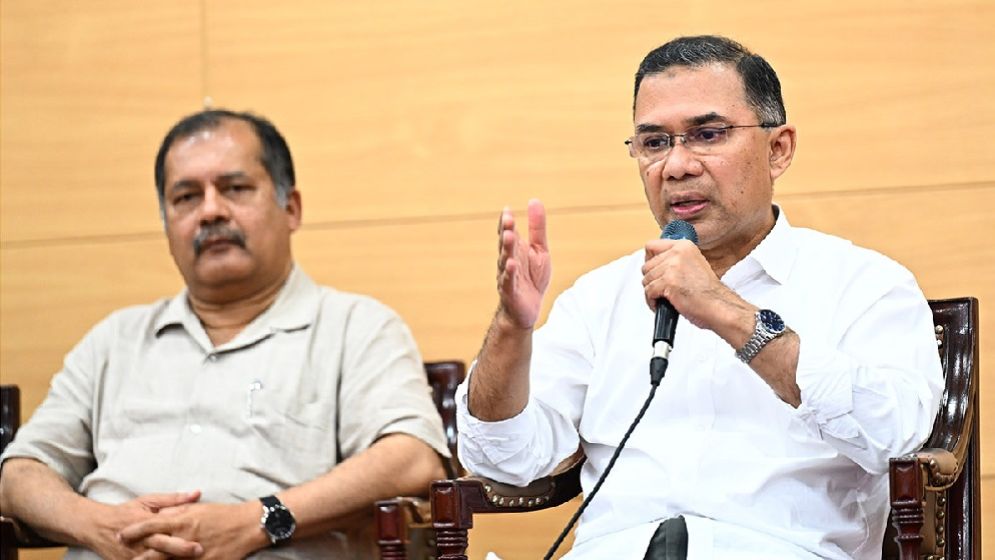
Photo: PID
Prime Minister Tarique Rahman on Tuesday called for a change
in the culture of vengeance, urging all to focus on contributing to the country
rather than seeking retaliation.
“We must change our mindset of revenge,” he said while
exchanging views with journalists covering the BNP beat at the Bangladesh-China
Friendship Conference Center in the city.
The Prime Minister added: “Let’s try to change our way of
thinking. Whatever happened to me in the past cannot be undone through revenge.
Instead of dwelling on retaliation, we should think about what we can do for
the country. Whether we succeed or not comes later …we should move forward with
a mindset of serving the nation.”
Tarique Rahman, also ruling chairman of the ruling BNP, reiterated his government's commitment to press freedom, saying, “The BNP government has repeatedly demonstrated that it has no hostility with the media. Therefore, the current government wants to ensure the freedom of the mass media. Government can make mistakes, let constructive discussions happen.”
Referring to 16 June as a significant day for Bangladesh’s newspaper
industry, the Prime Minister said, “Today is an important day for the country’s
media sector. On this day, all newspapers were once shut down except only four.
From there, today, we are talking to so many journalist brothers.”
He said this reflected the restoration of press freedom that
had once been curtailed.
“The restrictions imposed on the press at that time no
longer exist. We witnessed a period when all newspapers except four were
closed, and a single-party named BAKSAL was formed abolishing all political
parties,” said Tarique Rahman.
He noted that after assuming responsibility for the country,
Shaheed President Ziaur Rahman restored multiparty democracy and removed
restrictions on the media.
The 16th of June is observed in Bangladesh as the “Black Day
for Newspapers”. On this day in 1975, the then BAKSAL government revoked the
declarations and publication rights of all newspapers except four state-backed
publications. Since then journalists and media workers have been observing the
day as the “Black Day for Newspapers”.
Seeking cooperation from the media, the Prime Minister told
journalists, “You can help me greatly. The government alone cannot do
everything. I need your support. Without your cooperation, I could not know
whether our work is progressing in the right direction or not.”
“With everyone's cooperation, we will at least be able to
understand whether the work is going well or not. Or you can show the way to do
good work. We all should come forward to serve the country. I seek this
cooperation from you. If you cooperate, my work will be easy,” he continued.
Highlighting the growing challenge of drug abuse among
youth, Tarique Rahman stressed the importance of nationwide sports, cultural
activities, and innovation competitions as tools to address the issue.
“One of the major challenges facing our younger generation
today is drugs. While the problem exists globally, its impact here is alarming.
But the question is, how many people will we arrest, how many will we treat or
counsel? We have a limited capacity and resources. So, we must find alternative
ways to solve this problem,” he said.
Emphasizing the importance of nurturing future generations,
Tarique Rahman said that young people aged 15 to 25 possess tremendous physical
and mental energy that should be directed toward positive activities.
“Sports and cultural engagement are among the best ways to
channel that energy. Unfortunately, there is a severe shortage of playgrounds
across the country, including in Dhaka,” he added.
The Prime Minister referred to several government
initiatives aimed at harnessing this energy of the youth, saying, “We have
already launched the ‘Notun Kuri sports’ and cultural competition.”
“About 22 lakh boys and girls from across the country
participated in an education division event that concluded recently. Children
from all families, regardless of party or ideology, have joined in. But
unfortunately, such a large-scale initiative did not receive the media
attention it deserved,” he continued.
Beyond sports, the premier stressed the need to organize
innovation fairs and science fairs at district and divisional levels to
encourage creativity and scientific thinking among young people.
He also questioned why cultural and debate competitions are
not held throughout the year in educational institutions rather than being
limited to special occasions such as Victory Day or International Mother
Language Day. These practices must be continued throughout the year to return
the youth to a healthy lifestyle, said the Prime Minister.
Underscoring the need to address moral decline and restore
social values among young people, Tarique Rahman said, “Nowadays, we see a
living animal being beaten to death and 10 people capturing video of it through
their mobile phones. This is an abnormal mentality.”
“We have to increase the practice of social and religious
values right from the school level. The ministry of information has been
instructed to conduct an awareness campaign on this issue,” he added.
Replying to a question from a journalist, the Prime Minister
said that he is feeling ‘huge pressure’ in his role as the head of the government.
“Here, a (journalist) said in his speech that he is going to
different places after the elections and he saw happiness in people's eyes and
faces. I think I have seen the same thing. But even after that, I definitely
feel a pressure of responsibility. Because, there are a lot of problems and
limitations here,” he said.
At the same time, the expectations of people from different
classes and professions are very high, the premier said, adding, “So I feel an
impossible pressure in my role.”
Citing President Ziaur Rahman, Tarique Rahman said, “A few
days ago, when I was going home from the office, I was telling those in the car
with me that my father once told one of his colleagues that if the day had 48
hours, we could have done a little better.”
“Like my father, I was saying one day recently that I also
think that if it had been 48 hours, rather than 24 hours, it would have been a
little bit better,” he added.
Sharing his jail experiences, the Prime Minister said, “I
came from prison, where I was physically and mentally tortured. If I get an
X-ray to prove that I was physically tortured, it would probably show that one
bone of my back is still a little misaligned.”
“But if I now blame those who are responsible for this, if I
blame someone for doing this, my bone will not get healed . . . so instead of
thinking about the damage that has been done, we should think about the welfare
of the country,” he added.
Addressing journalists, Tarique Rahman said, “I am
requesting you to please convey this message to my party leaders and
activists.”
Before the discussion session, the Prime Minister attended a
luncheon with journalists where he engaged in informal and open conversations
with them.
Deputy Press Secretary Jahidul Islam Rony moderated the
programme.
Information and Broadcasting Minister Zahir Uddin Swapon, State Minister Yasser Khan Choudhury, Prime Minister's Adviser Mahdi Amin, Press Secretary AAM Saleh Shibly, Speech Writer Mahfuzur Rahman, Additional Press Secretary Atikur Rahman Rumon, Deputy Press Secretaries Mostafa Zulfiquar Hasan (Hasan Shiplu), Md Suzauddhowla and Shahadat Hossain Shadhin were present at the event.