


 For all latest news, follow the Daily Sun's Google News channel.


Experts call for scaling up gender-responsive climate solutions
As part of the programme, the EmPower Bangladesh webpage was launched to make results, knowledge products and resources more accessible
Daily Sun Report, Dhaka
Published: 28 Jun 2026, 08:56 PM
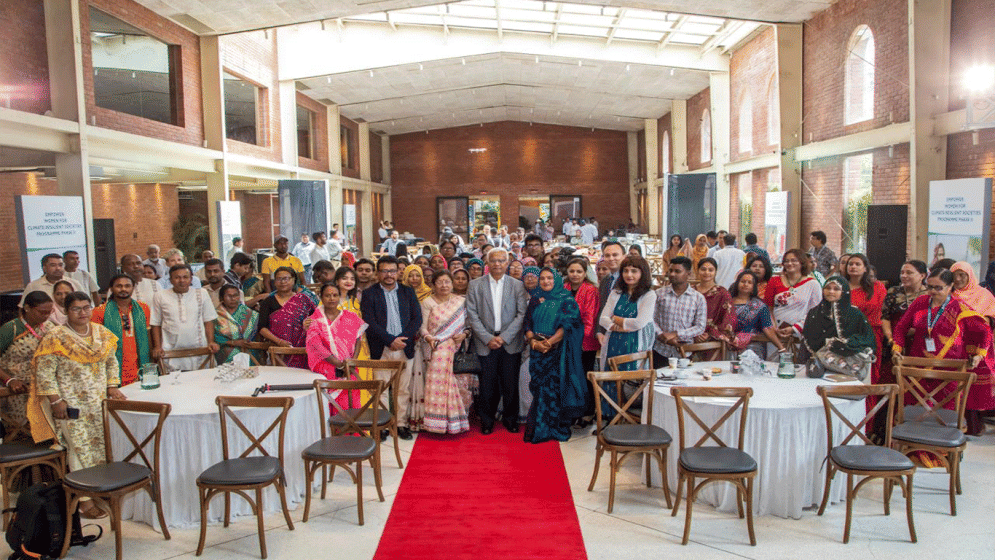
Experts at an event on impact of climate change on women organised by UN Women in the capital on Sunday. Photo: Courtesy
Experts has voiced out the central role of women’s leadership in Bangladesh’s climate response to scale local solutions into national action.
The call was made during an event titled “EmPower
II: National Lessons Learned and Scale-Up Workshop” organised by UN Women
Bangladesh at the capital’s Aloki, said a press release.
Supported by the governments of Sweden, Switzerland,
Germany and New Zealand, the workshop brought together senior government
officials, development partners, civil society organisations (CSOs), grassroots
women climate champions, financial institutions, academia and UN agencies.
Participants reflected on field-level learning and
identified pathways to scale gender-responsive climate action.
A regional initiative implemented in Bangladesh,
Cambodia and Vietnam, by UN Women and UN Environment Programme (UNEP), EmPower
promotes women’s leadership in climate resilience, renewable energy, access to
finance and locally led adaptation.
In Bangladesh, the project operates across five
climate-vulnerable districts including Khulna, Satkhira, Jamalpur, Kurigram and
Cox’s Bazar, covering ten upazilas.
The programme reached 33,284 women with
climate-resilient livelihoods and essential services and impacted approximately
1.6 million people.
It has helped mobilise USD$3 million to support 308
women-led renewable energy enterprises. It has supported the Bangladesh
government to turn the “Climate Change Gender Action Plan” into costed,
measurable sectoral interventions.
The workshop was inaugurated by Women,
Children Affairs and Social Welfare Minister Abu Zafar Md Zahid Hossain as
chief guest. He emphasised the need to translate community-level learning into
stronger national policy, planning and investment.
“When education, skills and confidence come
together, women can speak clearly, make decisions, and lead change in their
communities. We must give women the knowledge to adapt to climate change,
because those who are equipped with skills and confidence will be able to
survive and lead” he said.
Highlighting the results of EmPower phase II,
Gitanjali Singh, representative of UN Women, said, “Behind all the numbers are
women with stronger livelihoods, cleaner energy, greater confidence and a
stronger voice in shaping climate solutions. This is the evidence Bangladesh
can carry to global fora.”
“Bangladesh tells a simple and powerful story:
climate commitments matter most when they touch the lives of women and girls -
when they are financed, localised, measurable and led by the women most
affected by climate change,” she added.
Gitanjali further said that gender-responsive
climate action is practical, scalable and a smart investment.
The workshop highlighted women’s leadership in local
adaptation, renewable energy, climate-resilient livelihoods and collective
action. Women climate champions from the five districts shared their
experiences in a panel discussion.
While sharing her experience, Farida Yasmin from
Nari Associate for Revival and Initiative, Kurigram, said, “We are now equipped
with knowledge, information and confidence to negotiate on issues that affect
our lives. EmPower has been a journey of collective leadership and resilience,
enabling women in my community to build skills and claim a seat at the table.”
Special guests included Diepak Elmer, head of cooperation,
Embassy of Switzerland; Redita Rokib, adviser, development cooperation, German
Embassy Dhaka; Nayoka Martinez-Bäckström, first secretary & deputy head of
development cooperation, Embassy of Sweden; and Md Saidur Rahman Khan, secretary,
Ministry of Disaster Management and Relief.
Dr Nurun Nahar, additional secretary (development wing),
Ministry of Environment, Forest and Climate Change, attended as guest of honour.
They underscored the need for stronger collaboration
among government, development partners, civil society and financial
institutions to expand women-led climate initiatives, strengthen inclusive
financing and support effective implementation of gender-responsive climate
policies.
“The strength of EmPower lies in its holistic cycle
approach, linking local innovation and adaptation with policy discussions and
decisions while working closely with grassroots women’s networks. The project
has also focused on building the skills and capacity of local CSOs, enabling
them to seize opportunities as Bangladesh transitions from a lower- to a middle-income
country,” Nayoka said.
As part of the programme, the EmPower Bangladesh
webpage was launched to make results, knowledge products and resources more
accessible. A photo exhibition featuring stories and photographs captured by
members of the Women in Climate Action Network (WCAN) was also inaugurated,
showcasing women-led local adaptation initiatives.
The project partners including Bangladesh Center for
Communication Programs (BCCP), Manusher Jonno Foundation (MJF) and BRAC
University CED were also acknowledged for their contribution.
The event included thematic discussions on renewable
energy and financing, Gender Action Plan for Adaptation to Climate Change
(GAPACC) implementation, and women’s leadership in collective climate action.