


 For all latest news, follow the Daily Sun's Google News channel.


PM terms FY27 budget as ‘life-centric’
The prime minister said a number of vanity projects were undertaken, resulting in unnecessary domestic and foreign borrowing
BSS, Sangsad Bhaban
Published: 29 Jun 2026, 03:39 PM
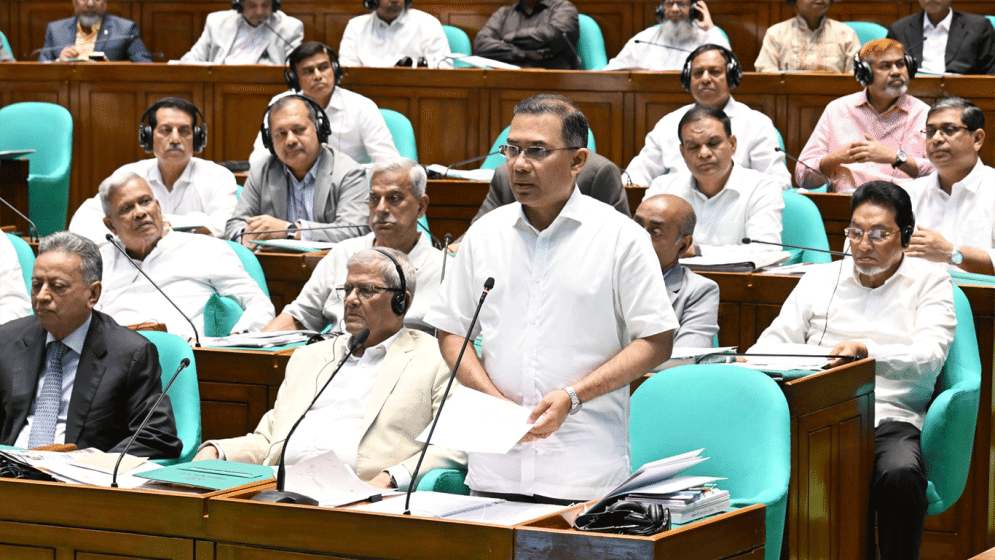
Prime Minister Tarique Rahman speaking during parliamentary session on Monday. Photo: BSS
Prime Minister Tarique Rahman on Monday described the proposed national budget for 2026–27 fiscal as a “life centric” one which focused providing at least some relief and comfort to people from all walks of life.
“I would like to give a name to the budget we are
presenting today...I would call it as a-life-centric budget,” he said.
The prime minister expressed this view while taking
part in the general discussion on the proposed budget for FY27 in the House
with Speaker Hafiz Uddin Ahmad in the chair.
Describing the budget as a highly important
component of state governance, the prime minister said, “Naturally, since the
ruling party is presenting the budget, we will strive to present a sound,
balanced, and realistic budget.”
“The reality is very challenging. Nevertheless,
after considering various factors, we have used our utmost wisdom, judgment,
and knowledge to prepare a budget that can provide at least some relief and
comfort to people from all walks of life,” he said.
Referring to the period after the finance minister
presented the budget, the prime minister noted that prices of essential
commodities had not increased.
He said taxes on 61 essential items, as commonly
understood by the public, were almost entirely withdrawn.
“In the past, we often observed sudden and
unjustified price increases in many essential goods both before and after the
budget announcement. We have not seen such a situation this year. We believe
that we have been able to fulfil at least part of our responsibility toward the
people. We have been able to provide some degree of relief,” he said.
He said when BNP government assumed office, it
inherited a fragile economy as corruption, looting, mismanagement, and flawed
policies had left the country’s economic sector in ruins.
“We have tried to revive the economy from that
situation,” he told the house.
The opposition leader also acknowledged that a
massive amount of money had been smuggled abroad, a fact recognised nationally
and internationally, he mentioned.
Production and investment had nearly stalled, and
inflation had reached severe levels two to two-and-a-half years ago—something
the BNP government all experienced firsthand, he said.
Mentioning the capital market as an extremely
important sector of the economy, he said situations had deteriorated to such an
extent that people who lost everything even took their own lives.
Meanwhile, vast sums of money belonging to ordinary
citizens were misappropriated, foreign exchange reserves had fallen to alarming
levels while the exchange value of the taka had declined by 40%, he said.
The prime minister said a number of vanity projects
were undertaken, resulting in unnecessary domestic and foreign borrowing which,
have now become a burden to the nation.
“They do not generate revenue, forcing us to repay
those foreign loans with resources from elsewhere. This burden may continue to
weigh on the nation for a long time,” he said.
He added, “I do not want to deny the crisis I have briefly
described. We cannot ignore it; doing so would be foolish. At the same time, we
do not want to use the crisis as an excuse.”
Therefore, he said, “I fully agree with the
opposition leader that, with the support of the people, political goodwill, and
effective policies, we want to confront this crisis successfully.”
The prime minister said, “The government began its
journey on 18 February, and immediately afterward we had to manage the month of
Ramadan, ensuring that essential goods remained within people’s purchasing
power as much as possible. At the same time, we faced the fragile economy I
have described. Through our collective efforts, we believe we can overcome this
situation.”
While the prime minister was explaining the
government’s position during his speech, members of the ruling party repeatedly
thumped their desks in appreciation and congratulations.
During the concluding phase of the budget debate,
Opposition Leader Dr Shafiqur Rahman spoke first, followed by the prime
minister, who is also the leader of the house.