


 For all latest news, follow the Daily Sun's Google News channel.


Rizvi stresses cultural awareness to curb human trafficking
Prof Sanjay Kumar Dey presided over the seminar
Daily Sun Report, DU
Published: 30 Jul 2026, 05:34 PM
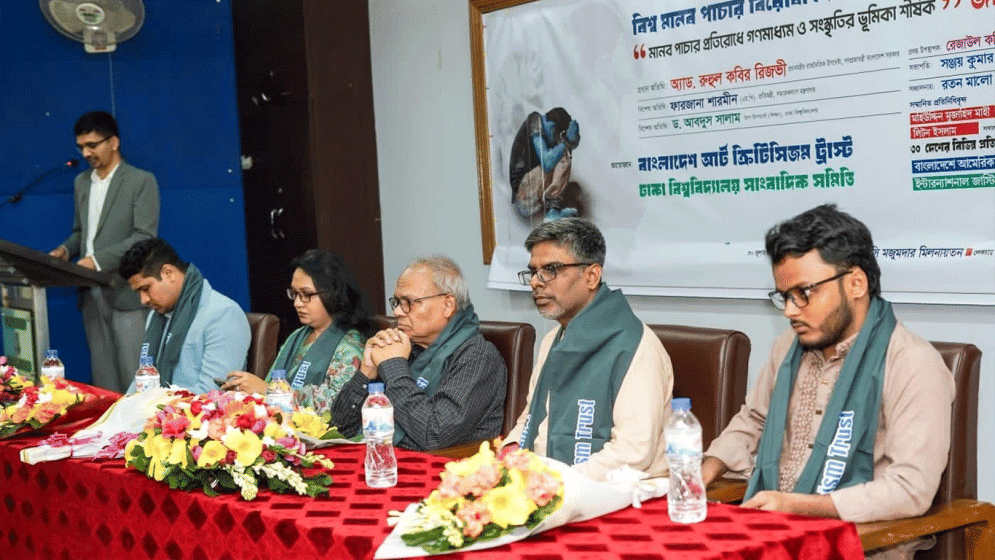
Photo: Daily Sun
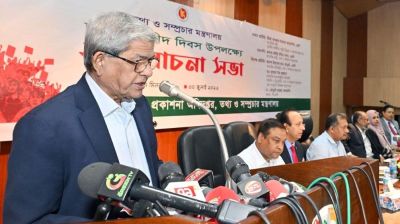
Prime Minister's Political Adviser Ruhul Kabir Rizvi has emphasised the importance of cultural activities and social awareness to curb human trafficking crime.
Addressing a national seminar on Thursday as the
chief guest, he noted that crime is rising in society due to a decline in
cultural activities. He stressed that preventing human trafficking requires
ensuring the rule of law, expanding education, and building cultural awareness
among people at the grassroots level.
The national seminar, titled “Role of Media and
Culture in Preventing Human Trafficking”, took place at the RC Majumder Arts
Auditorium of Dhaka University on the occasion of World Anti-Human Trafficking
Day 2026. The Dhaka University Journalists Association and the Bangladesh Art
Criticism Trust jointly organised the event.
“Cultural activities are necessary to curb heinous
crimes like human trafficking. Although cultural activities on these issues
have decreased in our country. Due to which awareness among people is
decreasing, crime is increasing in society,” Rizvi said.
He added, “The rule of law is necessary in society
to prevent human trafficking. On the other hand, education development is also
necessary. The nation must be built on an average education. So that even the
illiterate people at the grassroots can communicate with the local
administration or authorities. So that they do not fall victim to fraud,
exploitation, violence and human trafficking.”
Speaking as a special guest, State Minister for Social
Welfare Farzana Sharmin highlighted that journalists can play a vital role
against social problems by publishing evidence-based investigative reports. She
also urged coordinated action with domestic and international organisations for
the protection and rehabilitation of human trafficking victims.
Keynote speaker Prof Rezaul Karim Sohag, chairman of
the Department of Criminology at Dhaka University, presented an overview of
human trafficking in Bangladesh and worldwide.
He warned that forced labour, child and female
exploitation, and commercial sexual exploitation of children remain alarmingly
prevalent within the country. He called for effective preventive measures and
urged the enforcement of the recently re-enacted “Human Trafficking and Migrant
Smuggling Prevention and Suppression Act, 2026”.
Dhaka University Journalists Association President
Manjur Hossain Mahi highlighted the key responsibilities of the media in
providing information, building public awareness, and educating society. Citing
the Associated Press investigative report “Seafood from Slaves”, he noted how
investigative journalism exposed human trafficking and slave labour in
Southeast Asia, leading to the rescue of over 2,000 people and bringing
perpetrators to justice.
In his speech, Sanjay Kumar Dey, chairman of the
Bangladesh Art Criticism Trust and Assistant Professor in the Department of Art
History at Dhaka University, remarked that when a person is trafficked, society
loses that individual's knowledge, skills, and cultural contributions.
He asserted that the trust will continue organising
cultural initiatives to address social issues.
Representatives from the US Embassy in Bangladesh,
International Justice Mission Bangladesh, and “COTNET”-a joint 30-country
initiative to combat human trafficking attended the event alongside researchers,
journalists, writers, artists, and Dhaka University teachers and students.
Prof Sanjay Kumar Dey presided over the seminar,
while Bangladesh Art Criticism Trust General Secretary Ratan Malo moderated the
session.
At the start of the event, Dhaka University students
led by Kathak Biswas Joy performed traditional folk songs from the Rajshahi and
Chapainawabganj regions focusing on human trafficking awareness. SM Rakibul
Hasan, a part-time teacher at the Department of Oriental Art, later presented a
musical flute performance depicting the plight of trafficking victims.
The theme for this year's World Day against
Trafficking in Persons was “Trapped Behind the Scam”, focusing on global
awareness surrounding cyber slavery, digital exploitation, and online scamming
risks.