


 For all latest news, follow the Daily Sun's Google News channel.


US weighs smaller military, intelligence presence in Middle East
CNN
Published: 08 Sep 2026, 04:43 PM
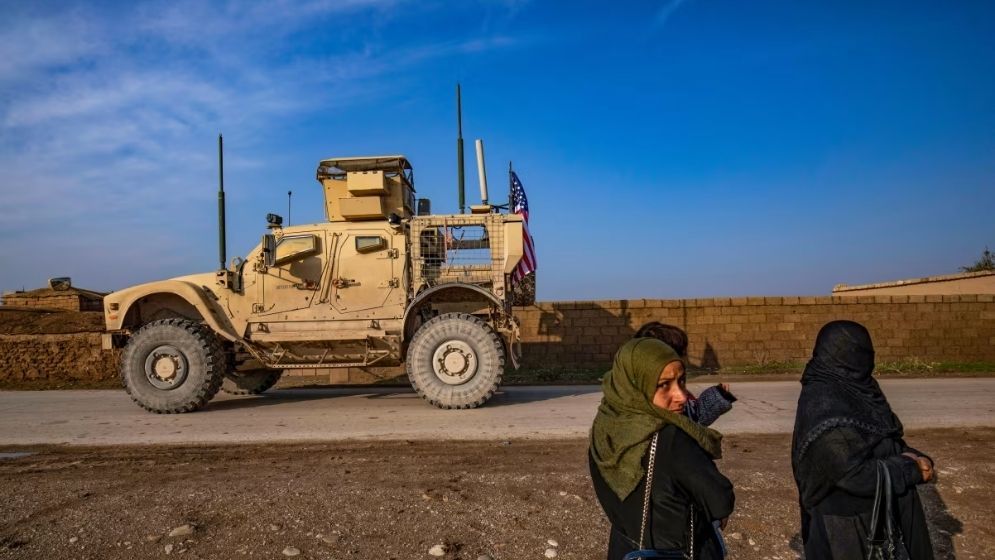
A US military vehicle patrols an area on the outskirts of Rumaylan in Syria's Kurdish-controlled northeastern Hasakeh province on 11 December 2023. Photo: AFP
In offices across the military and in the intelligence community, there have been recent quiet discussions about cutting the number of people and facilities typically stationed in the Middle East if the Trump administration succeeds in ending the Iran conflict, six sources say.
If those cuts happen, it would mark another
shift in how the US national security apparatus treats a region that successive
presidents have sought to leave behind.
In the wake of the 11 September 2001,
attacks, the US exponentially expanded a constellation of permanent military
and intelligence facilities to fight wars and conduct strikes in half a dozen
countries: Iraq, Afghanistan, Syria, Iran, Yemen, Libya.
But the recent fighting with Iran has laid
bare deep vulnerabilities in the American infrastructure in the Middle East as
many of those sites have become targets of repeated Iranian attacks in an
unpopular war that has killed 18 American service members.
The remains of Army 1st Lt Tyler Feehan and
Army Staff Sgt. Michael Emmanuel Swinton arrive at Dover Air Force Base on July
22 during a dignified transfer for military casualties of the war with Iran.
Officials involved in the informal
discussions in the military and the intelligence community indicated they are
now acting at least in part to predict what might be acceptable to a mercurial
president who sources say has articulated no clear strategy for a postwar
future — and who, in the past, has staked his political identity on reducing
American forces overseas.
Those discussions are happening even as there
are still 50,000 troops and a large number of military assets in the Middle
East, including two aircraft carriers and more than a dozen guided-missile
destroyers. CIA officers who were sent home during the hottest part of the
fighting earlier this year are being sent back to the region, one of the
sources said.
The US military is also evaluating how to
harden its defenses for those troops who are expected to remain in the region,
even once the war ends. That includes by moving some installations underground
to better defend against missile and drone attacks like those launched by Iran
in the monthslong conflict, according to two sources familiar with the
discussions.
While the Pentagon has long discussed moving
some bases in the region underground, the idea took on new urgency after the first
weeks of war as Iran exposed how vulnerable they were to drone and missile
attacks.
“The vulnerabilities were always known, but
the US never acted on it with urgency,” said one of the sources, a US official.
The military has developed several potential
courses of action for changing the US force structure in the Middle East as
soon as next year, two of the sources said — noting it would not make sense to
abandon those strategic locations for launching aircraft while the conflict is
ongoing.
The Office of the Secretary of Defense
directed questions to US Central Command. Central Command did not respond to a
query from CNN before publication. The Central Intelligence Agency declined to
comment.
In the background of today’s discussion are
the repeated planned pivots out of the region: 25 years of military
intervention in the Middle East since September 11 with cycles of promises to
pull back.
‘If we do’
The US military started dramatically increasing its footprint in the Middle East in the years before 9/11, maintaining a presence of roughly 27,000 active-duty troops across the region starting in 1998 — significantly more than in the decades prior.
That number would only continue to grow after
the September 11 attacks, as US basing grew to support first the war in
Afghanistan, then Iraq, then a metastasizing series of counterterrorism
conflicts in hot spots around the region.
Two years after the 11 September attacks, the
US had an estimated 250,000 troops in the Middle East during the invasion of
Iraq. Between 2007 and 2011, the number of Americans in the region fluctuated
but never dropped below roughly 100,000, according to publicly available
estimates.
In 2011, then-President Barack Obama
announced that “the tide of war is receding” in Afghanistan and that the US
would begin drawing down tens of thousands of troops whom he had surged to the
fight. The US would not withdraw fully from Afghanistan for another decade.
That same year, Obama withdrew combat troops
from Iraq in a bid to extricate the US from a war widely seen as a failure. But
he was forced to return when the vacuum of American power arguably led to the rise
of ISIS.
Even as the total of US troops in the Middle
East dropped in the years following 2011, it still hovered between 30,000 and
60,000. Throughout that time, the potential threat from Iran also loomed large
in the mind of US policymakers, in particular proxy groups that launched fatal
attacks on American service members in Iraq.
Though planners are discussing options for
potential cuts now, the US appears no closer to negotiating a settlement with
Iran that would end the conflict. Iran continues to target US bases and forces
deployed to the region, launching attacks against American installations in
Jordan and the United Arab Emirates last week as the two sides exchanged fire
for the first time in roughly a month.
The damage has been substantial, US officials
say: The CIA’s outpost in Riyadh, Saudi Arabia, for example, was effectively
destroyed by an Iranian attack, according to one US official and a former
intelligence officer. Although Pentagon officials have sought to downplay the
impact, American military installations in Bahrain, Qatar, Saudi Arabia and
Kuwait have all been struck by Iranian drones and missiles, and sources say the
damage has been significant.
For the CIA and the military’s elite special
operations command, some officials have considered whether the same sensitive
jobs can be done without permanent basing, according to two US officials: leave
personnel and equipment stationed in the United States, send them to the Middle
East for individual missions, then return home.
In some cases, the US government may simply
decline to rebuild assets that were severely damaged or destroyed by Iranian
attacks — in part due to cost considerations, one official and two other
sources familiar with the discussions said.
Pentagon officials have publicly refused to
say what they might rebuild.
In April, Pentagon comptroller Jules “Jay”
Hurst III told reporters it was not clear how much it would cost to repair
bases and facilities damaged from the war with Iran, “and part of it is we
would assess what our posture should be in the Middle East.”
Hurst later added that the Pentagon does not
“have a final number for what the damage is to our installations overseas,” and
it depends “on how we decide to rebuild those, or if we do.”
Senior Pentagon officials have privately made
clear they want to scale back the US military’s troop presence in several Gulf
countries as part of a broader effort to shift more of the defense burden onto
regional partners, according to three sources familiar with the discussions.
Sources said there was no official process or direct order to conduct what’s known formally as a force posture review. Officials within different parts of the military and the CIA are instead keenly aware that even as the military continues to escort ships through the Strait of Hormuz, launch attacks on Iranian infrastructure and threaten strikes against additional targets that would likely further escalate the conflict, President Donald Trump is known to change his mind quickly.
“Is there an implicit task? Is there
something coming down the pike where we need to be prepared to go, or are we
sitting [forward] just in case?” said another US official, describing the tone
of the discussions.
No clear timeline
The CIA was in search of a mission at the
time of the 9/11 attacks, former officers and historians say: Its chief
adversary, the Soviet Union, had fallen. There were analysts at the agency
deeply steeped in terrorism and in the Middle East — but not many of them.
Staff in the region probably numbered in the mere hundreds, according to
Jeffrey Rogg, an intelligence historian at the University of Texas at Austin.
After 9/11, that all changed. The agency
recruited heavily and grew a much larger cadre of paramilitary officers who
carried guns and worked closely with the US military to hunt out terrorists — a
contrast to the traditional picture of a case officer, who was tasked with
developing source relationships and gathering secrets.
But both organizations lived through the ebbs
and flows of a two-decade engagement in a region that presidents of both
parties at times wanted desperately to leave behind. Obama sought to engineer a
“pivot” of American military and intelligence resources to Asia; Trump’s
administration in his first term ranked China as America’s biggest threat in
his first national security strategy.
But the word “pivot” became a running joke in
national security circles as successive crises and policy decisions — including
the unforeseen rise of ISIS and Trump’s first-term decision to kill top Iranian
Gen. Qasem Soleimani — continued to suck the United States back into the Middle
East.
Top US military leaders have recently warned Trump that combat options for escalating the conflict with Iran are unlikely to achieve his stated objectives, CNN has reported, with the president instead opting to focus on ramping up economic pressure in hopes of crippling the regime.
But there is no clear timeline for how long
that strategy may take to produce results, and many analysts believe that
Iran’s current leadership may be willing to endure months of economic pain and
is unlikely to capitulate in the near term.
Broadly, Pentagon officials expect to
maintain some of the large, permanent military bases in the region, but
rebuilding those installations may depend on the host nation’s willingness to
contribute to the cost, which would likely be in the billions of dollars, one
of the sources told CNN. The source added that many were originally constructed
and paid for by the country in which they reside.
In the short term, US troops and bases in
neighboring countries will almost certainly face continued attacks from Iran.
The Navy’s top admiral said last week that
personnel would not be returning to Bahrain, the traditional home of the 5th
Fleet, “anytime soon.”
“We’re not getting back in there anytime
soon,” Chief of Naval Operations Adm. Daryl Caudle said. “I just want to be
completely honest with that.”