



 For all latest news, follow the Daily Sun's Google News channel.


Flash flood in Padma sees people stranded, educational institutes closed
Floodwater has also entered educational institutions
Amanur Aman, Kushtia
Published: 11 Sep 2026, 04:20 PM
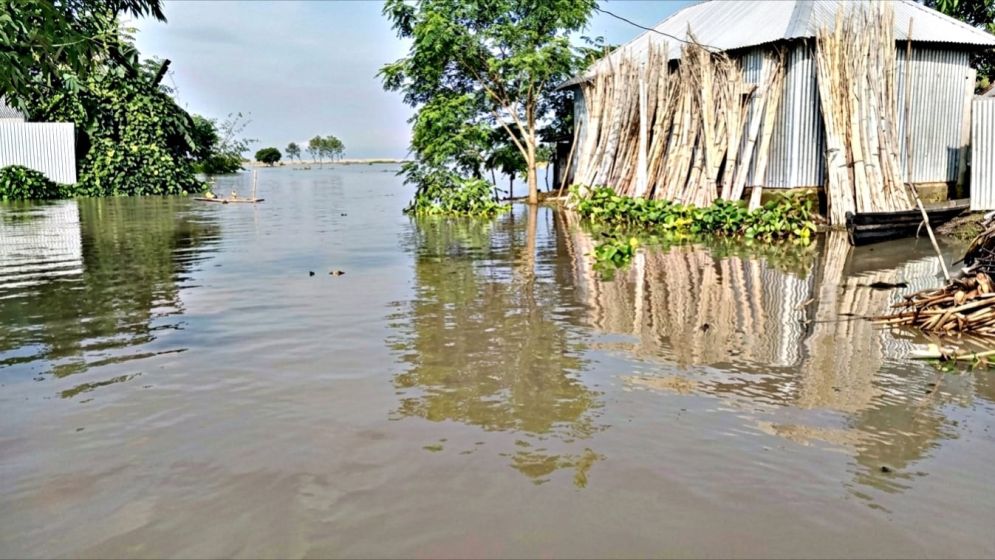
Photo: Daily Sun
Following an upstream surge of water coupled with several days of continuous rainfall, the Padma River catches a flood in different areas of Kushtia' Daulatpur upazila.
The local Water Development Board (WDB) says the
water level of the Padma has risen by 88 centimetres in the past week.
Officials say this is the highest rise recorded in the past three years.
The surge in water levels has now hit the
river-surrounded Ramkrishnapur and Chilmari unions of Daulatpur upazila in Kushtia.
Vast low-lying areas across nearly 40 villages have been inundated, leaving
around 80,000 people waterlogged.
Most roads have gone underwater. In some areas,
water has reached household courtyards; in others, it has surrounded homes,
while some houses are completely submerged. With regular road communication
disrupted, dinghies and small boats have become the main means of
transportation for many families.
Floodwater has also entered educational
institutions. Considering the safety of students, in-person classes at 25
primary and secondary educational institutions in the two unions have been
suspended locally.
However, the school buildings have not been closed.
They have been kept open so that people affected by the flooding can take
shelter there if necessary.
According to the Water Development Board, the Padma
began rising rapidly at the Hardinge Bridge point on 2 September. The river has
risen by around 88 centimetres in just one week.
On Thursday afternoon, the water level at the
Hardinge Bridge point was around 92 centimetres below the danger level. The
river is currently flowing at around 13 metres, while the danger level is 13.80
metres.
However, as the water level continues to rise,
authorities fear the situation could deteriorate further over the next few
days. According to the Water Development Board, the water level may continue to
rise until Saturday.
Where is the water coming from?
The Water Development Board identifies upstream
water flow and excessive rainfall as the main reasons behind the rise in the
Padma.
Local residents and elected representatives have
also pointed to the arrival of water from upstream.
However, there is another discussion among local
residents. They claim that after India opened the gates of the Farakka Barrage,
upstream water and rainwater came downstream simultaneously, causing the Padma
to rise rapidly.
As a result, water entered the river-adjacent chars
and low-lying areas within a short period, worsening the situation.
The Water Development Board, however, has not
provided any information confirming that water was released from the Farakka
Barrage. Officials maintain that the primary causes of the current rise are the
upstream surge and excessive rainfall.
50,000 people stranded in Ramkrishnapur
Siraj Mondal, chairman of Ramkrishnapur union parishad,
said around 50,000 people from 20 to 23 villages in his union have been
stranded by the floodwaters.
Water has entered many homes. Residents of houses
that have been inundated are being transported by boat to relatively safer and
higher areas.
He said most roads in the union have gone
underwater, leaving dinghies and small boats as the primary means of
transportation.
Several houses have been completely flooded, while
water has risen around most homes.
Water surrounds homes in Chilmari, almost all roads
submerged
Mannan Uddin, chairman of Chilmari Union Parishad,
said water has entered homes in the low-lying areas of 17 of the union's 19
villages.
As a result, around 25,000 to 30,000 people have
been stranded by the floodwaters.
Almost all roads in the union have already been
submerged, leaving virtually the entire union cut off by water. All educational
institutions in the union have also been closed.
Mannan Uddin said that given the rate at which the
water is rising, many more homes could be inundated within the next day.
He said the union authorities are maintaining
regular communication with senior administrative officials regarding the
situation.
He added that dry food, safe drinking water and
medical supplies were distributed among affected people by the administration
on Wednesday.
350 hectares of cropland inundated
The flooding has not been confined to homes and
roads; agriculture has also been affected.
According to the Agriculture Office, around 350
hectares of cropland in the two unions have been inundated.
Aman paddy, bananas, chillies and other crops grown
on the affected land have been damaged.
Officials concerned fear that agricultural losses
could increase if the water level rises further.
Concerns grow over drinking water and cattle feed
For people stranded by the floodwaters, the biggest
concerns now are access to safe drinking water, food and cattle feed.
These shortages could become more severe if the
water continues to rise.
The upazila administration is regularly monitoring
the situation in the affected areas. At the same time, efforts are underway to
deliver safe drinking water, food and medical supplies to people trapped by the
floodwaters.
Schools closed, buildings kept open
Mushtaq Ahmed, upazila primary education officer,
and Faruk Ahmed, upazila secondary education officer (additional charge), said
several areas of the char region have been submerged, along with roads and
other means of communication.
As a result, local residents have stopped sending
students to school, considering their safety.
They said that although in-person classes have been
suspended, educational activities are continuing. At the same time, school
buildings have been kept available so that people affected by the flooding can
take shelter there if necessary.
Water may continue rising until Saturday
Asauddoula, executive engineer of the Kushtia Water
Development Board, said the Padma has risen due to water flowing downstream
from upstream areas and excessive rainfall.
He said the low-lying areas of Ramkrishnapur and
Chilmari in Daulatpur are inundated every year.
The river is currently flowing at around 13 metres,
while the danger level is 13.80 metres. The water level is likely to continue
rising until Saturday, he said.
The Water Development Board and the upazila
administration are closely monitoring the situation.
However, local elected representatives fear that if
the Padma rises further, both the number of people affected and the extent of
damage could increase.