


 For all latest news, follow the Daily Sun's Google News channel.


Boosting investment, employment now top priorities: Khosru
Inflation has put pressure on people’s purchasing power, while tax collection as a share of GDP remained much lower than required, he says
Daily Sun Report, Dhaka
Published: 03 Oct 2026, 09:30 PM
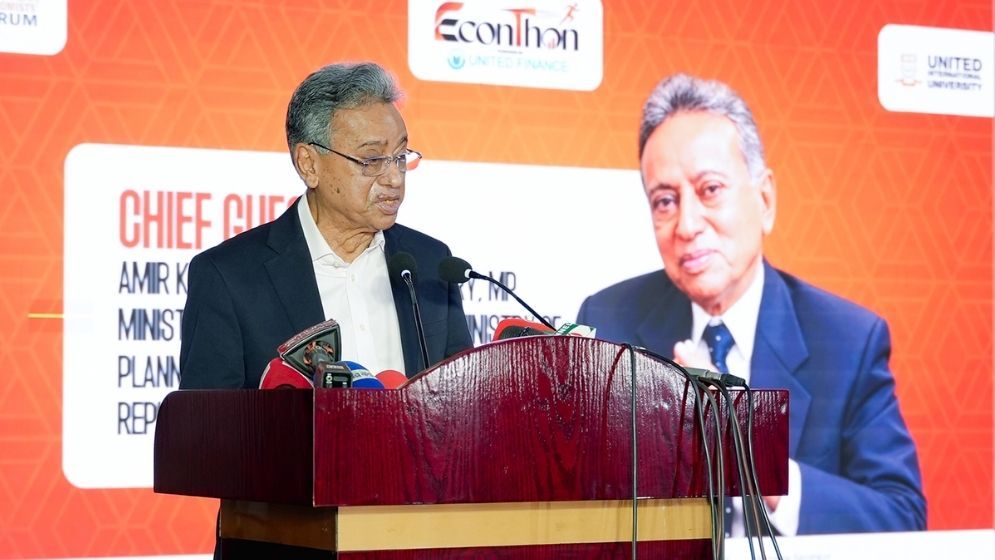
Photo: PID
Finance Minister Amir Khosru Mahmud Chowdhury said on Saturday that increasing investment and employment is now among the country’s top priorities as Bangladesh stands at a critical juncture amid economic challenges at home and abroad.
He
made the remarks as the chief guest at the grand finale of the national
inter-university economics competition ‘Econothon 2026’ at United International
University (UIU) in the afternoon.
Highlighting
the uncertainties in the global economy, the finance minister said global
growth has slowed, financing costs are higher than in the past decade, and
protectionism and tariff barriers in international trade are increasing.
Geopolitical
conflicts have kept energy and transportation costs volatile, while climate
change is adding to economic losses every year, he said.
As
an import-dependent and export-oriented economy, Bangladesh is directly
affected by these global shocks, which are reflected in commodity prices, the
exchange rate and export orders received by local factories, he added.
“Every day at the Ministry of Finance is a day with a surprise element. A budget is prepared based on certain assumptions, and then come shocks from fuel prices, pressure on foreign exchange, floods or uncertainties in global markets,” he said.
Turning
to the domestic economy, Amir Khosru said inflation had put pressure on
people’s purchasing power, while tax collection as a share of GDP remained much
lower than required.
He also stressed the need to restore confidence in the banking sector and improve the environment for private investment.
“Our
priorities are therefore clear: restoring macroeconomic stability and price
stability, making the tax system fair, simple and technology-driven,
establishing good governance in the banking sector, improving the environment
for private investment, and ensuring maximum returns from every taka spent on
education, healthcare and social protection,” he said.
The
finance minister said Bangladesh’s preparation for graduation from the least
developed country (LDC) category would require its exports to become
competitive rather than rely on trade preferences.
“Everything
will not be fixed in a day, but we will remain steadfast in pursuing these
goals,” he said.