


 For all latest news, follow the Daily Sun's Google News channel.


Fuel pump crisis for five lakh residents in east Dhaka
Daily commute to distant filling stations wastes hours, clogs key junctions
Daily Sun Report, Dhaka
Published: 06 Oct 2026, 09:54 AM
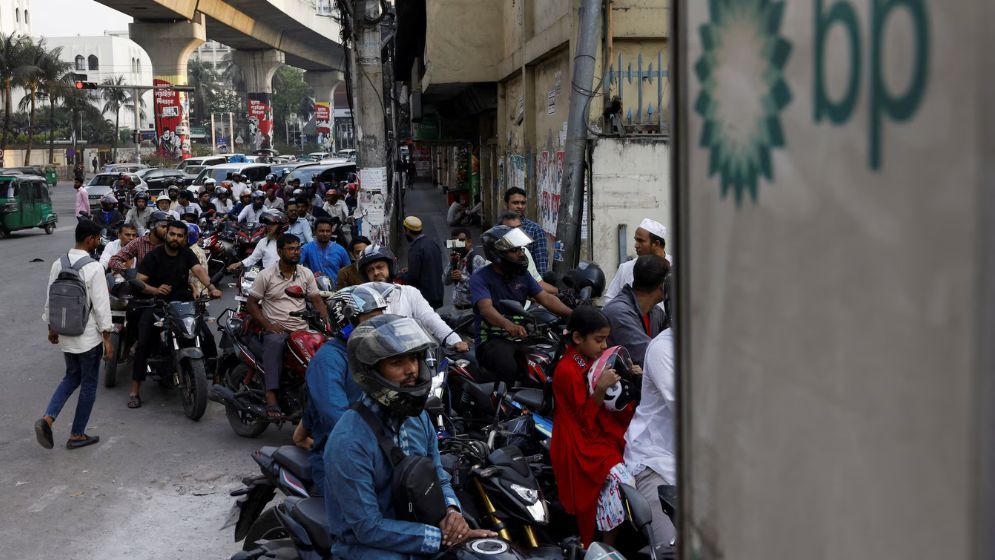
Long queues of vehicles snake out of a filling station in Dhaka, causing significant delays and traffic congestion. Photo: Reuters
The rapid eastward expansion of the capital has created a severe infrastructural blind spot: across the bustling 300 Feet corridor (Purbachal Expressway), home to over five lakh residents and multiple mega-housing estates, not a single conventional filling station exists to serve thousands of daily vehicles.
To buy fuel, motorists living in Bashundhara Residential
Area, Police Officers Housing Society, Navy Housing, Swadesh Swarnali, Swadesh
Sunvalley, and United City must make round trips of 10 to 18 kilometres towards
Kuril, Khilkhet, or Jolsiri.
Ironically, while these sprawling townships lack even one
pump, a mere 1.5-kilometre stretch from Gulshan-Tejgaon Link Road to Saat Rasta
houses seven filling stations.
Fuel burnt just to refuel
This severe scarcity is forcing motorists to burn a
substantial portion of their fuel merely trying to refill their tanks.
Abdullah Al Mamun, a resident of a housing project along the 300 Feet road, recounted nearly being stranded two days ago when he set out with only a few litres of petrol.
"Half of what was in my tank was
exhausted just navigating the distance to Kuril. Had I faced any delay or
shortage there, my car would have stalled on the road," he said, noting
that thousands share his daily ordeal.
Estimates indicate that if 50,000 vehicles in the area
travel an extra seven kilometres round-trip simply to access a petrol pump,
they log an additional 350,000 kilometres every single day.
At an average fuel consumption rate of 0.10 to 0.12 litres
per kilometre, this avoidable transit burns between 35,000 and 42,000 litres of
fuel daily.
Beyond the massive financial drain, this ritual consumes 30
to 60 extra minutes per vehicle, wasting thousands of working hours and
clogging key transit nodes like Kuril and Khilkhet.
The crisis is poised to escalate sharply as vehicular
traffic—boosted by private cars, freight carriers, ride-sharing motorbikes, and
public buses—is projected to climb between three and four lakh vehicles daily
once the Mohakhali Bus Terminal is fully relocated to the eastern periphery.
Lingering fallout of
policy freeze
Urban planners and residents trace the crisis directly to an
arbitrary executive order issued during the ousted Awami League regime, which
abruptly halted the approval and establishment of new petrol and diesel filling
stations while selectively permitting liquefied petroleum gas (LPG) outlets.
Although the policy was originally framed around 2019–20,
the subsequent freeze blocked fuel supply infrastructure from keeping pace with
rapid demographic and urban expansion in eastern Dhaka.
The result is compounding carbon emissions, heightened air
and sound pollution, and routine bottlenecks at Kuril and Khilkhet
intersections.
Demand for integrated
survey and stations
Residents are demanding that the authorities conduct an
immediate, integrated feasibility study to establish at least two to three
planned filling stations in suitable locations along the corridor.
"Setting up well-planned filling stations will cut
redundant trips, save time and money, and reduce congestion in Kuril and
Khilkhet," said Mohammad Ali, a resident of Police Officers Housing
Society.
Tajul Islam of United City said, "Eastern Dhaka is
expanding rapidly into both a residential and commercial hub. Fuel supply
infrastructure must be laid now before the gridlocks become unmanageable."
Stakeholders stressed that any new allocations must ensure strict compliance with fire safety norms, environmental clearances, road carrying capacities, segregated entry-exit lanes, and vehicle queuing space through coordinated planning by the Ministry of Power, Energy and Mineral Resources, Bangladesh Petroleum Corporation (BPC), Rajdhani Unnayan Kartripakkha (RAJUK), the Roads and Highways Department (RHD), city corporations, and the Department of Environment (DoE).
Officials, planners weigh in
Speaking on condition of anonymity, a senior BPC official
confirmed that approvals for new filling stations have remained frozen under a
special office order linked to the 2019–20 policy framework.
"The government has sought a revised draft policy from
the BPC for approving new petrol pumps and filling stations," the official
said.
"We previously submitted a draft to the ministry, which
was subsequently sent back to us for further scrutiny. We have consulted
multiple stakeholders and gathered feedback. The draft is now in its final
review stage and will be finalised shortly. This procedural transition is the
primary reason why approvals have remained suspended."
Urban planner Prof Adil Mohammed Khan noted that the crisis reflects chronic gaps in decentralised municipal governance.
"Urban
planning must always be anchored to actual population density and local demand.
When public planners fail to anticipate basic utility needs, the residents bear
the brunt. Here, townships expanded, but essential fuel infrastructure was
blocked, unnecessarily overburdening adjacent parts of the city,” he noted,