



 For all latest news, follow the Daily Sun's Google News channel.


Thieves tap Ctg-Dhaka fuel pipeline
Houses built over Mirsarai pipeline; diesel siphoned through punctured pipe
Daily Sun Report, Dhaka
Published: 11 Nov 2026, 11:50 PM
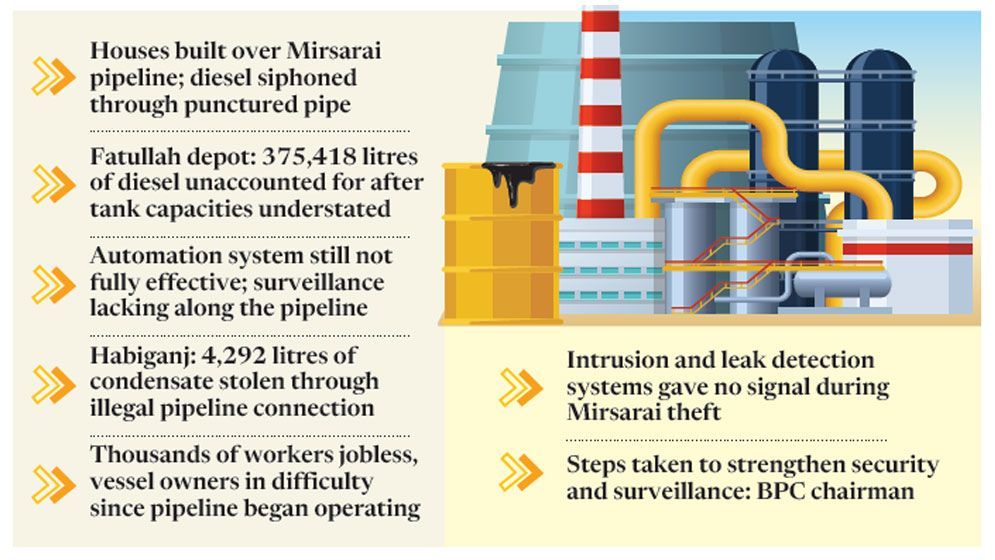
Diesel has been siphoned from the Tk3,699-crore Chattogram-Dhaka oil pipeline, built to curb fuel theft and cut transport costs, while internal documents show that its intrusion and leak detection systems failed to raise the alarm, and 375,418 litres of diesel remain unaccounted for at the Fatullah depot.
In one case, an underground section of the pipeline was punctured and diesel was drawn off directly. In another, the capacities of storage tanks were shown as lower on paper than they are in reality, leaving large quantities of fuel outside the accounts. The pipeline’s automated monitoring and control system is yet to become fully effective, and questions have been raised over whether the project is meeting its objectives.
Separately, in Madhabpur of Habiganj, thieves punctured a pipeline carrying condensate, a by-product of natural gas, on the national grid.
An organised gang made an illegal connection to the line and stole 4,292 litres of condensate over two days, storing it in a secret underground tank.
Last Wednesday, the Gas Transmission Company Limited (GTCL) filed a case with Madhabpur police station against four or five people, including Islam Uddin, a former union parishad member of Noapara union from Ratanpur village.
A review of internal documents of state-owned fuel marketer Jamuna Oil found serious weaknesses in security and automation in the case of the theft by puncturing the pipeline at Mirsarai in Chattogram. The incident came to light on 8 January, but attempts to steal oil through illegal connections to the pipeline had been under way for a long time before that.
The investigation committee has also found irregularities in the work of the contractor responsible for building and securing the pipeline. Additional joint kits were installed on the optical fibre cable in breach of rules, disrupting communications. This has affected the pipeline intrusion detection system (PIDS), leak detection system (LDS), supervisory control and data acquisition (SCADA) system and CCTV operations. These technologies are meant to detect instantly any intrusion, excavation or spillage along the pipeline.
According to Bangladesh Petroleum Corporation (BPC) sources, the roughly 250-kilometre Chattogram-Dhaka Petroleum Pipeline (CDPL) project cost Tk3,699crore. The project was approved in 2018 and construction formally began in 2022. The pipeline was built with a capacity to carry 5 million tonnes of fuel oil a year. Oil began to be transported directly through it in June 2024, and it was formally inaugurated on 16 August 2025. Officials said the 16-inch-diameter main pipeline lies five feet below the ground.
The project aimed to reduce the risks, theft and system loss associated with carrying oil by ship and tanker along waterways, and to cut transport costs. Project documents show an expected annual saving of Tk236 crore.
Automation failures, no signal at control room
The report of an investigation committee formed by Petroleum Transmission Company (PTC) PLC into the Mirsarai theft identified serious faults in the automation system. It said that when oil was being drawn off through a hole in the pipeline on 8 January, the PIDS and LDS installed in the control room at the despatch terminal gave no signal.
Officials in charge therefore could not learn of the incident through the technical systems. The matter came to the authorities’ attention only after staff of the security contractor informed them by mobile phone.
The investigation found that the PIDS failed 108 times in the three months from 1 October 2025 to 7 January 2026. Because of faults in field instruments, the LDS was effectively out of operation for 49 days. Disruption to telecommunications and defects in the optical fibre cable were identified as among the main causes.
The report also said the PIDS gave no signal on 9 January when soil was being excavated with an excavator and a repair clamp was being fitted over the hole in the pipe. By design, the system should send a signal when digging takes place within 10 to 20 metres of the pipeline. In practice, it was not working.
In addition, four servers of the SCADA system at the Godnyle receipt terminal had been out of order since 1 November 2025. They are the SCADA primary, SCADA secondary, LDS and web servers. Although the servers were reinstalled on 11 January this year, they were still not functioning when the investigation report was submitted.
With the LDS server down and power disconnected to the RTU panel, that system too remained out of action for a long time. Project officials said it might take further time to make the automation system effective along the entire 250 kilometres.
BPC chairman DrMdRafiqul Islam told this correspondent,“One of the main purposes of building the pipeline to carry fuel oil from Chattogram to Dhaka was to cut transport costs and system loss, prevent wastage and ensure quick and safe fuel supply.
“However, after an incident of oil theft from the pipeline came to light, steps have been taken to strengthen security and surveillance. Such problems had also arisen in the early stage of the India-Bangladesh Friendship Pipeline. For this reason, arrangements are being made to monitor the pipeline through optical fibre cable (OFC). There are some technical problems with using this technology. As the pipeline runs alongside the road, it is difficult to distinguish between the noise of vehicles and the noise caused by illegal interference with the pipeline. Work is underway to resolve the issue. Technical systems are being improved to ensure surveillance along the entire length of the pipeline.”
375,418 litres unaccounted for at Fatullah
Besides direct theft from the pipeline, allegations have emerged that a large quantity of diesel has gone missing at the Fatullah depot through discrepancies in the accounts.
According to Jamuna Oil’s internal records, a total of 375,418 litres of diesel cannot be accounted for during two rounds of supply through the pipeline. The shortfall was 262,804 litres in the first round and 112,614 litres in the second.
The information was given in a letter sent by Jamuna Oil’s operations division to the managing director on 24 September 2025.
According to the letter, a difference of 262,804 litres between the recorded and actual stock was found during the first round of supply, from 24 June to 4 July. A further shortfall of 112,614 litres emerged during the second round, from 14 to 22 September.
The matter has become more suspicious following the discovery of discrepancies in the capacities of Tanks 22 and 23 at the depot. It is alleged that the calibration certificates show lower capacities than the tanks actually have. This makes it possible to record less oil in the books than is physically in the tanks. The difference may have been used to remove surplus oil from the accounts.
Significant differences were found in particular between the 2018 and 2025 calibration reports for Tank 22. According to the 2018 certificate, the tank’s capacity at a height of 2,000 millimetres was 1,288,044 litres. The 2025 report shows the capacity at the same height as 1,228,840 litres. This means the capacity was shown on paper as 59,204 litres lower. Similarly, at a height of 12,140 millimetres, the capacity in 2018 was 7,266,397 litres, while in 2025 it was shown as 7,208,129 litres, a difference of 58,268 litres.
The calibration of the two tanks was carried out by Khulna-based contractor M/s SM NurulHaque. Its owner, Andalib Bin Haque, told the media that an error of up to 1 per cent in a calibration certificate can be acceptable, but a difference of 60,000 litres is not. He said it could be a printing error. He also acknowledged that Jamuna Oil had not properly verified the draft report.
Senior Jamuna Oil officials allege that the capacities of the tanks were deliberately understated to create an opportunity to divert oil. They believe around 250,000 litres of diesel may have been stolen over the two rounds. However, it is not yet confirmed whether the entire 375,418 litres that remain unaccounted for was stolen. Whether the discrepancy arose from oil remaining in the pipeline, measurement errors or other causes needs to be established through investigation.
Livelihoods hit on waterways
The start of oil transport through the Chattogram-Dhaka pipeline has also affected the livelihoods of workers who had long been involved in carrying oil by river. Large quantities of fuel were previously moved by ships, lighter vessels and tankers, and several thousand workers, employees, seafarers and related professionals were engaged in the work. With oil now moving directly through the pipeline, fuel transport by waterway has declined, and a large number of those workers face the risk of unemployment. Owners of the lighter vessels and tankers used for transporting oil have also faced financial difficulties as their incomes have fallen.
The pipeline project was meant to ensure energy security by reducing transport costs and theft, but questions have been raised over how far that goal is being met given weaknesses in its security and operations.
Experts say that building infrastructure alone will not stop fuel theft. They say it is essential to measure the quantity of oil accurately at both ends of the pipeline, verify tank calibration, introduce automated stock management and make security surveillance effective.