


 For all latest news, follow the Daily Sun's Google News channel.


Building from the Ground Up
A New Generation of PHC Pile Technology
As the country builds taller, heavier and more complex structures, the technology used beneath the ground is becoming just as important as what rises above it
Daily Sun Report, Dhaka
Published: 22 Sep 2026, 12:00 AM
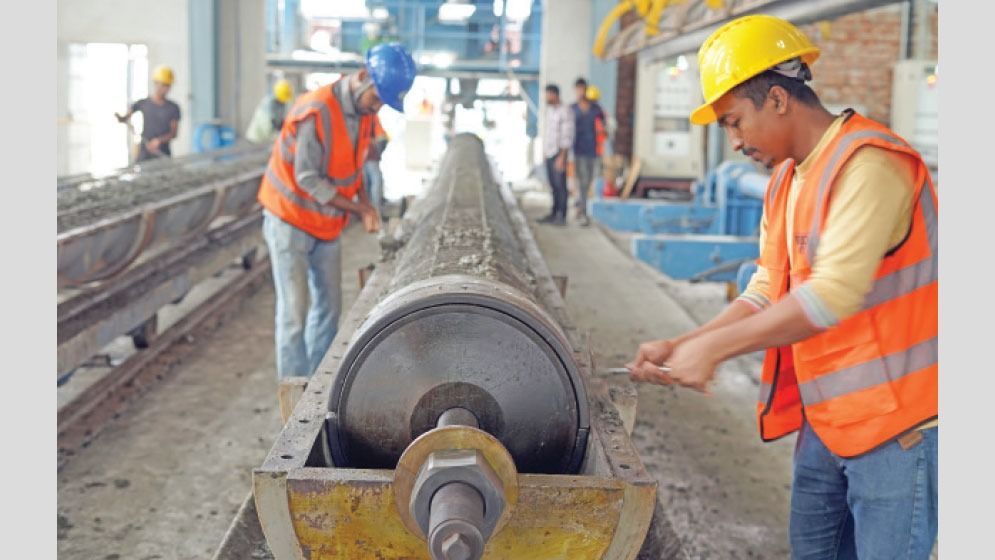
Production at Bashundhara's PHC pile facility
Rows of massive cylindrical concrete piles stretch across the production floor at Bashundhara’s PHC Pile facility in Mirsharai, their hollow cores giving them a distinctive appearance.
At first glance, they may seem like relatively simple structural components. But behind their uniform shape lies a carefully controlled manufacturing process involving prestressed steel, high-strength concrete, centrifugal spinning, steam curing and rigorous quality testing.
That process is what sets Prestressed High-strength Concrete (PHC) spun piles apart, and points to their potential role in Bangladesh’s rapidly evolving construction sector.
Unlike the solid concrete elements commonly associated with conventional piling, PHC spun piles are engineered to deliver high structural performance while keeping their weight more manageable.
Their strength, however, depends not only on their design but also on how precisely they are manufactured.
Inside the Mirsharai facility, much of that precision comes from factory-controlled production.

Operated by Bashundhara Ready Mix and Construction Industry Ltd. (BRMCIL), under Safwan Bashundhara Global, the facility at the National Special Economic Zone in Mirsharai, Chattogram, combines advanced Korean manufacturing machinery with a production system based on Japanese Industrial Standard JIS A 5373:2016.
From the preparation of reinforcement cages and concrete batching to high-speed spinning, curing and final testing, each stage is carried out under controlled conditions designed to ensure consistency in the finished piles.
For a country where buildings are reaching higher, industrial developments are becoming larger and transport infrastructure more complex, the significance of this technology may not be immediately visible.
It lies beneath the surface.

The engineering starts below ground
A building's columns may dominate the skyline, but the loads ultimately have to be transferred safely into the ground.
That becomes particularly challenging in areas where soil is soft, loose or water-affected. Deep foundations are designed to transfer structural loads to stronger strata below, making the performance of the pile system fundamental to the stability and durability of the structure above.
PHC spun piles address this challenge through a factory-manufactured combination of high-strength concrete and prestressed steel bars.
The technology itself is not new. Developed in Japan during the 1970s, PHC spun piles have subsequently been used for high-rise buildings, industrial facilities, infrastructure and marine structures.
What is increasingly relevant for Bangladesh is the ability to manufacture the technology locally under controlled conditions.

Inside the spinning process
The manufacturing sequence is where the technology becomes particularly interesting.
A prestressed steel cage is prepared and positioned inside a mould. Concrete is then poured into the mould around the reinforcement before the mould is rotated at high speed.
This centrifugal spinning is not simply a mechanical step in the production line. It is central to how the pile is formed.
The spinning action helps remove excess water and compact the concrete, increasing its density and promoting a more uniform concrete matrix.
The pile then undergoes steam curing, accelerating strength development before it is removed from the mould and inspected.
The finished product is a high-strength, hollow cylindrical pile.
Bashundhara PHC Pile specifies a concrete compressive strength of 80 MPa at 28 days, with standard lengths ranging from 6 to 15 metres.
Where deeper foundations are required, pile lengths can be extended through jointing, subject to engineering and design requirements.
The hollow core is significant from both engineering and logistical perspectives.
By eliminating concrete from the centre, where it is not required for the same structural purpose, the pile can achieve a lower self-weight while retaining its cylindrical structural form.
That can have implications for transportation, handling and installation.

From raw materials to finished piles
One of the most notable aspects of the facility is that quality control is integrated into the manufacturing sequence rather than treated simply as a final inspection.
The process begins with material acceptance and steel-bar preparation. Reinforcement cages are formed, end and joint plates are fitted, and moulds are prepared. Concrete is then batched and poured, followed by tensioning, centrifugal spinning and steam curing.
After demoulding, the piles undergo quality-control inspection before being prepared for delivery to project sites.
That controlled sequence matters because piles experience significant stresses even before they become part of a foundation.
They have to be manufactured, lifted, transported and driven into the ground without compromising their structural integrity.
Prestressing is therefore an important part of the system. It improves resistance to cracking during handling and installation, while the dense concrete matrix is designed to provide durability in demanding environments.

Quality that can be tested
The manufacturing floor is supported by a dedicated Quality Control Laboratory equipped for testing and product development.
Among the equipment are a digital pile-bending testing machine, a concrete compressive-strength testing machine, a universal testing machine for PC bars and spiral wires, and a test spinning machine supporting prototype production and research and development.
The facility's documented testing programme includes BUET test reports covering Grade 300A, 400A/400B, 450A, 500A/500B and 600A/600B piles, including tests of concrete compressive strength, PC bars and high-tensile spiral wires.
The company's PHC Spun Pile quality-management system is also covered by ISO 9001:2015 certification, providing an internationally recognised framework for quality management across the relevant production scope.
The combination of standardised manufacturing, laboratory testing and documented quality procedures points towards an important shift in how foundation materials can be produced: moving a substantial portion of quality-sensitive work from variable site conditions to a controlled industrial environment.
Where could PHC technology make a difference?
The potential applications are broad.
PHC piles can be used in foundation systems for high-rise and commercial buildings, residential and institutional developments, bridges, flyovers and elevated expressways, railway and highway infrastructure, power plants, industrial complexes, marine and offshore structures, airports, tunnels and metro stations.
Applications can also extend to reclamation, ground stabilisation and solar-panel structures where appropriate foundation design is required.
This breadth is particularly relevant as Bangladesh enters a period of increasingly complex construction.
Dhaka and other major urban centres continue to see vertical development, while industrial and economic zones are expanding beyond traditional urban boundaries.
At the same time, large-scale road, rail, bridge, power and other infrastructure projects are creating foundation requirements that can vary dramatically from one site to another.
For engineers, the challenge is therefore no longer simply to find a pile that can carry a load.
They must consider soil conditions, structural loading, durability, installation, quality consistency, logistics and construction time as part of a single foundation strategy.
That is where the potential of factory-manufactured PHC technology becomes more apparent.
The efficiency equation
A foundation pile is ultimately judged by how it performs as part of an entire project.
Factory-controlled production can provide greater consistency in dimensions and concrete quality. Rapid steam curing can accelerate production, while the prestressed structure is designed to withstand the demands of transportation and pile driving.
The hollow cylindrical design can also reduce individual pile weight, potentially easing transportation and handling requirements.
For large projects, these factors can become important considerations when engineers are balancing foundation performance against construction schedules and site logistics.
There is another potential advantage: reduced dependence on site-based production of the piles themselves.
Instead of manufacturing each pile under changing site conditions, the major production stages take place in a dedicated facility where materials, machinery, curing and testing can be systematically controlled.
A local manufacturing capability
The Mirsharai facility represents more than the introduction of another construction product to the market.
It represents the development of local manufacturing capability for a specialised foundation technology, combining Korean manufacturing machinery, Japanese product standards and production in Bangladesh.
For Bangladesh's construction industry, that combination could become increasingly relevant as projects become larger, structures become taller and foundation requirements become more demanding.
Of course, no piling system is universally suitable for every site. Final selection must always be based on geotechnical investigation, structural design, loading requirements and the specific installation conditions of a project.
But the emergence of locally manufactured PHC spun piles gives engineers and developers another technology to consider.
And that may be the most important development taking place in Mirsharai.
The piles themselves will eventually disappear beneath buildings, bridges, factories and other structures. Once construction is complete, few people will ever see them.
Yet their role will remain fundamental.
Because the future of Bangladesh's infrastructure will not be defined only by how high we build—but by how intelligently we build beneath the ground.