


 For all latest news, follow the Daily Sun's Google News channel.


Bangladesh risks losing $8b a year in RMG waste recycling
Daily Sun Report, Dhaka
Published: 09 May 2026, 09:04 PM
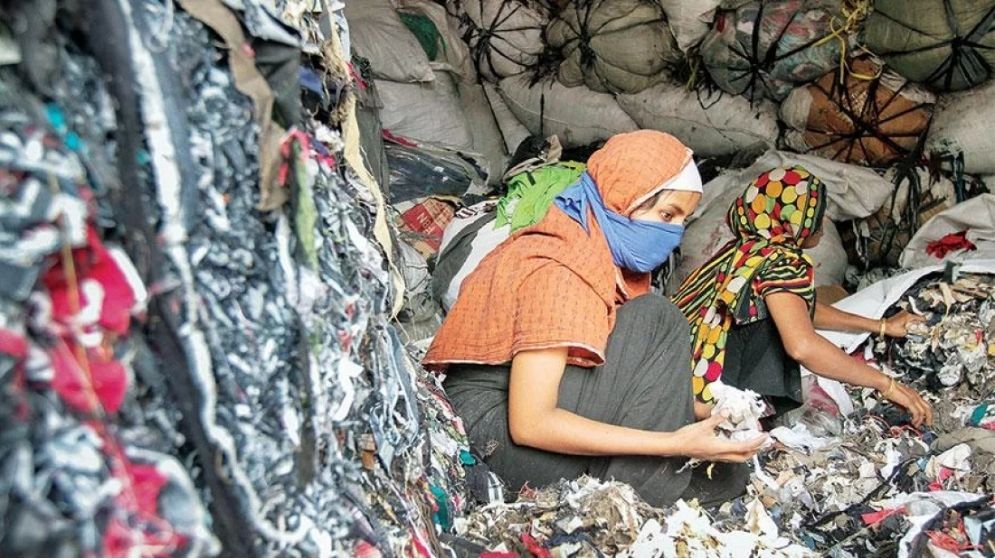
File Photo
Bangladesh risks losing an annual $8 billion opportunity in recycling waste from its readymade garment sector as weak policy support and limited technological capacity continue to slow the transition to a circular economy, industry insiders said.
They
warned that without urgent reforms, the country’s position as the world’s
second-largest apparel exporter could come under pressure as key export markets
move towards stricter environmental and traceability requirements.
The
observations came at a seminar titled Accelerating Circular Transition in
Bangladesh’s Textile Industry: Insights from SWITCH2CE Pilots, jointly
organised by the Ministry of Commerce and the Bangladesh Garment Manufacturers
and Exporters Association (BGMEA) in Dhaka on Wednesday (6 May).
Speaking
at the event, Sheikh HM Mustafiz, managing director of Cute Dress Industry Ltd
and a director of BGMEA, said global legislative changes are reshaping the
future of the apparel industry and pushing manufacturers towards circularity
and sustainability-driven compliance.
He
said initiatives such as the European Green Deal and the Digital Product
Passport would require greater transparency, product traceability and
environmentally friendly supply chains.
According
to Mustafiz, Bangladesh now generates nearly 600,000 tonnes of textile waste
annually. A large share of this waste is reused or processed through the
informal sector, but it has yet to be brought under a formal framework.
He
said bringing the sector into the formal economy would help reduce health and
safety risks and create a more organised industrial base.
While
100% cotton waste can be recycled mechanically, Bangladesh’s chemical recycling
capacity remains limited. Recycling is currently concentrated mainly on cotton,
with significant gaps in handling blended fabrics and man-made fibres.
He
also warned that rising global demand for resources and tighter raw material
supply by 2030 would require the sector to reduce dependence on virgin cotton
and move towards recyclable alternatives.
BGMEA
Vice-President Vidiya Ammrit Khan said recycling the entire volume of RMG waste
could generate a circular economy worth nearly $8 billion annually.
She
said Bangladesh currently recycles up to 30% of cotton-based garment cutting
waste, but a significant share is exported to India and Pakistan before being
reimported as recycled yarn.
She
added that around 17 factories in Bangladesh are now operating under pilot
recycling projects.
Addressing
the seminar, Michael Miller, Ambassador of the European Union to Bangladesh,
said Bangladesh is approaching a critical stage ahead of its graduation from
the least developed country category and needs to build a more balanced
commercial relationship with the European Union.
He
said the EU is assessing Bangladesh’s request for negotiations on a free trade
agreement, adding that the country must strengthen competitiveness, circularity
and eco-efficiency regardless of the graduation timeline.
Referring
to the EU’s 2022 strategy for sustainable and circular textiles, Miller said
new requirements such as eco-design standards, extended producer
responsibility, digital product passports and stricter anti-greenwashing rules
would directly affect Bangladesh, as Europe remains its largest export market
for garment products.
He
also said the EU is supporting Bangladesh’s circular transition through the
SWITCH to Circular Economy initiative, with brands such as H&M and
Bestseller leading pilot projects on recycling and waste traceability.
Commerce
Minister Khandaker Abdul Muktadir and Mahmud Hasan Khan, among others,
addressed the seminar, which was chaired by Md Abdur Rahim Khan, secretary
(routine charge) of the Ministry of Commerce.