



 For all latest news, follow the Daily Sun's Google News channel.


Govt moves to strengthen internal audit to safeguard public funds
Three-year roadmap proposes permanent audit units across ministries; revised 2026 manual aims to strengthen accountability
Daily Sun Report, Dhaka
Published: 09 Oct 2026, 01:01 PM
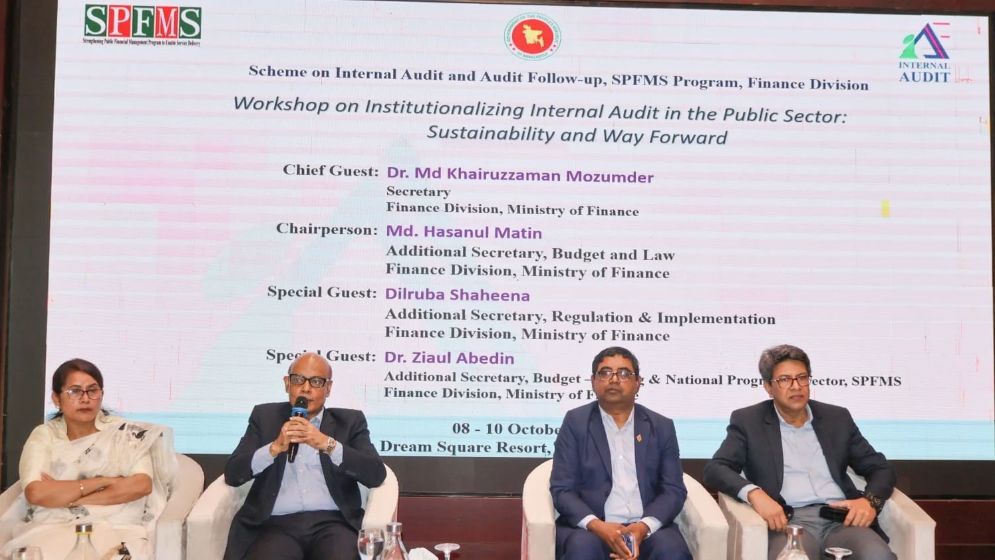
Photo: Daily Sun
The government is moving to establish permanent internal audit units across ministries and divisions to detect financial risks early, prevent misuse of public funds and improve public service delivery.
A three-year roadmap proposes setting up dedicated audit units or directorates, introducing recruitment rules and strengthening professional training and resources to replace the existing system, which relies heavily on temporarily assigned staff and lacks sufficient capacity.
The reform agenda was discussed at a three-day workshop titled “Institutionalizing Internal Audit in the Public Sector: Sustainability and Way Forward”, held on 8-10 October in Gazipur under the Finance Division’s Strengthening Public Financial Management Program to Enable Service Delivery (SPFMS).
Finance Secretary Dr Md Khairuzzaman Mozumder attended the inaugural session as chief guest and unveiled the revised 2026 Model Risk-Based Internal Audit Charter and Manual, which provides an updated framework for internal auditing in government institutions.
“The current government attaches great importance to institutionalise internal audit in the public sector,” he said, describing the introduction of internal auditing across ministries as a landmark step towards transparency and accountability in public fund management.
“Implementing internal audit comes with challenges, but we must work together to overcome them. Our task is to turn this initiative into an effective and sustainable system that strengthens public financial management,” he added.
The revised manual, based on the 2024 Global Internal Audit Standards, clarifies auditors’ mandates, responsibilities and reporting arrangements. It aims to help government institutions identify weaknesses in financial management, procurement, operations and information technology before they lead to losses or disrupt essential services.
Under the framework, internal auditors will report functionally to the relevant internal audit committee and administratively to the secretary or principal accounting officer. The arrangement is intended to strengthen professional independence and ensure that audit findings receive scrutiny beyond officials responsible for day-to-day operations.
-6ac891dc57424.jpg)
Audit gaps across departments
Presentations by five government departments at the workshop highlighted progress in risk-based auditing, alongside persistent staffing, funding and institutional constraints.
The Directorate General of Health Services (DGHS) identified 93 risks and completed six audit reports. Its priorities include reducing waste, ensuring compliance and improving healthcare delivery through skilled personnel, adequate funding, facilities and digital access.
The Public Works Department (PWD) identified 70 risks and advanced its annual audit plans. However, unresolved audit findings, limited independence, staff vacancies and weak coordination remain challenges. The department called for clearer responsibilities, deadlines, digital tracking and stronger committee oversight.
The Local Government Engineering Department (LGED) extended risk-based auditing to 78 cost centres and recorded 300 observations. However, temporary staffing, limited expertise and the absence of a permanent organisational structure have constrained progress.
The Directorate of Primary Education (DPE) reported a 13-member internal audit unit, identified 41 risks and conducted pilot activities in Raipura and Laxmipur Sadar. It highlighted the need for more personnel, training, logistics and technical support, with consolidated reporting scheduled for July 2027.
The Roads and Highways Department (RHD) identified 82 risks and completed six audit reports. Its findings pointed to weaknesses involving procurement, contracts, land acquisition, staffing and digital systems, while additional duties also limited audit capacity.
The departments emphasised that identifying risks alone would not be sufficient without timely corrective action and regular monitoring by internal audit committees.
Permanent structures, stronger oversight
The workshop also reviewed an internal audit action plan for 2026-2031, focusing on permanent institutional structures, adequate budgets, professional capacity and coordination between internal and external auditors.
The proposed reforms aim to make risk identification and corrective action routine responsibilities of public administration rather than occasional exercises dependent on individual officials.
Effective internal auditing could have direct implications for citizens by helping protect public spending on healthcare, primary education, roads and other infrastructure. Early identification of procurement irregularities, operational weaknesses and financial risks could reduce waste, prevent project delays and improve the reliability of public services.
Finance Division Additional Secretary Mohammad Azad Sallal presented the sustainability plan for public-sector internal auditing at the workshop.
The workshop featured three business sessions on the revised charter and manual, digital monitoring linked to the Integrated Budget and Accounting System (iBAS++), stronger internal controls and timely implementation of corrective measures.
The proposed roadmap will require administrative approval and sustained investment in staffing, training, technology and institutional oversight to translate the reform plans into an effective and lasting audit system.