



 For all latest news, follow the Daily Sun's Google News channel.


Allegations of fund misuse in UGC’s Tk4,000 crore ‘HEAT’ project
Daily Sun Report, Dhaka
Published: 11 Apr 2026, 08:33 AM
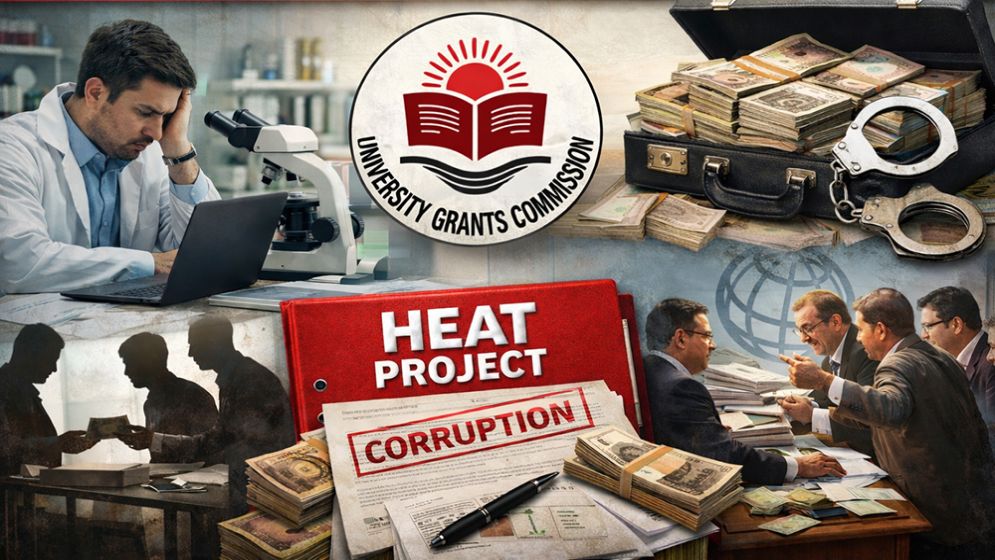
There are more than 170 public and private universities in the country. In most of these institutions, research activities are very limited, even though research and the creation of new knowledge are the core responsibilities of universities. To improve the quality of higher education, a major project titled “Higher Education Acceleration and Transformation (HEAT)” is being implemented with support from the World Bank.
However, there is no shortage of allegations regarding this Tk4,000 crore research project. Instead of focusing on research, some officials of the University Grants Commission (UGC) and the HEAT project have reportedly become busy misappropriating large sums of money and sharing them among themselves.
The World Bank has already expressed dissatisfaction to the Ministry of Education over the project. As a result, the objectives of this large loan-funded project are at risk of being undermined.
Sources say that alongside government funding, the World Bank is providing loan assistance for the HEAT project implemented by the UGC. The five-year project began in July 2023, with a total cost of Tk 4,016.57 crore. Of this, 50.96% will be financed by the Bangladesh government and the remaining 49.4% by the World Bank.
Recently, a World Bank delegation met Education Minister Dr. A N M Ehsanul Haque Milan. After the meeting, the minister said the delegation made various negative comments about the HEAT project and expressed dissatisfaction. This led to widespread criticism and put pressure on the UGC.
On April 1, the UGC issued a press release stating that the implementation progress of the HEAT project is satisfactory. It claimed that the World Bank rated the overall progress as “moderately satisfactory.”
According to the statement, a World Bank delegation presented the latest progress during a meeting with UGC Chairman Professor Mamun Ahmed. This indicates differing positions between the Ministry of Education and the UGC regarding the World Bank’s level of satisfaction.
Professor Mohammad Tanzimuddin Khan, a UGC member responsible for the HEAT project, told Kaler Kantho that the allegations are not accurate. He said that although claims of irregularities worth hundreds of crores have been made, only Tk 116 crore has been released so far for research funding, with another fund currently in process. He added that the project is being implemented based on an earlier Development Project Proposal (DPP), which creates complexities.
Recently, several professors from Shahjalal University of Science and Technology—including Dr. Saiful Islam, Dr. Abul Hasnat, Jahangir Alam, Dr. Rezaul Karim, Dr. Sahabul Haque, and Dr. Jamal Uddin—alleged irregularities and corruption in the HEAT project at a press conference.
They said that instead of selecting well-established researchers, projects were awarded to low-profile academics with fewer citations. They claimed that merit and qualifications were not properly evaluated, and political influence and favoritism played a role. According to their observations, around 40% of selected researchers had fewer than 100 total citations, while another 40% had fewer than 500 citations. Globally recognized researchers were overlooked in favor of less accomplished ones.
Teachers also alleged that political loyalty and personal connections were prioritized over qualifications in awarding research projects. In some cases, teachers from unrelated disciplines were assigned to evaluate proposals—for example, social science teachers reviewing business, economics, accounting, and even architecture-related research.
Despite these allegations, on August 27 last year, the UGC signed agreements with 43 public and private universities to implement 151 sub-projects. Recently, several hundred crores of taka have also been disbursed, with around Tk 600 crore planned for release in the first phase.
A vice-chancellor of a public university, speaking anonymously, said that while the project’s objectives are good, problems lie with those managing it. He acknowledged that some of the allegations regarding the first phase are valid and emphasized the need for full transparency in the second phase.
Relevant sources claim that a powerful syndicate within the UGC and HEAT project arranged the distribution of around Tk 100 crore in the first phase. It is alleged that reviewers were influenced to approve projects of favored individuals, with promises of up to Tk 1 million for giving top scores, despite an official honorarium of Tk 15,000 per review. In some cases, verbal agreements were made to share project funds equally.
UGC Chairman Professor Mamun Ahmed recently instructed officials to ensure careful and transparent evaluation of research proposals in the second phase under the Academic Transformation Fund (ATF). He emphasized the importance of avoiding controversy and ensuring fair assessment based on social, political, and academic realities.
Sources say irregularities began with the appointment of the project director. The top candidate, Professor Abul Hasnat Muhammad Solaiman, was initially appointed on March 14, 2024, but his appointment was cancelled within a day following verbal instructions from the then education minister Mohibul Hasan Chowdhury Nowfel due to political differences. Later, Professor Asaduzzaman from Chittagong University of Engineering and Technology was appointed.
Professor Solaiman later appealed to the Ministry of Education, claiming his appointment was unjustly cancelled due to political bias. Although his claim was informally acknowledged, a powerful group within the UGC reportedly wants to keep the current project director in place.
Currently, Bangladesh has 55 public universities and 116 private universities. However, private universities claim they have been discriminated against in the first phase, as many did not receive any projects despite strong research performance and international recognition.
Project Director Professor Asaduzzaman said work on the second phase is ongoing and reviews will begin soon. When asked about allegations of irregularities in the first phase, he said detailed discussion would require reviewing documents but assured that steps have been taken to improve the process in the second phase.
Source : Kaler Kantho