


 For all latest news, follow the Daily Sun's Google News channel.


Mintoo seeks int'l cooperation to address growing climate risks
He laid importance on making long-standing partnership with the UNDP even more practical and fruitful
Daily Sun Report, Dhaka
Published: 08 Oct 2026, 08:37 PM
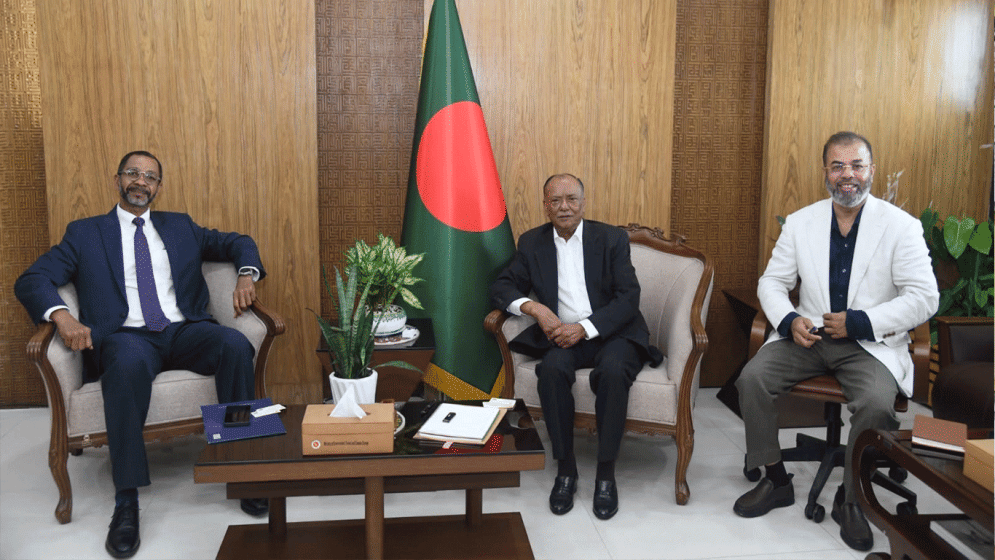
Photo: BSS
Minister for Environment, Forest and Climate Change Abdul Awal Mintoo has said since Bangladesh is one of the most vulnerable countries to climate change, adaptation activities must be made more effective considering local realities.
At the same time, he said, it is essential to ensure
a balance between the conservation of the environment and natural resources,
and the promotion of people's livelihoods and economic development, said a
press release.
The environment minister said this when Stephen
Rodrigues, resident representative of the United Nations Development Programme
(UNDP) in Bangladesh, met him at his Secretariat office in the capital on Thursday.
State Minister for Environment Shaikh Faridul Islam
was also present during the meeting.
During the meeting, emphasis was placed on
strengthening cooperation regarding climate resilience, financing for
biodiversity conservation, and facilitating Bangladesh's entry into carbon
markets.
The existing cooperation between Bangladesh and the
UNDP in the environment, forest, and climate change sectors was reviewed, and
discussions were held on further expanding this collaboration in the future.
Key topics of discussion included the Biodiversity
Finance Initiative (BIOFIN) formulated by Bangladesh for biodiversity and
ecosystem conservation, the National Cooling Plan (NCP) for low-carbon
development, climate change adaptation and impact mitigation, pollution control,
plastic waste management, and enhancing the climate resilience of local
communities.
Speaking at the meeting, Mintoo said Bangladesh is
working to address the impacts of climate change by leveraging its own
resources and capabilities.
However, he said, international cooperation,
accessible climate finance, technology transfer, and capacity-building are
crucial to tackling escalating climate risks.
He laid importance on making long-standing
partnership with the UNDP even more practical and fruitful.
Faridul Islam emphasised the need for increasing the
involvement of local governments and communities in climate adaptation
activities.
He particularly highlighted the necessity of
expanding nature-based solutions and climate-resilient livelihood initiatives
in climate-vulnerable areas, such as coastal regions, riverine islands (chars),
hilly areas, haor basins, and the drought-prone Barind tract.
The state minister also put emphasis on
strengthening UNDP's technical support to secure increased funding from
international climate funds and development partners for the implementation of
Bangladesh's national climate commitments.
Stephen Rodriques reiterated UNDP's commitment to
supporting Bangladesh's climate-resilient and eco-friendly development.
He stated that UNDP is keen to work in alignment
with the government of Bangladesh's priorities regarding climate adaptation,
nature and biodiversity conservation, addressing pollution and plastic waste,
climate finance, and enhancing local-level resilience.
He added that UNDP would continue to provide
necessary technical support and partnerships to scale up successful initiatives
by engaging government institutions, local communities, development partners,
the private sector, and other stakeholders.
Both parties agreed to accelerate the implementation
of ongoing joint projects and identify new areas of cooperation focusing on
climate adaptation, ecosystem restoration, financing for biodiversity
conservation, mitigation of global warming, air pollution control, and carbon
credits.
Fahmida Khanam, acting secretary of the Ministry of
Environment, Forest and Climate Change, and senior officials from UNDP were
present.