



 For all latest news, follow the Daily Sun's Google News channel.


Boeing E-4B
Aircraft that can fly 7 days nonstop, survive nuclear attacks
The estimated cost of the aircraft is around $223 million. Besides the United States, only Russia possesses similar aircraft.
BBC Bangla, Washington
Published: 12 Apr 2026, 08:55 AM
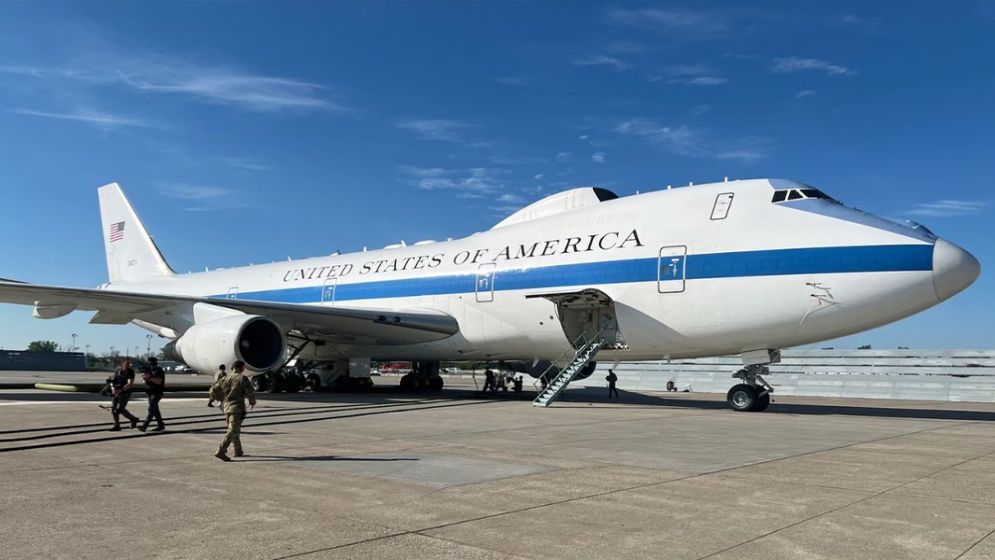
Boeing E-4B. Photo : Collected
The aircraft is known as the “Doomsday Plane,” which in Bengali translates to “the aircraft of apocalypse.” Its actual name is the Boeing E-4B. It is capable of flying continuously for seven days.
This aircraft was designed to operate during extreme emergencies such as nuclear attacks or other catastrophic disasters.
It was introduced into military service in 1974, at the height of the Cold War. Its purpose was to function as an airborne command center if the situation in the United States went out of control or if ground-based command and control centers were disrupted.
Designed for wartime use, this aircraft serves as an airborne command center for the US President, the Secretary of Defense, and the Joint Chiefs of Staff during crises and extreme emergencies.
Through it, control of the situation can be maintained and communication with the rest of the government can be preserved.
Capabilities
The United States has a fleet of four E-4B aircrafts, which are flown regularly throughout the year to ensure military readiness.
Currently, the US Air Force is modifying five Boeing 747-8 aircraft so they can be used as replacements for the E-4B fleet. These aircraft were previously used by Korean Air.
The upgraded aircraft are being equipped with protection against radiation and electromagnetic pulses. They will also include communication antennas, computers, mission systems, modern interior designs, and the ability to refuel in mid-air.
The total cost for these five aircraft is estimated at around $13 billion.
These aircraft have capabilities not found in other planes, including support for missile operations and the ability to withstand nuclear attacks, cyberattacks, and electromagnetic effects.
They are equipped with powerful communication systems, including 67 antennas that allow communication from anywhere in the world. They also have heat and nuclear protection systems.
The aircraft operates with four engines, has swept wings, and can be refueled in mid-air.
By the end of 1974, the United States upgraded its active Boeing E-4A aircraft to the E-4B version.
In 1980, the U.S. Air Force received the first B-series aircraft, and by 1985, the entire “Doomsday Plane” fleet had been upgraded to the B-series.
What makes the Doomsday Plane different?
In addition to being able to fly continuously for seven days, the aircraft has several unique features. While in flight, crew and passengers can communicate with ground stations from anywhere in the world.
Its strength surpasses that of the US Air Force’s regular aircraft fleet. It is designed to withstand nuclear attacks, meteor strikes, and attacks from other air forces.
It can refuel in mid-air. Its engines are designed to remain on standby 24 hours a day, allowing it to take off within minutes during any emergency or attack.
The estimated cost of the aircraft is around $223 million. Besides the United States, only Russia possesses similar aircraft.
It can also communicate with submarines deep underwater and provide them with instructions.
This aircraft is different from “Air Force One,” which is used for the regular travel of the U.S. President.
How it gained media attention
Media interest in the aircraft increased after Donald Trump came to power in 2017, when tensions rose between him and North Korean leader Kim Jong Un.
The tension peaked in January 2018 after Kim Jong Un stated that a “nuclear button” was always ready on his desk to prevent the United States from starting a war.
The Doomsday Plane fleet conducts regular flights to ensure its operational and military readiness and to confirm that all its capabilities are functioning effectively.
The aircraft has been spotted multiple times in the skies over Washington, including in June last year and January this year.