



 For all latest news, follow the Daily Sun's Google News channel.


Media Consolidation
Almost everyone loves watching movies. Every time a new superhero blockbuster is released, we dive into a streaming platform; if not, we find ourselves in a comfortable seat at the multiplex. Our lives have become thoroughly submerged in media.
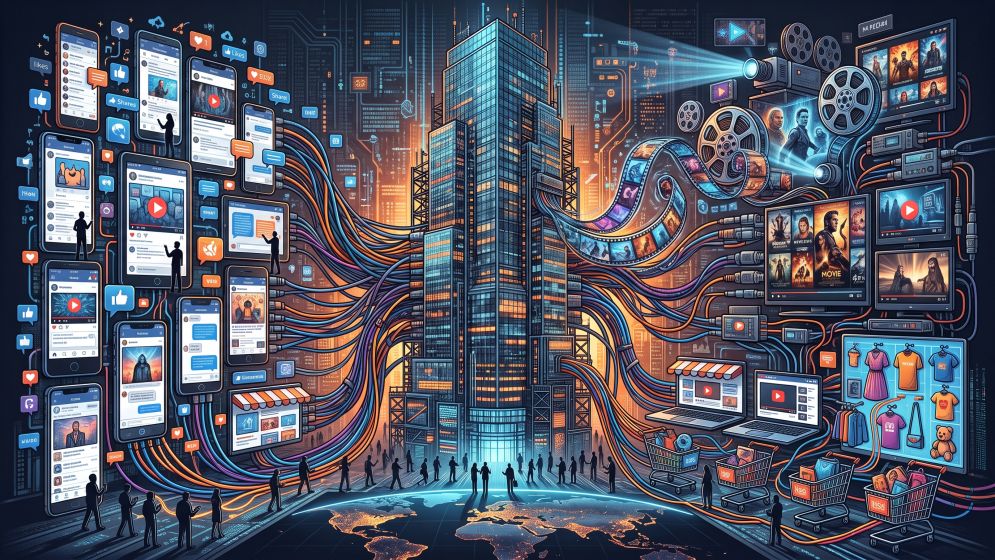
Our mornings start with scrolling through reels on Instagram, sharing a franchise meme on Facebook over breakfast, browsing comic book universes during our daily commute, and discussing the latest streaming releases with colleagues at work. Almost all of us are immersed in media content, yet we rarely stop to ask how we are being controlled by it, how our consciousness is being shaped, and how our attention is being monetised so that media giants can generate massive profits in the process.
Besides, the political economy of these media conglomerates is not driven by profit alone; rather, creating "cultural imperialism," a term proposed by Herbert Schiller to describe the exercise of cultural dominance over other nations, has also been a motive. So, it is high time we thought about what we are consuming and how this ecology functions within today's global media and economic landscape.
To understand this profit-oriented mechanism of contemporary media, we must examine its structural consolidation over time. In 1983, Ben Bagdikian showed that approximately fifty independent corporations controlled the vast majority of American news, publishing, and broadcast media; by the time of his final edition in 2004, that number had fallen to just five conglomerates dominating nearly every form of media content.
Today, megamergers, such as Disney's $71.3
billion acquisition of 21st Century Fox and the union of WarnerMedia and
Discovery, have collapsed the landscape further into four or five legacy
giants: The Walt Disney Company, Warner Bros. Discovery, Comcast
(NBCUniversal), and Paramount Global/Skydance. These media conglomerates now
exist in close structural alignment with Silicon Valley tech platforms like
Alphabet, Meta, Amazon, and Apple, creating an intertwined media-tech ecosystem
that exercises significant influence over both narrative production and digital
distribution infrastructure.
A question now arises: how do these megamergers work? The answer is hidden behind a term: "corporate synergy," the strategy by which a conglomerate uses its various media holdings to promote, cross-sell, and reinforce one another. In this synergistic process, a single piece of content is turned into a self-sustaining ecosystem of products across the company's entire portfolio. To understand this strategy, let's consider a major entertainment company, Disney, as an example.
First, it designs a character or a shared cinematic universe as a
multi-platform asset. The films are released first in cinemas and then on Disney+, the
company's own streaming platform. Both platforms secure recurring revenue,
first through theater ticket sales, then through subscriptions. After that,
subsidiary record labels release original soundtracks, while publishing
divisions distribute tie-in novels, children's books, and comics. High-margin
licensing agreements bring branded merchandise, clothing, and housewares into
global retail spaces. Finally, the intellectual property extends into physical
space altogether, anchoring theme park attractions, live touring spectacles,
and dedicated resort cruise lines. In this way, a single narrative universe is
stretched across nearly every division a conglomerate owns, so that one
creative investment generates returns many times over, this is the essential
logic of corporate synergy.
Vincent Mosco offers a way to understand why media consolidation matters beyond profit. In The Political Economy of Communication, he names three processes at work in commercial media: commodification, spatialisation, and structuration.
Commodification means turning use value into exchange value. It happens in
three ways. Content gets fenced off through intellectual property. Audiences
get packaged and sold too. This builds on Dallas Smythe's idea of the
"audience commodity": platforms collect our attention and data, then
sell it to advertisers. Labor gets commodified as well. Creative and
journalistic work is broken into pieces and measured by automated metrics.
Spatialisation is about overcoming distance and time. Conglomerates do this through vertical integration, controlling the whole supply chain from production to distribution. They also use horizontal integration, acquiring competitors to grow their market share. This is exactly the logic behind the Disney-Fox merger and the WarnerMedia-Discovery merger discussed earlier.
Structuration is the third process. It describes how social structures like class, power, and ideology are built by human choices and actions, even as those same structures shape and limit what choices people can make. Applied to media, this means media companies aren't just neutral messengers. They are shaped by existing power structures, and they help remake those structures every time they produce content.
This is how media ends up reproducing class inequality, normalising neoliberal economic logic, and pushing aside narratives that challenge the existing order, not through any single deliberate decision, but through the everyday structure of how media businesses operate. This is the bridge between economics and ideology.
This is where Antonio Gramsci's idea of hegemony becomes useful. Hegemony is domination without force. It works through manufactured consent; people come to accept the dominant worldview as simply natural. Applied globally, this explains how Western media conglomerates shape consciousness in countries like Bangladesh. We can see this first in what policy debates once called the "one-way flow" of global media. The Global North exports huge amounts of programming to Asia, Africa, and Latin America.
Meanwhile, local work struggles
to find the same kind of distribution. This creates a second problem:
indigenous storytelling gets pushed aside. Multiplexes and streaming platforms
favor international content over local films. Slowly, a cultural commons rooted
in folklore, theater, and literature gets crowded out.
The
deeper effect is ideological. We see media sometimes normalising Western
consumer capitalism. It does this by building a consumer identity, one where
self-worth gets measured through global brands. At the same time, it
depoliticises real problems. Precarious employment and climate vulnerability get
drowned out by stories about individual gratification.
When
media output is concentrated in the hands of a few corporate decision-makers,
something important is lost. The public sphere that democracy depends on gets
weaker. Art loses its power to challenge or provoke. Instead, it becomes a tool
for grabbing attention and generating revenue.
But
resisting this doesn't mean giving up on media. It means consuming more
critically, and pushing for structural change. We need stronger public and
community journalism, ones not driven by advertiser incentives. We need
stricter rules against monopoly and algorithmic dominance. And we need real investment
in local storytelling, grants and distribution support for artists working
outside corporate formulas.
Until
culture is separated from the constant pressure to generate profit, the stories
that shape our imagination will keep reflecting corporate balance sheets, not
human experience. The answer isn't to abandon film or television. It's to watch
and read with open eyes, and to protect the alternatives still worth saving.