



 For all latest news, follow the Daily Sun's Google News channel.


Iran reopens Strait of Hormuz as Lebanon ceasefire takes effect
Trump says Iran war could end ‘soon’; US blockade ‘will remain in full force’ until peace deal
Agencies, Beirut/Tehran/ Washington/Paris
Published: 18 Apr 2026, 12:00 AM
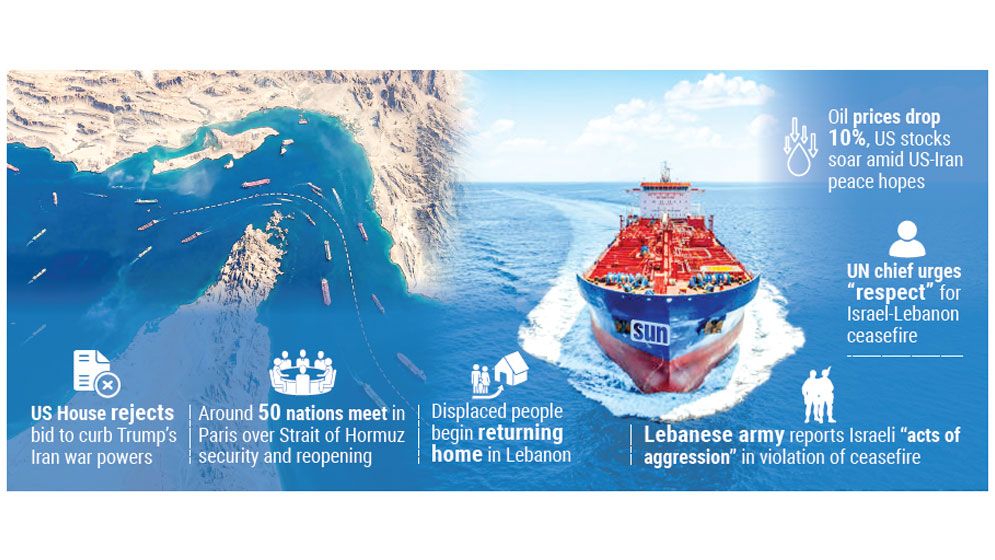
A 10-day ceasefire between Lebanon and Israel came into effect at midnight on Thursday, while Iran announced that the Strait of Hormuz was open to commercial shipping amid broader diplomatic signals from US President Donald Trump that renewed talks with Tehran could take place as early as this weekend.
Speaking outside the White House, Trump said Washington and Tehran were “very close” to reaching a deal, adding later at an event in Las Vegas that the war with Iran “should be ending pretty soon”.
He said Iran had offered not to possess nuclear weapons for more than 20 years and claimed Tehran had agreed to hand over its stockpile of enriched uranium, one of the key sticking points in negotiations, although he provided no further details.
“We’re going to see what happens. But I think we’re very close to making a deal with Iran,” Trump said, adding that he might travel to Islamabad if an agreement is signed there.
Strait of Hormuz open amid ceasefire
Iranian Foreign Minister Abbas Araqchi said the Strait of Hormuz was open to commercial shipping following the Lebanon ceasefire accord.
In a post on X, he said the waterway would remain open for all commercial vessels for the duration of the US-brokered 10-day truce between Israel and Iran-backed Hezbollah, though ships must follow routes designated by Iran’s Ports and Maritime Organisation.
Trump initially welcomed the announcement, posting “THANK YOU!” on Truth Social. But minutes later, he said that while the strait is now open, the US naval blockade will continue until a deal with Iran is “100% complete.”
Fragile truce in Lebanon
Celebratory gunfire and rocket fire were heard across parts of Beirut as the ceasefire took effect. However, the pause in hostilities quickly appeared fragile.
Lebanon’s army reported Israeli “acts of aggression” shortly after the truce began, describing them as violations of the ceasefire.
The state-run National News Agency reported shelling in the southern villages of Khiam and Dibbine around 30 minutes after midnight. Israel’s military said it was looking into the reports.
Residents in southern Lebanon were urged to exercise caution amid what the army described as multiple violations.
The latest escalation stems from the broader regional conflict. Hezbollah resumed hostilities on 2 March in support of Iran, prompting an Israeli offensive in Lebanon more than a year after their last major confrontation.
Displaced civilians have begun returning to their homes as the ceasefire largely holds, though uncertainty remains high.
Diplomatic efforts and US politics
Trump said he had held “excellent conversations” with Israeli Prime Minister Benjamin Netanyahu and Lebanese President Joseph Aoun and planned to invite both leaders to the White House for “meaningful talks” in the coming weeks.
He added that he had directed Vice-President JD Vance, Secretary of State Marco Rubio and Chairman of the Joint Chiefs of Staff Dan Caine to work with Israel and Lebanon to secure lasting peace.
A US delegation led by Vance held talks with Iranian officials in Islamabad last weekend but made little progress. The White House confirmed discussions are under way for a second round, likely again in Pakistan.
Trump praised Pakistan’s Prime Minister Shehbaz Sharif and army chief Asim Munir for their role in facilitating dialogue with Tehran.
Iran welcomed the Lebanon ceasefire, with its foreign ministry describing it as part of a broader understanding reached through mediation efforts.
However, divisions persist in Washington. The US House of Representatives on Thursday rejected a measure aimed at curbing Trump’s authority to conduct military operations against Iran without congressional approval.
The proposal, brought forward by Democrats, would have required the president to end military action unless explicitly authorised by Congress under the 1973 War Powers Resolution. The largely party-line vote highlighted growing unease among lawmakers over the conflict’s cost, uncertain objectives and the risk of wider escalation.
Iran’s position
Iranian President Masoud Pezeshkian reiterated that Tehran does not seek nuclear weapons, unrest or terrorism in the region, stressing that the country remains committed to peace while defending its territorial integrity within legal frameworks.
According to Iranian media, he emphasised that Iran’s position must be clearly conveyed in negotiations.
Disagreement over nuclear activity remains central to US–Iran talks. Washington has proposed a 20-year suspension of Iran’s nuclear programme, while Tehran has suggested a shorter halt of three to five years.
Global response and Hormuz talks
In Paris, around 50 countries and international organisations gathered on Friday to discuss reopening the Strait of Hormuz, a vital shipping route through which roughly one-fifth of the world’s oil passes.
The meeting, led by France and the United Kingdom, forms part of a broader effort by countries not directly involved in the conflict to mitigate its global economic impact. The United States is not participating in the initiative.
French President Emmanuel Macron said the proposed maritime security mission would be “strictly defensive” and limited to non-belligerent nations. British Prime Minister Keir Starmer called the immediate reopening of the strait a “global responsibility”.
More than 40 nations have taken part in related diplomatic or military discussions in recent weeks, although fewer are expected to commit forces. Britain has explored deploying mine-hunting drones from the RFA Lyme Bay, while France has sent its nuclear-powered aircraft carrier, alongside other naval assets, to the region.
The war has also exposed the limited capacity of some European militaries. The Royal Navy has deployed a single destroyer, HMS Dragon, to the eastern Mediterranean.
The initiative is partly seen as a response to Trump’s criticism of allies, whom he has accused of failing to support US efforts and of not contributing sufficiently to reopening the strait.
Recommended Stories
Oil flows and markets
In a sign of tentative movement, three Iranian oil tankers carrying approximately five million barrels of crude were reported to have passed through the Strait of Hormuz this week—the first such shipments since a US-imposed blockade began.
The vessels, tracked by maritime data firm Kpler using satellite imagery, departed from Iran’s Kharg Island earlier this month. Their destinations remain unclear, although such shipments have previously been routed towards Asia via ship-to-ship transfers.
Markets reacted cautiously to the developments. Oil prices declined and stock markets were mixed on Friday as investors weighed optimism over a potential US–Iran agreement against concerns that the fragile ceasefire could collapse.
Several indices, including the S&P 500 and Nasdaq, reached record highs earlier in the week on hopes that the conflict may be nearing an end.