


 For all latest news, follow the Daily Sun's Google News channel.


Nobel in physics goes to Halzen for work on cosmic particles
Agencies, Stockholm
Published: 07 Oct 2026, 12:00 AM

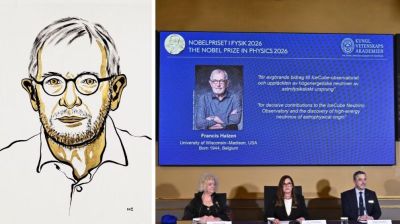
The 2026 Nobel Prize in physics was awarded to Francis Halzen, a pioneering Belgian astrophysicist whose work developing a massive observatory in Antarctica to detect “ghostly” cosmic particles laid the foundations for an “entirely new type of astronomy.”
These tiny, high-energy particles from space, known as neutrinos, transmit information which allow scientists to better understand distant galaxies and exploding stars, said Nobel committee member Eva Olsson at the award presentation on Tuesday at the Royal Swedish Academy of Sciences in Stockholm.
The Royal Swedish Academy of Sciences said "his vision and scientific leadership have been fundamental for the IceCube Neutrino Observatory".
Halzen, 82, who received the news while travelling in Italy, said he was working on a new proposal and hoped that winning the prize would help in getting it approved.
The neutrino interactions collected by the IceCube observatory in Antarctica provide information about how high-energy neutrinos are created and may even reveal previously unknown phenomena, the Academy said.
In 2014, the US-based Smithsonian magazine dubbed Halzen "Neutrino Man" when giving him one of its Ingenuity Awards, acclaiming him for an "amazing experiment (that) heralds the beginning of a new era in astronomy".
It even published a comic illustrating his life: "How One Physicist’s Pursuit of the Cosmos Took Off in Antarctica".
The particle detector is set in a cubic kilometre of pristine Antarctic ice, which extends to a depth of 2,500 metres below the surface, near the Amundsen-Scott South Pole Station.
The observatory searches for the nearly massless high-energy neutrinos in the hope of tracing their paths back to exploding stars, gamma-ray bursts, and cataclysmic phenomena involving black holes and neutron stars. It can expect to register about one per day.