


 For all latest news, follow the Daily Sun's Google News channel.


Govt plans 70MW solar power plant on unused Matarbari land
Daily Sun Report, Dhaka
Published: 02 Nov 2026, 12:00 AM
The government plans to set up a 70-megawatt (MW) grid-connected solar power plant on 171 acres of unused land within the Matarbari coal-fired power plant complex in Maheshkhali, Cox’s Bazar, with the project targeted for completion by 2028.
A Development Project Proposal (DPP) for the project has been sent to the Planning Commission for consideration, Coal Power Generation Company Bangladesh Limited (CPGCBL) Managing Director Md Nazmul Haque told the media on Sunday.
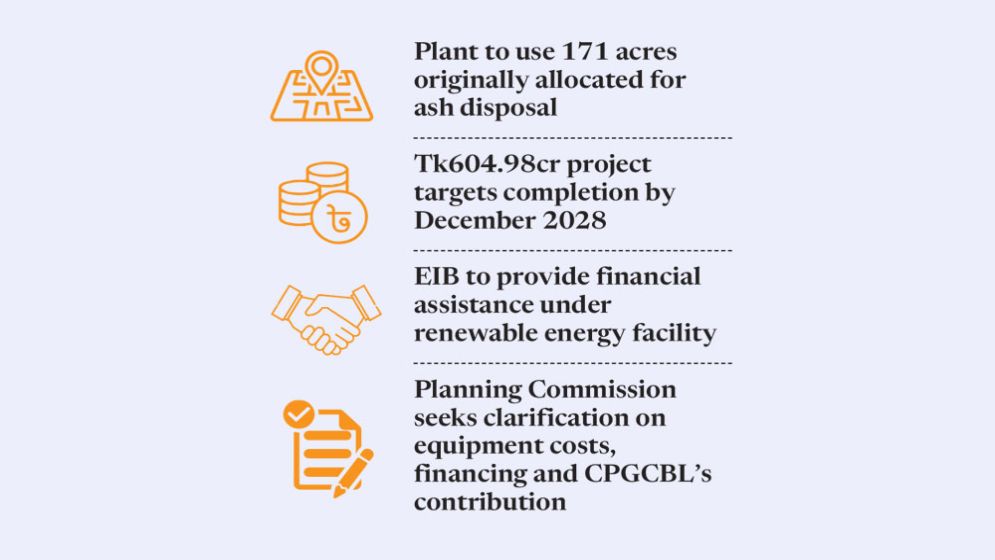
The proposed plant will be built within the premises of the 2x600MW Matarbari ultra-supercritical coal-fired power plant, using land originally allocated for ash disposal but left unused.
According to the draft DPP prepared for a meeting of the Planning Commission’s Project Evaluation Committee (PEC), the project is scheduled to run until 31 December 2028, at an estimated cost of Tk604.98 crore.
Of the total cost, Tk42.87 crore will come from the government, Tk532.39 crore from project financing and Tk29.71 crore from the implementing agency’s own resources.
A Planning Commission official said the proposed project was in line with the government’s electoral commitments to expand renewable energy. The European Investment Bank (EIB) will provide financial assistance under its Bangladesh Renewable Energy Facility framework loan, which includes 350 million euros in loans and 45 million euros in grants.
The official said the project would supply additional electricity to the national grid, reduce reliance on fossil fuels and cut carbon emissions, helping strengthen long-term energy security and support a more sustainable power system.
Project documents show that the coal-fired power plant authority initially allocated around 630 acres for ash disposal but eventually built an ash pond on only 105 acres, leaving the remaining 525 acres unused.
The proposed solar plant will use part of this unused land, avoiding the need for fresh land acquisition.
The existing 14-metre-high embankment around the ash pond will also eliminate the need to build a separate protective embankment for the project.
The project will involve installing solar photovoltaic (PV) modules, inverters and associated equipment. It will also include a one-kilometre, 132-kilovolt overhead transmission line to connect the plant to the nearby Matarbari 132/33kV grid substation. In addition, a second-circuit overhead conductor spanning 17.5 kilometres will be installed between the Matarbari and Chakaria 132/33kV grid substations. Four 132kV air-insulated switchgear (AIS) bays will also be constructed — three at Matarbari and one at Chakaria.
Project authorities expect the nearby Matarbari deep-sea port to facilitate the unloading and transportation of imported equipment.
A feasibility study completed in February 2026 recommended increasing the proposed plant’s capacity from the initially considered 50MW to 70MW.
Planning Commission Joint Chief of the Power Wing Mohammad Ashraful Islam told the media that a PEC meeting to examine the draft proposal would be held soon.
He said the project was consistent with the government’s electoral manifesto and would help fulfil its commitments. The project also aligns with Sustainable Development Goal 7, which seeks to ensure access to affordable, reliable, sustainable and modern energy for all.
The Renewable Energy Policy 2025 sets a target of meeting 20% of the country’s total electricity demand from renewable sources by 2030 and 30% by 2040.
According to the Planning Commission’s assessment, Bangladesh has an installed power generation capacity of 32,688MW, including captive and renewable sources. Renewable energy accounts for 1,934.54MW, or 5.91%, of the total capacity. However, the Planning Commission has raised several issues that need to be addressed before the proposal is finalised. These include a comparative analysis of the proposed prices of major equipment against those in similar ongoing or completed projects, prior approval from the Finance Division for the proposed financing structure, and an increase in the implementing agency’s own contribution. The Commission observed that although the project appears financially viable, CPGCBL has proposed contributing only Tk29.71 crore, representing 4.91% of the total cost.
The PEC meeting will also examine the quality and prevailing market prices of solar PV modules and inverters, as well as the justification for allocating Tk36.50 lakh for vehicles, office equipment and furniture. The Commission has also asked the agency to specify the number of motorcycles required rather than listing them in lots.
In addition, the Planning Commission has sought detailed information on the country’s public and private power generation capacities, renewable energy targets and existing solar power generation capacity, including a breakdown by implementing agency and location.
The proposed project has been included in the list of new, yet-to-be-approved projects under the Annual Development Programme (ADP) for FY2026-27 to facilitate foreign financing.