


 For all latest news, follow the Daily Sun's Google News channel.


Myanmar guilty of genocide against Rohingyas: ICJ
For the 1st time ever, a state held responsible for the crime
Agencies, The Hague
Published: 20 Nov 2026, 12:00 AM
Myanmar committed genocide against its Rohingya minority, the International Court of Justice (ICJ) ruled on Thursday.
It was the first time the court held a state responsible for genocide.
Gambia brought the case in 2019, arguing that Myanmar’s military offensive that drove at least 730,000 Muslim Rohingya from Buddhist-majority Myanmar amounted to genocide.
“The court finds that Myanmar’s security forces killed thousands of Rohingya civilians, perpetrated widespread acts of sexual violence as well as acts of extreme violence against children and attacked fleeing Rohingya as they sought to flee in large numbers to Bangladesh,” said ICJ President Yuji Iwasawa.
Iwasawa also said the actions by Myanmar’s security forces showed the “intention to destroy” a substantial part of the Muslim minority population, meeting the legal threshold for genocide.
“Myanmar is under an obligation to compensate the Rohingya group and its members for the damage caused by the violations of its obligations... in so far as such damage is not made good by restitution,” added the ICJ president.
Judges voted by 9 votes to 6 that the state of Myanmar was guilty.
It is only the third time in the ICJ’s history that the court has issued a judgment on a genocide case and marks the first time a state has been found guilty.
It is the fourth time since the Nazi Holocaust that an international court ruled genocide had been committed, with courts previously recognising the 1994 Rwanda genocide, the 1995 Srebrenica killings in Bosnia, and atrocities by Cambodia’s Khmer Rouge in the late 1970s as such.
The court ruled that thousands of killings and widespread sexual violence by Myanmar’s security forces against the Rohingya Muslim minority population in 2017 amounted to state-sponsored genocide.
The panel found “that the Republic of the Union of Myanmar has committed genocide against the Rohingya group in Northern Rakhine State.”
Myanmar’s government did not immediately respond to a request seeking comment.
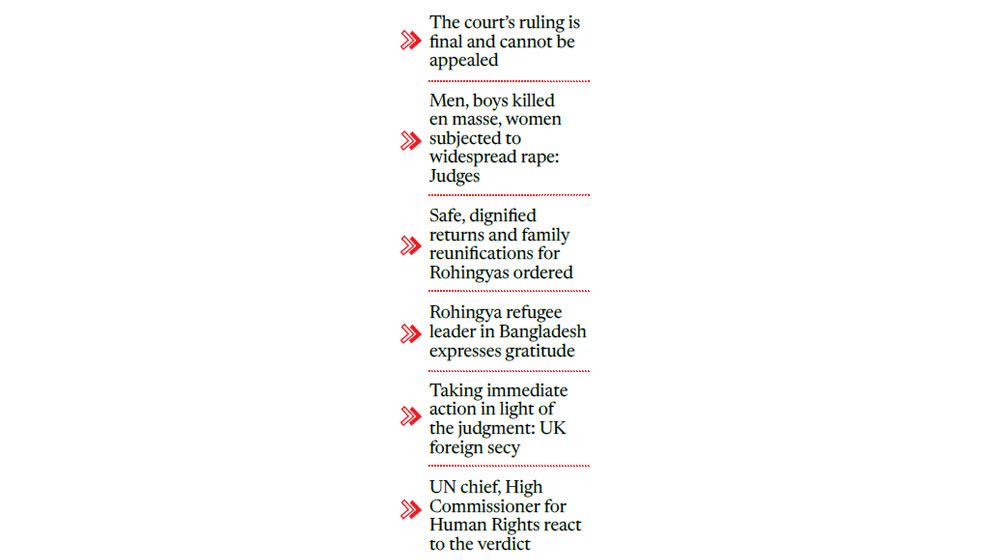
Judges found that Myanmar’s military carried out mass executions of men and boys, committed widespread rape and sexual violence against Rohingya women and burned or razed hundreds of villages during so-called clearance operations. The military actively spread hate speech targeting the Rohingya population, they said.
The court’s ruling is final and cannot be appealed.
Genocide has rarely been established in international courts, largely because prosecutors must prove a specific intent to destroy, in whole or in part, a national, ethnic, racial or religious group.
The decision by the International Court of Justice, or World Court, is expected to have repercussions far beyond Myanmar, including for South Africa’s 2023 case accusing Israel of genocide in Gaza.
The first major decision by the court in more than a decade on the application of the 1948 Genocide Convention will be pored over by legal experts for clues to how the bench assessed state responsibility in the alleged commission of international crimes.
Both Israel and Myanmar deny genocide and say their forces responded legitimately to attacks by armed groups.
In a major legal victory for Gambia, the court found the state responsible for genocide resulting from a military offensive that drove at least 700,000 Muslim Rohingya from Buddhist-majority Myanmar.
A panel of 15 judges said “the only reasonable inference that can explain Myanmar’s actions is an intention to destroy a substantial part of the protected group namely the Rohingya population in Northern Rakhine state,” meeting the legal threshold for genocide.
The court said Myanmar had an obligation to compensate the Rohingya for the violations it had committed, to be determined at a later date.
Myanmar must also allow the “safe and dignified return to their place of residence and the reunification of families for the Rohingya displaced as a result of Myanmar’s wrongful acts,” it said.
International courts previously only recognised genocide during the 1994 Rwanda genocide, the 1995 Srebrenica killings in Bosnia, and atrocities by Cambodia’s Khmer Rouge in the late 1970s.
While rulings by the ICJ, which settles disputes between states and rules on alleged breaches of international treaties, are final, the court has very limited options to enforce them.
It is distinct from the International Criminal Court, which prosecutes individuals for war crimes, crimes against humanity and genocide and can impose jail terms.
A leader of Rohingya refugees in Bangladesh expressed his “deepest gratitude” on Thursday after the International Court of Justice ruled that Myanmar committed genocide against the minority group.
“We express deepest gratitude to Bangladesh, The Gambia and the OIC (Organisation of Islamic Cooperation) who have been with us through all these years,” Sayed Ullah told AFP in Cox’s Bazar refugee camp, adding, “We request everyone to be with us till we return home.”
The International Court of Justice’s verdict Thursday that Myanmar committed genocide against the Rohingya is a victory for the community, said the justice minister from The Gambia, which brought the case.
“The victory belongs to the Rohingya. They survived. They testified. And today, they will believe,” Dawda Jallow told reporters at the Peace Palace in The Hague after the historic ruling.
UK Foreign Secretary Ed Miliband said, "We are taking immediate action today in light of this judgment. Building on existing sanctions against the Myanmar regime, we are ordering the expulsion of the Myanmar Defence Attaché from the UK and calling urgently for a UN Security Council session to discuss the judgment. We are also summoning Myanmar's Charge d'Affaires, and will set out further action in the coming days to ensure those responsible are held to account."
UN Secretary-General Antonio Guterres said, "(The case) is a demonstration of international justice and a reaffirmation that impunity for such horrific acts must not stand. It is the first time that the Court has found a State responsible for committing genocide."
"In its judgement, the Court establishes an appalling picture of the reality of this case, including killings of more than 10,000 people, rapes and extreme hardship."
"Myanmar must act in accordance with its obligation to comply with the Court’s decision."
UN Human Rights Chief Volker Türk said, "This judgment clearly concludes the State of Myanmar stands responsible for one of the most egregious crimes known to humankind."
"The suffering, misery and humiliation inflicted on the Rohingya by the Myanmar State is a stain on the conscience of humanity. I salute the courage of the victims and survivors whose horrific experiences were before the Court. I commend the States that intervened in this case."