


 For all latest news, follow the Daily Sun's Google News channel.


Govt placing health issues at the centre of national development: Muhit
He said that efforts are being intensified to address non-communicable diseases (NCDs)
Daily Sun Report, Dhaka
Published: 21 May 2026, 06:31 PM
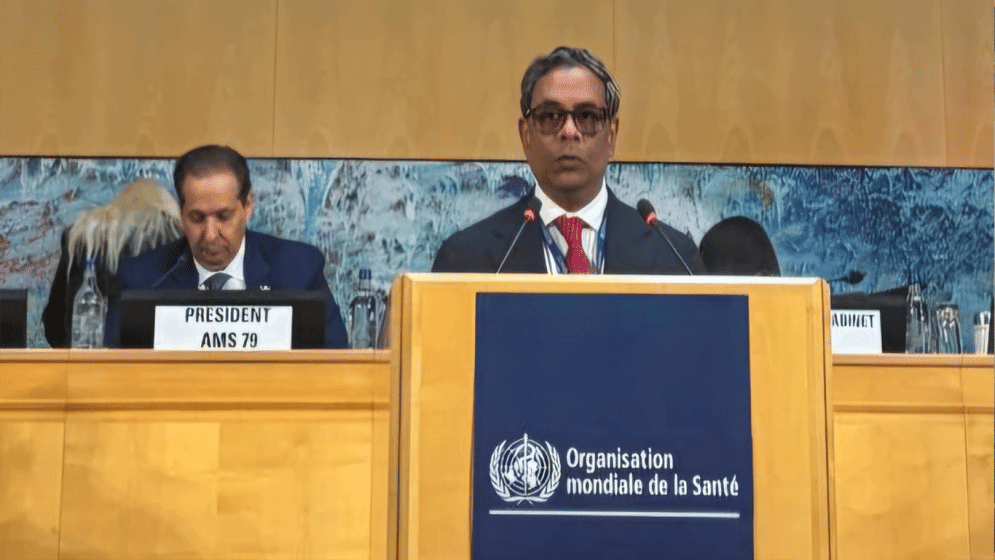
Photo: Daily Sun
State Minister for Health and Family Welfare Dr MA Muhit is leading a high-level six-member Bangladesh delegation at the 79th World Health Assembly (WHA), the world’s largest global health forum, which is currently taking place Switzerland’s Geneva.
In his speech at the event, Muhit said that the new
government of Bangladesh has placed health issue at the centre of national
development. However, more than 70% of the country’s total healthcare
expenditure is still borne directly by individuals, pushing many families
towards poverty.
To address this, the government is taking steps to
increase public health funding, he added.
Confirming Muhit’s statement, the ministry officials
said that alongside the main event, the state minister for health also
participated in a high-level ministerial meeting organised by Gavi, the Vaccine
Alliance, joining health ministers from around the world to discuss global
immunisation strategies.
Outlining the ongoing national health reforms, Muhit shared that the government is actively working to expand universal healthcare access, synchronise health data across public and private sectors, and reinforce infectious disease prevention.
He said that efforts are being intensified to address non-communicable diseases (NCDs), mental health challenges, and disability-friendly services, while simultaneously scaling up community programmes to promote health awareness and healthy lifestyles.
Addressing global environmental challenges, he
expressed deep concern over the adverse health impacts of climate change on
Bangladesh. He pointed out that shifting climate patterns are rapidly altering
disease profiles, exerting massive additional pressure on the country's
existing medical infrastructure.
Furthermore, he reminded the global community that
the protracted presence of over 1.3 million forcibly displaced Myanmar
nationals (Rohingyas) continues to place an immense and disproportionate burden
on Bangladesh’s limited healthcare facilities and infrastructure.
On the global health policy front, Muhit urged world
leaders to urgently finalise a safe, transparent, accountable, and equitable “Pathogen
Access and Benefit Sharing” framework. He emphasised that the stark inequities
and systemic gaps witnessed in vaccine and treatment distribution during the
COVID-19 pandemic must never be repeated, making a robust international legal
framework a necessity for the future.
Reminding delegates of the severe impact that
shrinking global health finances, active conflicts, and ongoing humanitarian
crises have on low- and middle-income countries, he urged for the efficient and
strategic utilization of available resources.
He concluded by demanding stronger global cooperation to combat silent killers, particularly non-communicable diseases and Antimicrobial Resistance (AMR).