


 For all latest news, follow the Daily Sun's Google News channel.


KUET researchers explore fuel production from waste
BSS, Khulna
Published: 04 Oct 2026, 12:00 AM
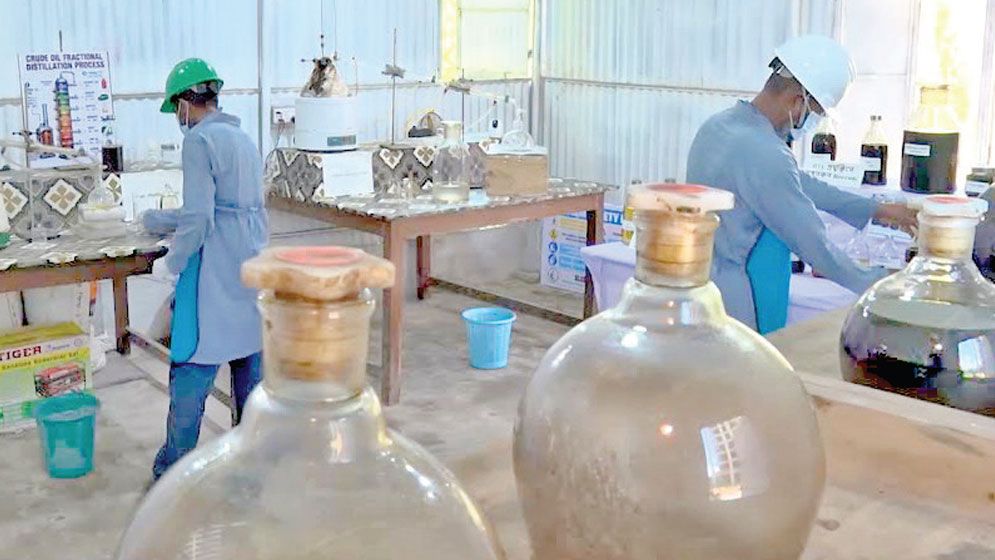
Researchers at Khulna University of Engineering and Technology (KUET) have made significant progress in producing diesel-rich bio-crude from human waste, sewage sludge and agricultural residues, raising prospects of reducing Bangladesh’s dependence on imported liquid fuels.
The research, led by Professor Dr Md Khalequzzaman of the Department of Civil Engineering, has been underway since 2016 with the participation of 13 researchers.
Initially, the researchers focused on producing petrol- and octane-range fuel-rich bio-crude from human waste and sewage treatment plant sludge. Laboratory experiments produced bio-crude with a yield of 50%-55%.
Given Bangladesh’s high dependence on imported diesel, which accounts for around 70%-75% of the country’s liquid fuel imports and requires an estimated US$3.5 billion-$4 billion in foreign exchange annually, the researchers later shifted their focus to producing diesel-rich bio-crude.
By mixing the waste with rice husk and sawdust, they have successfully produced bio-crude containing more than 50% diesel-range components, demonstrating the potential to replace a portion of imported diesel with locally produced fuel.
The research has so far resulted in more than 15 publications in international scientific journals, including Q1-ranked journals, according to the researchers. The project received initial support from the government’s Power and Energy Research Council about a year ago, which helped accelerate the experimental work.
The researchers are using Hydrothermal Liquefaction (HTL) technology, which processes wet organic waste under high temperature and pressure without requiring prior drying. The process converts the waste into bio-crude, which can subsequently be refined into usable fuels.
The researchers said the technology could potentially meet around 30% of the country’s diesel demand through domestic production, subject to successful commercial-scale implementation.
According to their estimates, establishing a commercial plant with a processing capacity of three tonnes per day would require an investment of around Tk80 crore-Tk120 crore. Commercial production could begin within a year of investment, they said.
Talking to BSS, Professor Khalequzzaman said the project had already achieved successful results, with diesel-rich components accounting for more than 50% of the produced bio-crude.
“The technology has already gained scientific acceptance, with more than 15 research papers published in Q1 journals. It has the potential to meet around 30% of our import-dependent fuel demand,” he said.
The researchers estimated that processing 25%-50% of the country’s human waste, sewage sludge and wet organic waste through the technology could replace around 10%-15% of imported crude oil, potentially saving foreign exchange equivalent to Tk 6,500 crore-Tk 13,000 crore annually, he said.