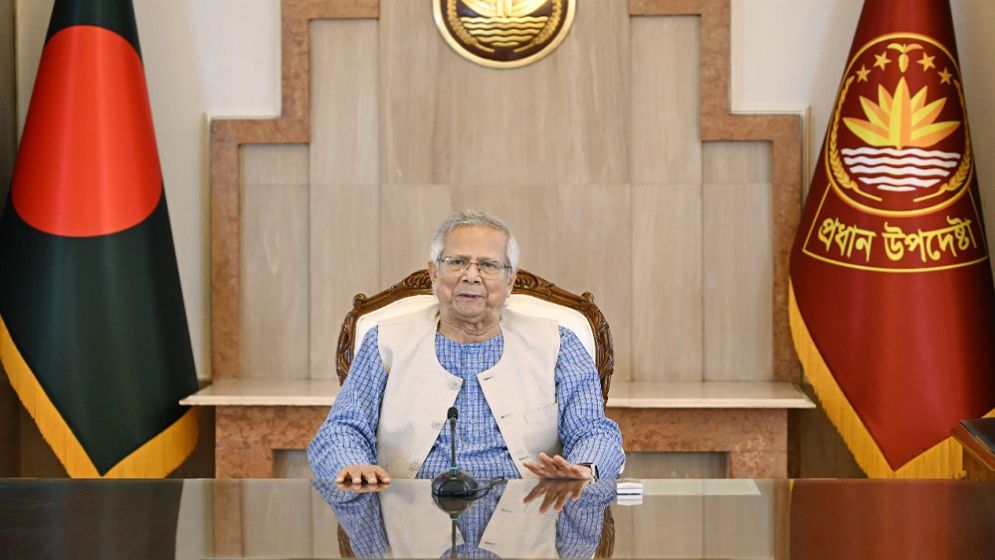
A beautiful morning does not always promise a beautiful day. Perhaps the strongest example of this is the interim government led by Muhammad Yunus.
Tomorrow, an elected government led by Tarique Rahman, chairman of the Bangladesh Nationalist Party, is set to assume responsibility for the country.
The tenure of Prof Yunus’s interim administration will end as soon as the new government is sworn in. The unelected government of civil elites will depart. While people are happy about the peaceful election on 12 February, many are even more pleased that this government is stepping down. It feels as though Bangladesh is being freed from a suffocating environment.
After the fall of the Awami League on August 5, 2024, an interim government was formed on August 8 under Prof Yunus’s leadership. It began with immense popularity and international support.
Few governments in Bangladesh’s history have received such overwhelming public backing upon taking office.
Citizens looked to Prof Yunus with hope – believing he would move the nation forward, elevate Bangladesh’s standing globally, and build a society free from inequality.
People dreamed of a corruption-free Bangladesh where citizens could speak openly, politics of vengeance would end, and the economy would gain momentum.
Bangladesh would be seen as modern, developed, and progressive. With these hopes, the public welcomed the Yunus government.
However, over the past 18 months, many Bangladeshis have become disappointed. Critics say the interim government acted contrary to public expectations. Prof Yunus failed to unite the nation; instead, divisions deepened and the country became engulfed in political hostility.
Prof Yunus, a Nobel Peace Prize laureate and internationally respected figure, was expected to act as a guardian of the nation.
Many believed he would place national interests above all else. Critics argue, however, that during his tenure he focused more on personal matters.
After assuming office, several cases against him were withdrawn. Allegations involving money laundering and labor law violations were reportedly resolved with unusual speed – a contrast that raised public questions, given how ordinary citizens often spend years navigating the courts.
During this period, large outstanding taxes of Grameen Bank were waived, and its future income was made tax-free – an unprecedented move. Government ownership in the bank was reduced from 25% to 10%. Approval was granted for Grameen University.
Through affiliated employment services, individuals connected to Prof Yunus reportedly gained access to labor markets. Grameen Telecom received permission to launch a digital wallet. A social security fund of Tk7 billion was transferred to Grameen Trust without competitive tender, drawing criticism. Allegations of corruption surfaced against advisers and key officials; critics say investigations were superficial, and some accused individuals reportedly fled abroad with government patronage.
It has also been alleged that, near the end of its tenure, the interim government entered opaque agreements, including aircraft procurement, viewed by critics as contrary to national interests.
Former Jahangirnagar University professor Anu Muhammad claimed that irregular contracts were being signed and that foreign lobbyists were effectively operating within the advisory structure. Media reports suggest some of these individuals left the country before the transfer of power.
Supporters argue these privileges might not have raised concern if public life had remained stable. Instead, many citizens describe the past 18 months as marked by fear.
Mob violence, extortion, robbery, violence against women, and youth gang activity reportedly increased, with limited effective control.
A 2026 annual report by Human Rights Watch stated that the interim government failed to stabilise law and order or deliver promised human-rights reforms following the fall of former prime minister Sheikh Hasina.
Human rights organizations expressed concern over unidentified bodies, deaths in custody, mob violence, and repeated attacks on minorities. Religious shrines and cultural sites were reportedly targeted. Incidents of violence and harassment against women also drew attention.
Ironically, at an International Women’s Day event, Prof Yunus himself called recent attacks on women deeply alarming and inconsistent with the vision of a “new Bangladesh”.
Criticism also arose over widespread murder cases filed against businesspeople, teachers, journalists, and other professionals, with claims of politically motivated charges and questionable detentions. Concerns remain over the transparency and fairness of judicial proceedings.
Economic hardship deepened. According to the Bangladesh Bureau of Statistics, inflation reached 8.58% in January, putting heavy pressure on middle- and low-income households.
The World Bank reported rising poverty rates, while the Power and Participation Research Centre estimated even higher poverty levels and increasing unemployment. Non-performing loans reportedly surged past Tk6 trillion — over one-third of total lending — according to Bangladesh Bank.
To control inflation, the government adopted contractionary monetary policies and raised interest rates, discouraging borrowing and investment. Businesses reported insecurity, legal harassment, and declining confidence. Energy shortages and high financing costs further strained the private sector, undermining economic momentum and international credibility.
Education faced disruption, with reports of campus violence and intimidation of teachers. Bangladesh’s international image reportedly weakened, with visa restrictions and strained regional relations. Sports and cultural sectors were affected by political tensions and security concerns, including canceled events and threats against artists.
Media organisations, including Bangladesh Pratidin, Kaler Kantho, Daily Sun, Prothom Alo, and The Daily Star, reportedly faced attacks, while journalists were detained or charged, raising concerns about press freedom. Critics say the government remained silent in the face of attacks on dissenting voices.
Before taking office, Prof Yunus spoke of building Bangladesh as a family and encouraging open criticism. Critics argue that reality did not match that vision. Many believe the opportunity created by the July movement was squandered and that this period would be remembered by some as a troubling chapter, even a nightmare, in Bangladesh’s history.




 For all latest news, follow the Daily Sun's Google News channel.