



 For all latest news, follow the Daily Sun's Google News channel.


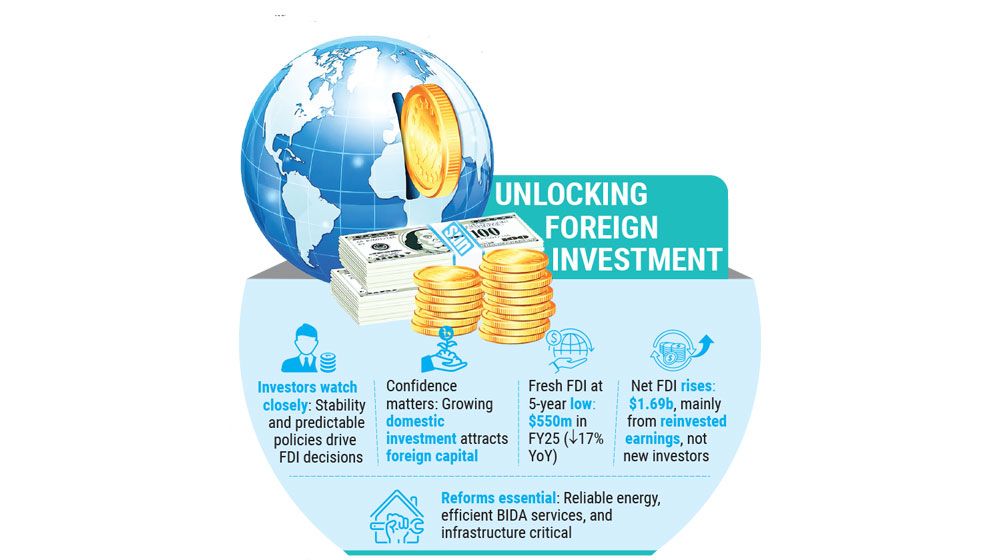
Foreign direct investment figures appear, at first glance, to be moving in the right direction.
Net FDI rose 19% in the outgoing fiscal year to US$1.69 billion, according to Bangladesh Bank data.
But beneath that headline growth lies a more sobering reality: fresh equity inflows, the clearest indicator of new investor confidence, have fallen to their lowest level in five years.
New foreign investment dropped to just $550 million in the fiscal 2024-25, nearly 17% lower than the previous year.
Even during the Covid-19 pandemic, fresh equity stood higher at $720 million. After peaking at $1.14 billion in FY22, the inflows have steadily declined.
For economists, the message is clear: Bangladesh is not yet attracting enough new long-term capital.
Headline growth, limited new capital
The recent rise in overall FDI has been driven largely by reinvested earnings and loans from parent companies rather than new equity from fresh investors.
While reinvestment signals that existing investors are staying, analysts caution that it does not reflect expanding global confidence in Bangladesh as a new destination for capital.
“Investors look at profitability and predictability,” said Dr Mustafa K Mujeri, executive director of the Institute for Inclusive Finance and Development and former chief economist of Bangladesh Bank.
According to him, foreign investors closely monitor domestic investment trends before making decisions.
“When domestic investment increases, it sends a strong signal,” he said. “Foreign investors prefer to enter markets where local entrepreneurs are confident about the future.”
Bangladesh is not alone in its pursuit of foreign investment. Across Asia and beyond, emerging economies are competing aggressively for limited pools of global capital.
“Every country is competing,” Dr Mujeri noted. “Investors will go where returns are likely and risks are manageable.”
In an increasingly volatile global economy, investment decisions are rarely short term. Most foreign investors plan on a five- to 10-year horizon.
That means they look beyond immediate incentives and assess structural conditions – policy continuity, regulatory consistency, infrastructure readiness, political stability, and institutional reliability.
Without these foundations, temporary improvements in macroeconomic indicators may not be enough to attract new entrants.
Stability is not enough
Distinguished Fellow of the Centre for Policy Dialogue (CPD), Prof Mustafizur Rahman, believes Bangladesh stands at an important juncture.
“Stability creates the opportunity,” he said. “But reforms and implementation will determine whether Bangladesh can capitalise on that opportunity.”
He pointed to persistent structural bottlenecks that continue to concern investors – particularly energy shortages and bureaucratic delays.
Reliable gas and electricity supply remain critical for industrial expansion.
He also stressed the importance of strengthening the efficiency and accessibility of the one-stop service offered by the Bangladesh Investment Development Authority (BIDA), noting that bureaucratic delays and procedural complexities continue to discourage both foreign and domestic investors.
“Policy consistency, infrastructure preparedness and efficient institutions are essential,” Prof Rahman said. “Without these, investor confidence will remain cautious.”
From conferences to commitments
Efforts have been made to re-engage global investors. In April last year, BIDA organised a four-day international investment conference aimed at restoring confidence and showcasing opportunities.
Yet the decline in fresh equity inflows suggests that promotional events alone cannot substitute for deeper reforms.
Analysts say investors are now watching whether policy pledges translate into tangible improvements in regulatory processes, dispute resolution, energy access and contract enforcement.
A critical test ahead
Bangladesh’s economy continues to grow, supported by strong domestic consumption and export performance.
But sustaining long-term growth will require higher levels of productive investment, particularly in manufacturing, infrastructure and high-value industries.
The fall in fresh FDI signals that while existing investors remain engaged, new global players are still hesitant.
Turning that hesitation into confidence will depend not merely on macroeconomic stability, but on delivering predictable policies, removing administrative barriers and strengthening institutional credibility.
For Bangladesh, the challenge is no longer just attracting capital, it is convincing the world that long-term investment here is both profitable and secure.