






 For all latest news, follow the Daily Sun's Google News channel.


No quality in education, only unchecked tuition fees
Special Correspondent, Dhaka
Published: 24 Feb 2026, 12:00 AM
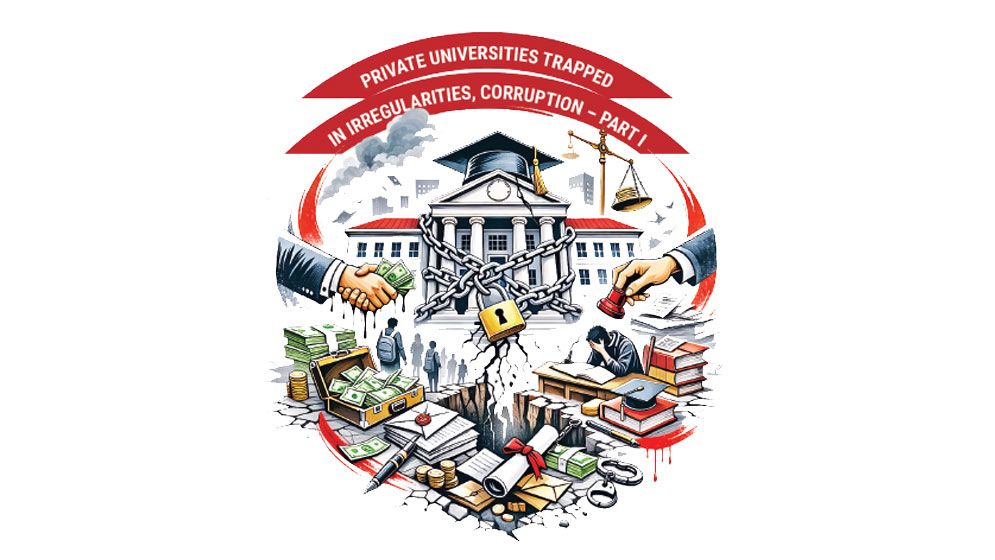
Over time, the number of private universities has risen to 117
In the 1990s, opportunities for higher education in the country were extremely limited. A handful of public universities were unable to meet the growing demand for higher education among students from upper- and middle-class families.
As a result, a significant number of aspiring students sought higher education abroad – particularly in neighbouring India, as well as in Europe and America – financing their studies independently. This led to both brain drain and a substantial outflow of foreign currency.
Considering these issues, in 1992, the government enacted a law allowing the establishment of private universities to provide opportunities for students to pursue higher education with their own funding within the country. Over time, the number of private universities has risen to 117.
However, most of these institutions lack quality. Despite not having even the minimum facilities required to qualify as universities, many of them charge exorbitantly high tuition fees. In numerous cases, there is hardly any real academic activity – these institutions are effectively selling certificates.
Within just three decades, 117 universities have been established, many of which suffer from severe shortages of qualified teachers and essential facilities. As a result, graduates from these institutions often suffer from learning deficiencies and struggle to succeed in the job market.
This skills gap is one of the major reasons behind the rising number of educated unemployed in the country.
The Board of Trustees plays the most crucial role in managing private universities. From appointing faculty and staff to determining curricula, nearly all key decisions are made by the trustees.
However, conflicts within trustee boards are common. Even in several well-known private universities, disputes among trustees have disrupted academic and research environments, causing significant suffering for students. In some cases, trustee board members have been involved in major financial scandals. Such conflicts have negatively affected the overall functioning of these institutions.
The second major crisis facing private universities is the lack of an appropriate academic environment and quality curricula. Ensuring quality higher education first requires a conducive learning environment. Except for a few reputable institutions, most private universities lack adequate facilities. Many do not have sufficient faculty members, laboratories, libraries, or permanent campuses.
Some operate in rented buildings, with departments run by only one or two lecturers. Under such circumstances, ensuring quality education is impossible. Even many well-known private universities with their own buildings lack essential facilities such as residential halls and playgrounds.
Most private universities also lack up-to-date curricula. Even when curricula are modernised, they often cannot be properly implemented due to the shortage of skilled teachers and laboratory facilities. As a result, students neither receive education aligned with current demands, nor do they get proper opportunities to develop and utilise their talents.
A significant number of private universities are constantly striving to turn themselves into profit-making enterprises. Today, not only students from upper- and upper-middle-class families but also meritorious students from lower-middle and lower-income families are enrolling in private universities.
Some families even sell their land to finance their children’s education. Sadly, many universities exploit this situation by charging excessive fees, transforming themselves into commercial ventures.
While it is natural that the cost of studying at private universities is higher than at public institutions, this does not justify charging abnormal fees far beyond actual expenses. Many institutions are collecting several times their actual costs and operating as highly profitable businesses. Their primary focus appears to be extracting money from students and depositing it in banks to earn interest.
Although there are government regulations regarding tuition fee structures, many private universities ignore them. They arbitrarily fix tuition fees, burdening students heavily. According to the Private University Act 2010, tuition fees are supposed to be determined in consideration of the country’s socio-economic conditions and reported to the University Grants Commission (UGC). However, this provision is rarely followed, and the UGC’s role appears largely passive.
Abbas, a student from Cumilla studying in the Pharmacy Department of a mid-range private university in Banani, Dhaka, shares his struggles. His father and elder brother have small jobs, and their family barely makes ends meet. Despite financial hardship, he enrolled in the private university with big dreams. However, he constantly struggles to manage expenses, tutoring others, and repeatedly requesting money from home to pay semester fees. If he fails to pay on time, he is not allowed to sit for exams.
He says he must pay Tk56,000 per semester as tuition, along with additional assignment and miscellaneous costs. His monthly living expenses amount to Tk11,000-Tk12,000. Altogether, he needs about Tk128,000 for a six-month semester and Tk256,000 annually. Yet, in India, a mid-level university charges around 20,000 rupees per semester for Pharmacy – roughly Tk30,000 in Bangladeshi currency – while maintaining a much higher standard of education.
This raises the question: why are private universities here charging such arbitrary fees?
A student from the Economics Department of a leading private university in Dhaka reports that his per-credit fee was Tk4,000 at the time of admission, which has risen to Tk5,500 over four years. Previously, a semester cost Tk50,000-Tk55,000; now it exceeds Tk70,000. With three semesters a year, tuition alone amounts to Tk210,000 annually. Adding living expenses of Tk13,000 per month, his total annual cost exceeds Tk350,000.
He says, “Our universities charge cut-throat tuition fees. There is no one to monitor them. Some may ask why we enrolled in private universities – what alternative did we have?”
The Private University Act 2010 specified how these institutions should be operated. Section 41 outlines six sources of funding, including donations, loans, grants, student fees, the university’s own income, and other sources approved by the government or the University Grants Commission.
Section 42 states that universities must prepare a fee structure consistent with the country’s socio-economic conditions and inform the UGC, which may provide advice if necessary. Section 44 also requires each university to maintain a general fund where tuition fees and other income are deposited and spent accordingly.
Despite having six possible funding sources under the law, many universities depend almost entirely on tuition fees. When asked why, a trustee of a private university said they receive no government funding and cannot secure foreign grants, so they rely solely on student fees.
However, without improving educational quality, it is impossible for these institutions to attract income from alternative sources. Unfortunately, in most cases, private universities show little interest in improving standards; instead, they prefer to impose increasing tuition burdens on students to maximise profits.
Read More