


 For all latest news, follow the Daily Sun's Google News channel.


Iran retaliates as Israel launches ‘broad-scale’ strikes on Tehran
Agencies, Tehran/Washington
Published: 07 Mar 2026, 12:00 AM
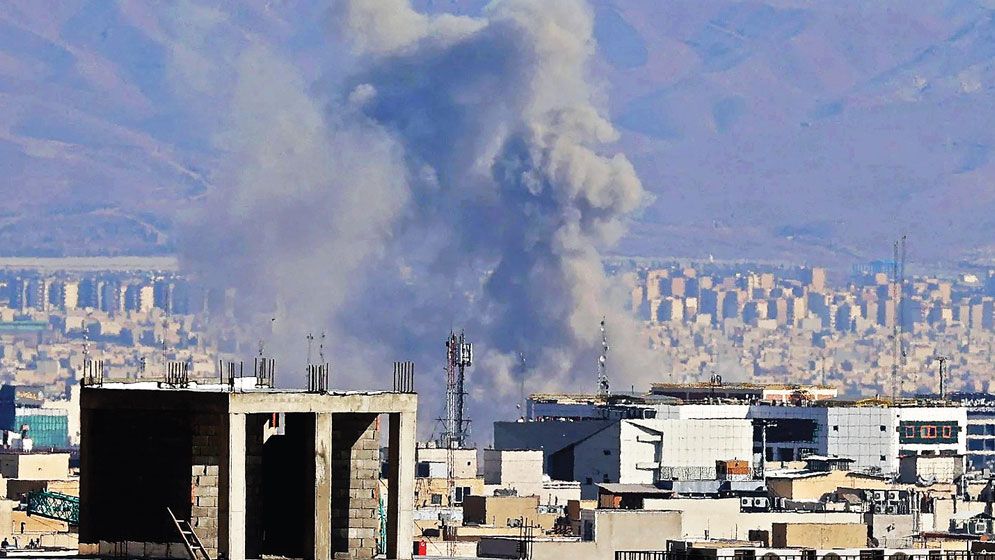
ISRAEL’S MILITARY SAYS IT HAS LAUNCHED A NEW WAVE OF STRIKES – ITS 15TH – ON IRANIAN “REGIME INFRASTRUCTURE”. - PHOTO: AFP
Israel launched a “broad wave of attacks” on Tehran on Friday, while Iran responded with missiles and drones aimed at Tel Aviv and US-linked military facilities across the Middle East, as the conflict between Iran, Israel and the United States entered its seventh day.
Israeli military officials said the strikes marked a new phase in the campaign against Iran, targeting what they described as “regime infrastructure” in the capital. Residents of Tehran reported massive explosions overnight and into Friday morning, describing the bombardment as the most intense since the war began.
Witnesses said powerful blasts shook residential districts across the city as fighter jets roared overhead. Thick plumes of smoke rose from several locations, including areas near Pasteur Street, one of Tehran’s most heavily secured districts where key government institutions are based.
The Office of the President of Iran is located in the area, which was also among the locations struck during the opening hours of the conflict last week when Iran’s Supreme Leader Ayatollah Ali Khamenei was killed in joint US-Israeli air strikes.
An Iranian military academy was also reportedly struck while a journalist from Iran’s state broadcaster was reporting live nearby.
Residents described the overnight assault as relentless. “Last night was the worst night in the war so far,” one man in Tehran told the BBC. He said his house shook continuously for several minutes as explosions echoed across the city.
Another resident said the blasts began before dawn and continued for hours. “They were hitting so hard that all the windows were shaking,” she said. “It sounded as if a dragon was roaring in the sky.”
Iranian officials said at least 20 people were killed and 30 injured when strikes hit a residential district in the Zibashahr area of Shiraz. Jalil Hasani, deputy governor of Fars province, said the victims were “innocent citizens” caught in the attack.
Iran’s Tasnim news agency reported that two paramedics were among those killed.
In western Iran, at least six people were injured when a missile strike hit residential buildings in the town of Poldokhtar in Lorestan province.
The Iranian Red Crescent Society said that more than 1,300 people had been killed across the country since the war began last weekend.
The Islamic Revolutionary Guard Corps (IRGC) said Kheibar ballistic missiles were fired towards Tel Aviv as part of the 21st phase of its “Operation True Promise 4”.
In a statement, the IRGC said the wave began with a combined missile and drone operation targeting sites “in the heart of Tel Aviv”.
Israel’s military said it had detected missiles launched from Iran and that air defence systems were operating to intercept them.
Israeli authorities did not immediately report casualties.
Iranian forces also claimed to have targeted Israeli military facilities including the Ramat David air base and a radar installation.
Meanwhile, US President Donald Trump said on Friday there would be no deal struck with Iran except “unconditional surrender,” a week after launching war with Israel against Tehran.
“After that, and the selection of a GREAT & ACCEPTABLE Leader(s), we, and many of our wonderful and very brave allies and partners, will work tirelessly to bring Iran back from the brink of destruction,” Trump said in a social media post, adding that they would work to boost Iran’s economy.
In a statement, it claimed the compound “extended beneath entire streets in central Tehran” and included meeting rooms, adding that senior government officials continued using the facility after Khamenei’s killing.
Reuters footage showed flashes and explosions lighting up the skyline as buildings were hit.
The Israeli military said it carried out 26 waves of strikes targeting Hezbollah command centres and weapons storage facilities linked to the Iran-backed militia.

“Let’s be clear: we are committed to lasting peace in the region yet we have no hesitation in defending our nation’s dignity & sovereignty,” the president wrote on X. “Mediation should address those who underestimated the Iranian people and ignited this conflict.”
US officials also said B-2 stealth bombers had dropped dozens of 2,000-pound bunker-penetrating bombs on deeply buried Iranian ballistic missile launchers.
Admiral Brad Cooper, commander of US forces in the Middle East, said the strikes were aimed at degrading Iran’s ability to launch missiles.
“We’ve also struck Iran’s equivalent of Space Command, which degrades their ability to threaten Americans,” Cooper said.
Iran’s military also said it had targeted US bases in Kuwait with drones.
Ambassador of the Bangladesh Embassy in Kuwait, Major General Syed Tarek Hussain, confirmed the death. The dead is Mohammad Jahed Hossain, 28, son of Kamal Dafadar, of the upazila’s Rahmatpur area. He had been working at a commercial establishment in Kuwait, where he had lived for several years.
News of his death reached his village home on Thursday evening, leaving relatives and neighbours in deep grief.
According to family members, he sustained critical injuries during a missile strike linked to the ongoing regional conflict and died at the scene.
Jahed was the main breadwinner of his family and regularly sent money home. His sudden death has plunged his family into mourning and cast a shadow of grief over the entire neighbourhood.
This marks the second death of a Bangladeshi expatriate from Sandwip in the recent Middle East unrest. On Sunday, Abul Mohsin, also known as Tarek, 52, from Azimpur union of Sandwip, died in an Iranian strike in Bahrain.
Besides these two, Saleh Ahmed, a Bangladeshi national from Baralekha, Sylhet, tragically lost his life in Ajman in the United Arab Emirates after being struck by debris resulting from an aerial attack on a civilian installation last week.
Azerbaijan said four Iranian drones crossed its border and injured four people in the Nakhchivan exclave. Tehran denied targeting its neighbour.
In the Indian Ocean, a US submarine reportedly sank an Iranian naval vessel near Sri Lanka during an overnight confrontation.
Iran’s Deputy Foreign Minister Saeed Khatibzadeh described the conflict as an “existential war” for his country. “This was an existential war for Iran, leaving us with no choice but to respond wherever American attacks originate from,” he said at the Raisina Dialogue conference in New Delhi.
“They’ve lost everything,” he told NBC News in a telephone interview.
However, Trump also signalled support for reshaping Iran’s leadership following the killing of Supreme Leader Ayatollah Ali Khamenei in the opening strikes of the war. He said the United States would need to play a role in determining who should lead Iran next.
“We’re going to have to choose that person along with Iran,” he said.
The council includes President Masoud Pezeshkian, judiciary chief Gholam Hossein Mohseni Ejehi and senior cleric Ayatollah Ali Reza Arafi. The Assembly of Experts, an 88-member clerical body, must formally select the new leader.
Some analysts believe a successor may already have been chosen but not publicly announced for security reasons.
Internet shutdowns have previously been used by Iranian authorities during periods of domestic unrest.
Air transport across parts of the Middle East remains heavily disrupted, while shipping and logistics routes have also been affected.
Qatar’s energy minister Saad al-Kaabi warned that prolonged conflict could severely disrupt global energy markets.
Even if the war ended immediately, he said, it could take weeks or months for energy exports to return to normal levels.
He warned that Gulf energy exporters could halt production if the conflict continued, potentially pushing oil prices towards $150 a barrel and triggering severe economic consequences worldwide.
Analysts say Russia and China have so far limited their response to diplomatic statements, calculating that direct involvement in the conflict would bring high costs and uncertain benefits.
Russia has noted that higher energy prices resulting from the conflict have increased demand for its oil and gas exports.
“The world urgently needs to see steps to contain and extinguish this blaze,” he said.
“But instead we are only seeing more bombings, more destruction and more inflammatory rhetoric.”
“We have additional surprises ahead,” he said in a televised statement.
As the war enters its second week, missile exchanges, drone attacks and air strikes continue across several countries in the Middle East.
With casualties rising, energy markets shaken and military forces mobilising across the region, diplomats warn that the conflict risks expanding into a far broader regional war with global consequences.
Recommended Stories