


 For all latest news, follow the Daily Sun's Google News channel.


Middle East tensions likely to slow foreign investment
Rising energy costs, disrupted trade routes and domestic power shortages add to investor caution, while fresh FDI hits five-year low

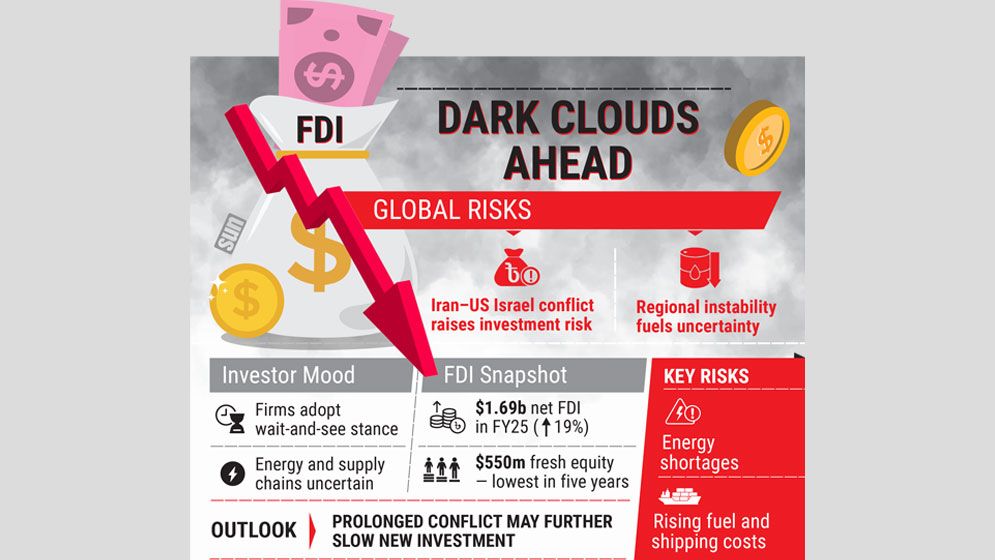
Ongoing conflict involving Iran and Israel, along with broader tensions surrounding the United States in the Middle East, are expected to further dampen foreign direct investment (FDI) inflows into Bangladesh, economists have warned.
They said the conflict has disrupted global energy supply chains, trade logistics and shipping routes, creating fresh uncertainty for investors and worsening an already fragile investment climate.
According to experts, both foreign and local investors are reluctant to make new investments while Bangladesh grapples with energy shortages, rising transport costs and unstable global markets triggered by the conflict.
Dr Mustafa K Mujeri, former chief economist of Bangladesh Bank, said the country has already been experiencing a slowdown in foreign investment since the tenure of the interim government, and the current geopolitical tensions could further discourage investors.
“Foreign and local investors want uninterrupted energy supply and efficient services. If these cannot be ensured, fresh investment will not come,” Mustafa told the Daily Sun.
He noted that industries cannot operate efficiently without stable power and gas, which remains one of the biggest barriers to investment in Bangladesh.
Mustafa added that improving governance, establishing a functional one-stop service for investors, and reducing corruption would be crucial to restoring confidence.
Echoing similar concerns, Dr Zahid Hussain, former lead economist of the World Bank’s Dhaka office, said global geopolitical tensions often lead investors to delay or reconsider investment decisions in developing economies.
“The ongoing war is disrupting global trade and shipping. Energy prices and supply chains are becoming uncertain, which affects business planning,” he said. “In such a situation, investors tend to adopt a wait-and-see approach rather than committing new capital.”
Economists highlighted Bangladesh’s vulnerability to global energy shocks due to its heavy reliance on imported fuel and raw materials.
Any disruption in shipping routes, rising freight costs, or volatility in energy prices could raise production costs and reduce the country’s competitiveness.
Recent data reflects the slowdown. Net FDI rose 19% to US$1.69 billion in the outgoing fiscal year, according to Bangladesh Bank.
However, fresh equity inflows, a key measure of new investor confidence, fell to their lowest level in five years, dropping to $550 million in the 2024-25 fiscal year, nearly 17% lower than the previous year.
For comparison, fresh inflows were around $720 million during the Covid-19 pandemic and peaked at $1.14 billion in FY22.
Economists warn that unless Bangladesh resolves its domestic energy crisis, improves trade logistics, and ensures policy stability, attracting new foreign investment will remain difficult, especially amid rising geopolitical tensions.
“If the Middle East conflict continues for a prolonged period, Bangladesh could face additional pressure on investment, trade, and energy supply in the coming months,” they said.