


 For all latest news, follow the Daily Sun's Google News channel.


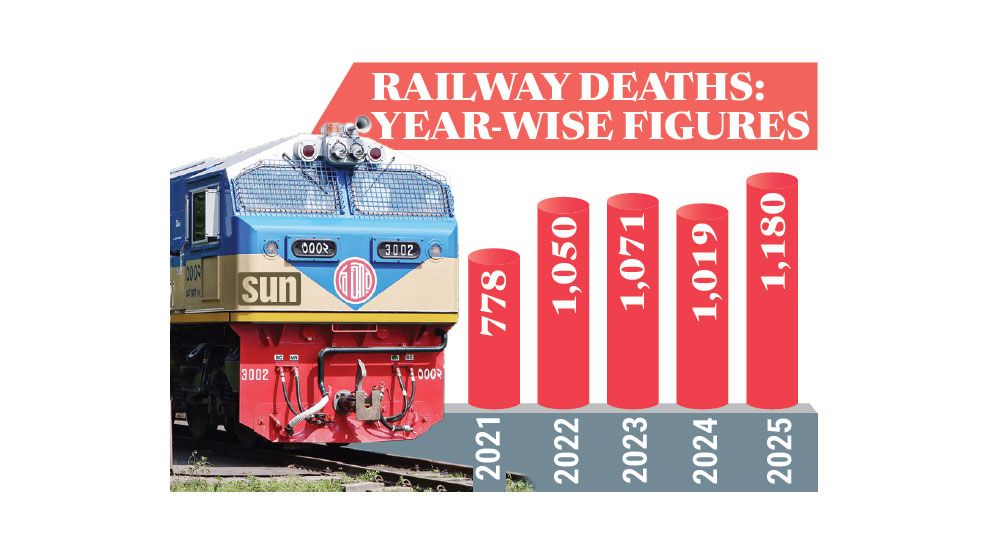
Bangladesh witnesses almost daily fatalities on its railway tracks, with accidents, suicides, and murders collectively claiming around 85 lives every month.
According to the Railway Police, a total of 5,098 bodies were recovered from rail lines across the country between 2021 and 2025, of which 5,009 cases were registered as unnatural deaths.
The statistics reveal that men are disproportionately affected, with 3,930 deaths recorded, compared with 1,168 women. Yearly figures show a rising trend: 778 deaths in 2021, 1,050 in 2022, 1,071 in 2023, 1,019 in 2024, and 1,180 in 2025. Among these, police investigations identified 25 cases as murders.
The Railway Police have traced accidental deaths to several causes: pedestrians failing to hear train whistles due to earphones, sitting or walking carelessly on tracks, rushing across rail lines, and falling from moving train rooftops.
Officers also note that the majority of victims are so severely mutilated under train wheels that identification is often impossible, resulting in unclaimed burials.
Suicides make up a significant portion of these deaths, followed by disguised murders. Sources within the police attribute the overall rise in fatalities to unprotected railway crossings, public negligence, and administrative mismanagement.
Under the Railway Act of 1890, Section 144 prohibits anyone from entering within 10 feet of the railway lines at any time, with violators subject to arrest.
Even cattle grazing within the boundary can be seized and auctioned, with proceeds deposited into the government treasury. However, officials acknowledge that enforcement is practically impossible due to the country’s dense population.
“It is never possible for the railway police to guard the entire railway line. Moreover, the entire railway line is open. There are no fences or walls. Ninety-eight percent of the more than 3,200 km of railway is in darkness at night. Many areas are deserted. Criminals choose these dark and deserted areas to hide bodies. For this reason, it is necessary to install CCTV cameras along the lines to reduce such crimes,” an officer of the Railway Police said.
Md Shah Alam, former chief of the Railway Police, emphasised the need for specialised investigations. “Deaths on the rail lines should be investigated by officers trained in homicidal crimes. Every police station should have a team for such cases; otherwise, investigations by traditionally trained officers may risk suppression of evidence,” he told the Daily Sun.
The retired additional inspector general highlighted a digital solution: the “CDMS++” app. “Most deaths on the rail lines cannot be identified due to the condition of the bodies. Families file GDs when someone goes missing. If photos of missing persons are uploaded to the app, and then matched with the 32 photos snapped at the scene, police can identify the deceased. Once identified, the cause of death can be determined more easily,” he explained.
Addl DIG (Crime and Operations) of the Railway Police Md Tofayel Ahmed confirmed the ongoing investigations, “Deaths occur on the railways for various reasons. Unnatural death (UD) cases are filed for every death, and investigations are carried out accordingly.”