



 For all latest news, follow the Daily Sun's Google News channel.


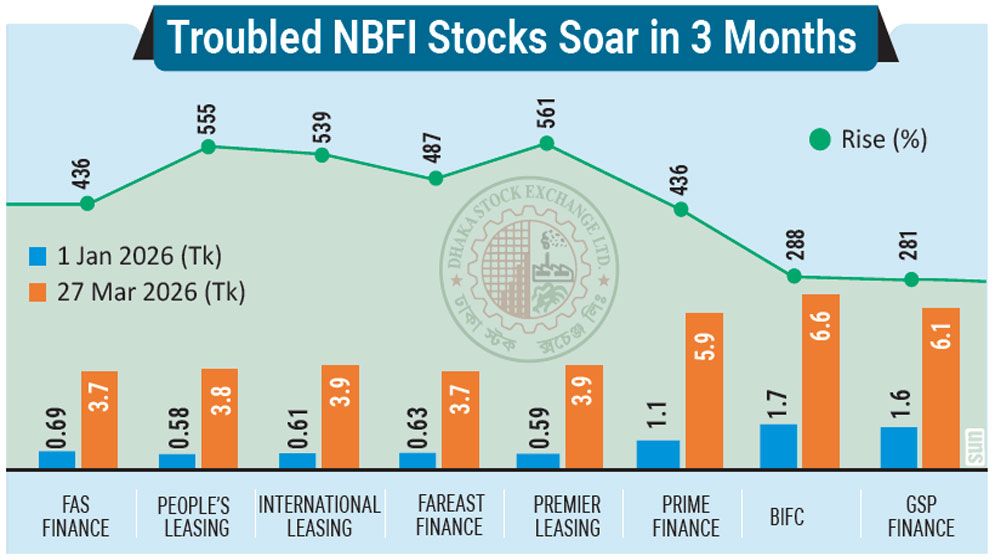
Investing in several listed non-bank financial institutions (NBFIs) in the capital market has recently yielded extraordinary returns, despite their severely weakened financial conditions and poor fundamentals.
Many of these institutions are struggling with extreme levels of defaulted loans and have failed to repay depositors. Their financial health has deteriorated to such an extent that Bangladesh Bank had previously initiated steps to shut them down.
The central bank had identified nine such institutions: FAS Finance, Bangladesh Industrial Finance Company (BIFC), Premier Leasing, Fareast Finance, GSP Finance, Prime Finance, Aviva Finance, People’s Leasing, and International Leasing. Due to prolonged irregularities and weak management, their default loan rates range between 75% and 98%.
Except for Aviva Finance, all are listed on the stock market. Between January and March, the share prices of these eight listed firms surged by more than 500%, prompting investors to liken them to “Aladdin’s lamp.”
Responding to concerns about possible manipulation, BSEC spokesperson Abul Kalam said the price movements followed market rules.
He noted that while surveillance systems can detect insider trading or irregularities, no such evidence has yet been identified.
A case in point is FAS Finance & Investment Limited, whose share price rose from Tk0.69 on 1 January to Tk3.70 by 25 March. This sharp increase illustrates the scale of gains investors could make within a short period.
For example, an investment of Tk10 lakh in mid-January, at a price of Tk0.69 per share, would have been worth around Tk37 lakh within three months, generating a profit of over Tk30 lakh.
Market participants, however, view such abnormal gains as a sign of possible manipulation.
Mizanur Rahman, president of the Bangladesh Investors Unity Council, said the dramatic rise in the shares of institutions once marked for closure raises serious concerns.
“Such evidence does not even require surveillance to indicate manipulation,” he said.
He warned investors against chasing rising prices, cautioning that these stocks could soon result in significant losses.
In May last year, Bangladesh Bank issued notices to 20 NBFIs, asking why they should not be shut down due to high default loans and failure to return deposits.
Of these, nine were shortlisted for closure after failing to provide credible recovery plans.
However, on 28 January this year, three institutions – GSP Finance, Prime Finance, and BIFC – were removed from the closure list.
ICB Chairman Abu Ahmed said share prices began rising after this decision by former governor Dr Ahsan H Mansur.
Still, he described the magnitude of the increase as abnormal and called for an investigation into the trading activity behind the surge.
Within just 78 days, from 1 January to 27 March, 2026, share prices of these companies multiplied several times over.
Market insiders said that prices had earlier fallen below Tk1 following regulatory moves to shut down failing institutions.
However, subsequent political developments, including national elections and the resignation of the central bank governor, fuelled speculation, triggering a sharp rally.
According to market data, People’s Leasing and Financial Services rose by 555.17%, International Leasing by 539.34%, Fareast Finance by 487.30%, and Premier Leasing by 561.02%. Prime Finance gained 436.36%, BIFC rose 288.24%, and GSP Finance increased 281.25%.
Meanwhile, a total of Tk15,370 crore in deposits remains stuck in these nine institutions, according to central bank data.
Of this, Tk3,525 crore belongs to individual depositors, while Tk11,845 crore is held by banks and corporate entities.
Among individual depositors, the largest exposure is in People’s Leasing (Tk1,405 crore), followed by Aviva Finance (Tk809 crore), International Leasing (Tk645 crore), Prime Finance (Tk328 crore), and FAS Finance (Tk105 crore).
These nine institutions together account for 52% of total defaulted loans in the financial institution sector. By the end of last year, their combined defaulted loans stood at Tk25,089 crore.