



 For all latest news, follow the Daily Sun's Google News channel.


The events of 1/11 have come back into focus as law enforcers step up action against key figures linked to the 2007 military-backed caretaker government.
The recent arrests have also led many victims to speak out about alleged repression and its lasting impact on the economy.
In January 2007, a general election was scheduled for the 22nd. Campaigning was in full swing. The situation changed suddenly when the Awami League-led grand alliance boycotted the polls. This led to the formation of a military-backed caretaker government led by Fakhruddin Ahmed on 11 January, widely known as “1/11”.
Years later, the issue has resurfaced. People from different sectors now started describing “harassment, detention and intimidation during 2007 and 2008”.
Business leaders say the period created deep fear. They claim arbitrary arrests and interrogations shook confidence among entrepreneurs. Many avoided new investments. Expansion plans were halted.
Industry insiders say private investment dropped sharply during that time. Both local and foreign investors pulled back. Industrial growth slowed as capital flow declined. Business operations were disrupted. Demand also weakened.
The labour market felt the impact. Formal jobs declined. Informal work increased across sectors.
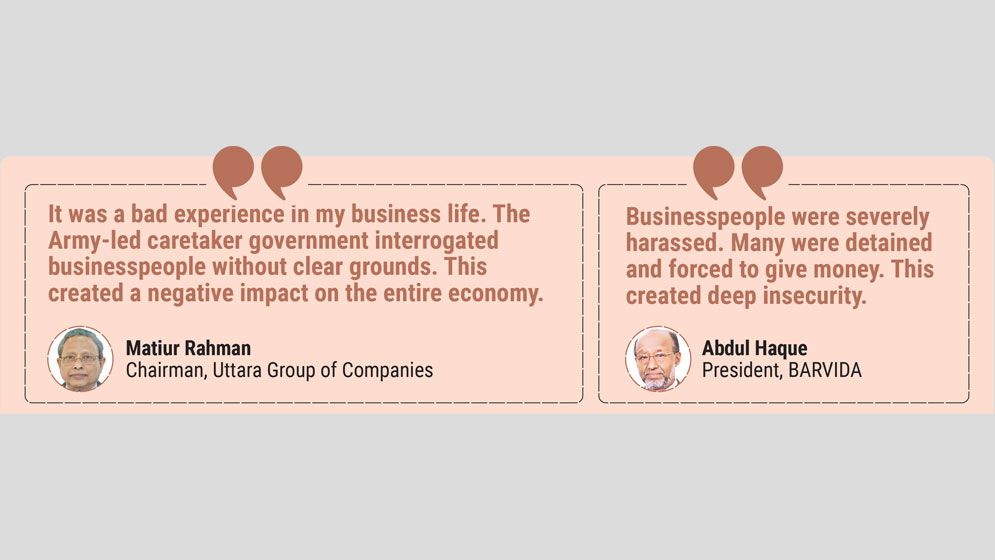
Chairman of Uttara Group of Companies Matiur Rahman said he was interrogated over alleged political links. “It was a bad experience in my business life. The Army-led caretaker government interrogated businesspeople without clear grounds. This created a negative impact on the entire economy,” he told the Daily Sun.
He said authorities should have acted on specific allegations instead of taking broad action. He believes the steps were driven by other motives.
Abdul Haque, president of the Bangladesh Reconditioned Vehicles Importers and Dealers Association (BARVIDA), said the damage was long-term. “Businesspeople were severely harassed. Many were detained and forced to give money. This created deep insecurity.”
Abdul, also a former president of the Japan-Bangladesh Chamber of Commerce and Industry (JBCCI), said the arrests of major businesspersons hurt confidence. Investment fell. Job creation slowed.
He urged the current government to ensure accountability and rebuild trust. He said a business-friendly environment is essential. Corruption and extortion must be controlled. Genuine entrepreneurs should get support.
Some business leaders still fear speaking openly. The managing director of a group of companies, who did not want to be named, said he remained cautious about sharing his experience.
Police sources say a list of about 113 individuals has been prepared. The list includes retired Army officers, bureaucrats, businesspeople, politicians and former law enforcement officials linked to 1/11.
The Detective Branch of Dhaka Metropolitan Police has been assigned to arrest them. The listed individuals are under surveillance. Immigration authorities have been alerted to stop them from leaving the country.
Efforts are also underway to trace those abroad. Police have contacted Interpol for information on several individuals believed to be in the United States, Australia and the United Kingdom.
So far, former lieutenant general Masud Uddin Chowdhury, former DGFI chief Sheikh Mamun Khaled and former DGFI director Lt Col Md Afzal Naser have been arrested. Investigators say they have gathered some information about key planners.
A senior police officer said the investigation faces challenges. Many officers handling the case are too junior to know the events of that time. “Senior officers with experience from that period would be more effective in questioning.”
As the investigation continues, the renewed focus on 1/11 is raising old questions. Issues of accountability, governance and economic damage are once again at the centre of public debate.
Read More