



 For all latest news, follow the Daily Sun's Google News channel.


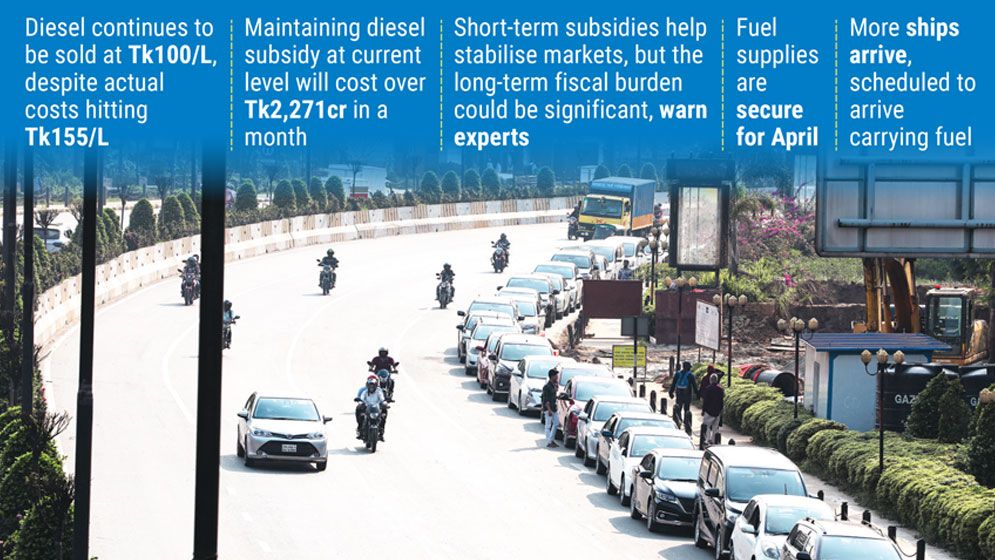
A long queue of cars stretches for hundreds of metres along Airport Road on Monday as ongoing fuel shortages leave commuters waiting for hours to stock up, while the opposite part of the road remains nearly empty amid the crisis. -kamrul islam ratan
The government is providing substantial daily subsidies on diesel sales – amounting to nearly Tk75.71 crore – to maintain fuel price stability and curb inflation, officials said on Monday.
The subsidy, part of a broader policy to shield domestic markets from global fuel price volatility, ensures that diesel continues to be sold at Tk100 per litre, despite actual costs reaching approximately Tk155 per litre.
Analysts warn that while short-term subsidies help stabilise markets, the long-term fiscal burden could be significant.
According to Bangladesh Petroleum Corporation (BPC), total fuel sales on Sunday reached 16,038 tonnes, of which diesel accounted for 11,608 tonnes. Using BPC’s standard conversion of one tonne equaling 1,186 litres, the daily subsidy for diesel alone is estimated at Tk75.71 crore. If maintained at this level, monthly diesel subsidies could exceed Tk2,271 crore.
Other fuel sales reported by BPC include 1,164 tonnes of octane, 1,305 tonnes of petrol, 125 tonnes of furnace oil, 1,631 tonnes of jet fuel, and 205 tonnes of kerosene. Marine fuel sales were not recorded on the day.
Energy expert Prof M Tamim said that the government can provide short-term fuel subsidies for a month or two. However, if the conflict situation persists, price adjustments may become unavoidable.
He emphasised that despite economic pressures, subsidies for the current month of April are necessary, and future decisions will depend on global developments. He also noted that Bangladesh is not alone as every country in the world is currently under pressure regarding energy supply, and expressed hope that the situation will stabilize somewhat this month.
Joint Secretary of the Ministry of Power, Energy and Mineral Resources, Monir Hossain Chowdhury, said that, “The government provides subsidies to ensure that domestic supply remains uninterrupted and prices stay stable.”
He emphasised that fuel supplies are secure through April, with incoming shipments expected to arrive soon to support May demand. “There is no reason for panic. Diesel, petrol, and octane supplies are sufficient for the coming weeks,” he added.
Experts note that diesel price hikes directly impact agriculture, transport, and electricity generation, eventually increasing the cost of consumer goods. In this context, the government has opted to maintain subsidies rather than passing price increases to consumers.
Rising domestic fuel demand
Data indicates that national fuel consumption has grown from approximately 5.5 million tonnes in 2019-20 to over 7 million tonnes currently.
Diesel accounts for roughly 70% of total fuel consumption, with the remainder comprised of petrol, octane, kerosene, furnace oil, and jet fuel. Nearly 92% of the country’s fuel is imported, with the remaining 8% sourced domestically, primarily from processed gas condensate.
Monir Hossain Chowdhury told the Daily Sun that 40% of octane supply is imported directly, while of the remaining 60%, 20% is produced from domestic feed, and of the remaining 40%, some is sourced from local ERL facilities, while some raw materials are imported and processed.
“In the case of petrol, production is 100% domestic. However, even though it is produced locally, 60% of the total supply relies on imported raw materials, and the remaining 40% comes from domestic production. In the case of diesel, 100% has to be imported from abroad,” he mentioned.
He said, “We do produce fuel domestically, but due to some dependence on imported raw materials, the supply system is maintained through a combination of imports and local production.”
“The government is closely monitoring the situation and has taken all necessary measures to ensure stable supply,” he added.
To ensure the country’s energy security, four large fuel-carrying vessels transporting liquefied petroleum gas (LPG) and gas oil have arrived at Chattogram port and are being unloaded at high priority.
According to a report released yesterday by the port authority’s Marine Department, these ships have come from various countries, including the Gulf region, and have now anchored at Chattogram for discharge.
The unloading process is underway to maintain a smooth and uninterrupted fuel supply for electricity generation and industrial use.
The incoming vessels include Gas Challenger from India carrying LPG, which arrived at the port on 31 March and is currently stationed at the Bhatiaree area; Shan Gang Fa Xian from Malaysia carrying gas oil, which arrived on 3 April and is presently at the jetty, with its cargo expected to be fully unloaded by Tuesday; Cool Voyager from Nigeria transporting liquefied natural gas (LNG), which arrived on 5 April and is now at the LNG terminal, with operations anticipated to be completed by 8 April; and Gas Journey from China carrying LPG, which also arrived on 5 April.
Chattogram Port Authority Secretary Syed Refayet Hamim said that the unloading of these vessels is being prioritised to keep domestic fuel supply stable and ensure uninterrupted electricity generation. He further assured that all cargo from the four ships would be fully discharged within the scheduled timeframe.
Public response and market pressure
Despite adequate supplies, long queues at filling stations across Dhaka – including Bijoy Sarani, Asad Gate, and Khilkhet – are common, with motorists sometimes waiting four to five hours. The high demand is largely driven by public anxiety rather than an actual shortage. Filling station operators report that while diesel previously lasted two days at pumps, it now runs out within three to four hours due to panic buying.
Officials urge citizens to remain calm and avoid stockpiling, stressing that sufficient fuel reserves exist and that market stability is being closely monitored.
Energy expert Prof Dr Ijaz Hossain told the Daily Sun that the conflicting stories from pump owners and the BPC point to deep-seated gaps.
“Fuel is being diverted from depots to unofficial channels, exploited by hoarders and black-market networks,”
Dr Ijaz Hossain observed, noting that this creates undue pressure on both ordinary consumers and the industrial sector.
In addition, mobile court operations have been conducted across the country from March 2026 to 5 April 2026 to ensure proper management of fuel distribution.
During this period, 6,242 operations were carried out, resulting in 2,456 cases filed, with total fines amounting to Tk12,539,500 and 31 custodial sentences issued.
The operations also led to the recovery of substantial quantities of illegally hoarded fuel, including 333,157 litres of diesel, 36,405 litres of octane, and 78,894 litres of petrol, bringing the total recovered volume to 448,456 litres.
Authorities emphasise that these measures are part of ongoing efforts to maintain market stability, prevent black-market activities, and ensure uninterrupted fuel supply for consumers and industry.
Read More