


 For all latest news, follow the Daily Sun's Google News channel.


Poultry sector seeks tax relief to avert crisis
Rising costs and high taxes push Tk50,000-cr industry towards crisis, with small farmers hardest hit

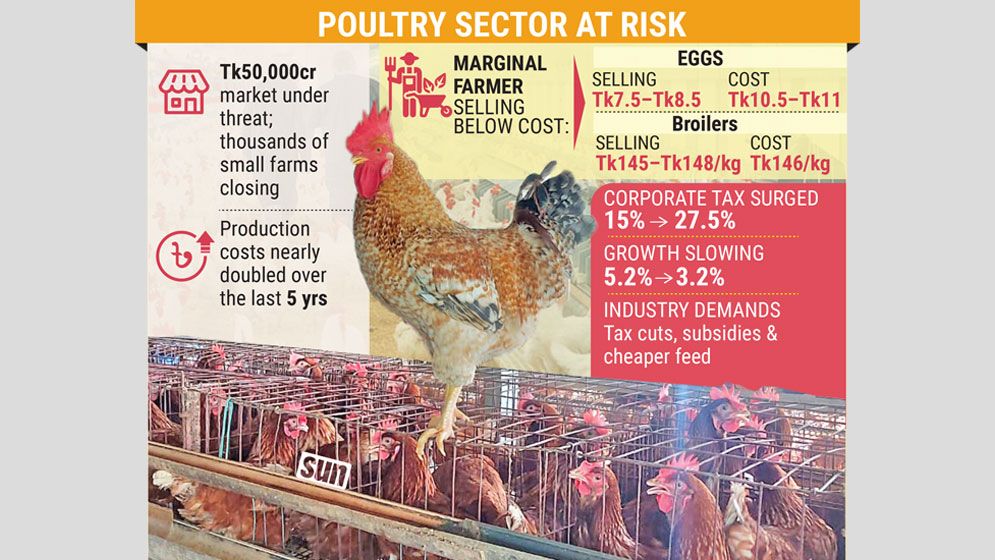
Industry leaders and analysts have called for urgent tax relief in the upcoming national budget, warning that Bangladesh’s poultry sector risks sliding into a deep crisis without immediate intervention.
They warned this could trigger higher food prices and widespread farm closures.
Valued at around Tk50,000 crore, the poultry industry has seen production costs nearly double over the past five years, driven primarily by rising feed prices and mounting tax burdens.
The sharpest increases have occurred in the current fiscal year, putting acute pressure on small and medium-scale farmers.
Producers say a widening gap between escalating costs and stagnant market prices has already forced thousands of farmers out of business, with many others operating at a loss.
Farmers estimate that producing a single egg now costs between Tk10.5 and Tk11, while wholesale prices often drop to Tk7.5-Tk8.5.
Broiler production costs have similarly risen to around Tk146 per kilogram, leaving minimal margins when wholesale prices hover between Tk145 and Tk148.
Sector insiders attribute much of the strain to recent tax increases, including a rise in corporate tax from 15% to 27.5%, alongside higher advance income tax (AIT) and turnover tax.
These measures have significantly raised the cost of key inputs, particularly poultry feed, which accounts for 75%-80% of total production expenses.
Experts note that Bangladesh imposes higher taxes on poultry and animal feed than several regional peers, including India, Pakistan, Nepal, Thailand, and Malaysia, where governments offer tax exemptions and incentives to support the sector.
“Reducing feed costs is the most critical step,” said Dr Ripon Kumar Mondal, professor of agricultural economics at Sher-e-Bangla Agricultural University. “This will not be possible without lowering import duties and taxes on feed ingredients, which are largely import-dependent.”
Industry leaders warn that without meaningful fiscal support, the sector could become increasingly dominated by large corporate players, squeezing out smallholders and reducing competition, ultimately pushing up consumer prices.
Mosharraf Hossain Chowdhury, president of the Bangladesh Poultry Industries Association, described the current tax structure as unsustainable.
“Nowhere in the world is such a high tax burden imposed on a food production sector. If this continues, small and medium farmers will not survive,” he said.
He also called for the removal of taxes on farm-level sales, stricter regulation of intermediaries, subsidised electricity, and easier access to credit.
Entrepreneurs echoed similar concerns, warning that investment could stall without policy support.
“If incentives are not provided in the next budget, new investment will stop and existing operators may exit,” said Safir Rahman, a director of a poultry breeding firm.
Data from sector associations and the Bangladesh Bureau of Statistics show that while production costs have surged, sector growth has slowed, from 5.2% in 2022 to 3.2% in 2025.
Analysts say targeted tax cuts, increased budgetary support, and broader policy reforms are essential to stabilise the industry, protect small farmers, and ensure affordable protein supply for millions.
Without swift intervention, they warn, one of the country’s most critical sources of animal protein could face long-term disruption.
Read More