



 For all latest news, follow the Daily Sun's Google News channel.


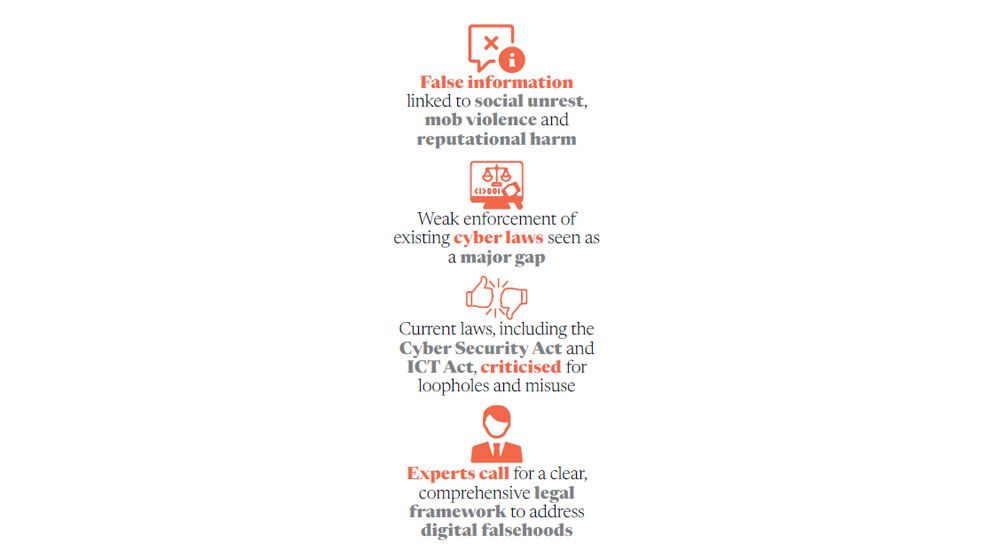
As the digital landscape continues to expand, misinformation, disinformation and misleading content are spreading at an alarming rate across the country, driven by the absence of a comprehensive legal framework and weak enforcement of existing laws.
The rapid circulation of false information and manipulated images has raised serious concerns about social stability and public safety, with current legal provisions widely regarded as either too broad or too slow to effectively address the fast-moving nature of fake news and coordinated disinformation campaigns.
Against this backdrop, experts and legal analysts say a comprehensive law is urgently needed to counter the growing threat of infodemics. “We need a specific and comprehensive legal framework that can effectively deter and punish deliberate attempts to cause harm through the spread of misinformation and disinformation,” said Advocate Muzahedul Islam Shahin, a lawyer at the Supreme Court.
He noted that while the issue is partially addressed under cyber security legislation and certain provisions of the Penal Code, these measures are insufficient to deal with the systematic spread of fake news.
Fact-checking pioneer Qadaruddin Shishir highlighted the lack of effective enforcement of the Cyber Security Act and other relevant laws, which are intended to curb the spread of false information and propaganda. However, he did not specifically call for a separate law on the issue.
He emphasised that strong legal measures must not only exist but also be properly enforced to address the problem effectively. He also stressed the importance of public awareness, urging citizens to verify the source of information before accepting or sharing news and images.
In recent years, the spread of false news, fabricated images and misleading narratives on social media platforms has contributed to incidents of communal tension, mob violence and reputational harm.
According to a report by a fact-checking organisation, misinformation and disinformation in the country’s digital and political spheres rose by around 30% in the first half of 2025 compared with the same period last year. Of 1,795 identified instances of false or misleading content, 1,125 were entirely fabricated, while the remainder were classified as misleading.
Facebook remains the largest source of misinformation and disinformation, although false content also spreads through YouTube, messaging applications, online news portals and, at times, mainstream media outlets. These channels are often exploited to manipulate public opinion, deepen divisions and advance particular agendas.
Experts believe that in today’s digital era, the proliferation of misinformation and disinformation has become a major challenge to democracy. “The spread of misinformation and propaganda is stifling democracy in Bangladesh and undermining the country’s progress towards a more open and inclusive society,” said an expert.
The country’s legal framework for addressing false and fabricated information, transitioning from the Digital Security Act 2018 to the Cyber Security Act 2023 and subsequent 2025 reforms, has been criticised for containing significant loopholes and being open to misuse. The Information and Communication Technology Act 2006, which also covers related issues, has similarly been criticised for its weaknesses and potential for abuse.
Critics argue that these laws have, at times, been used as tools to suppress dissent rather than to curb genuine disinformation. Section 57 of the ICT Act, in particular, has been widely cited for its use against journalists, activists and ordinary citizens.
They further note that existing legislation fails to adequately protect personal data or prevent excessive state surveillance under the guise of national security. In this context, experts argue that the enactment of a comprehensive and well-defined law is essential to effectively address the spread of fake news, misleading content and rumours.