




 For all latest news, follow the Daily Sun's Google News channel.


PM unveils sweeping reforms across edu, health, jobs
Daily Sun Report, Dhaka
Published: 16 Apr 2026, 12:00 AM
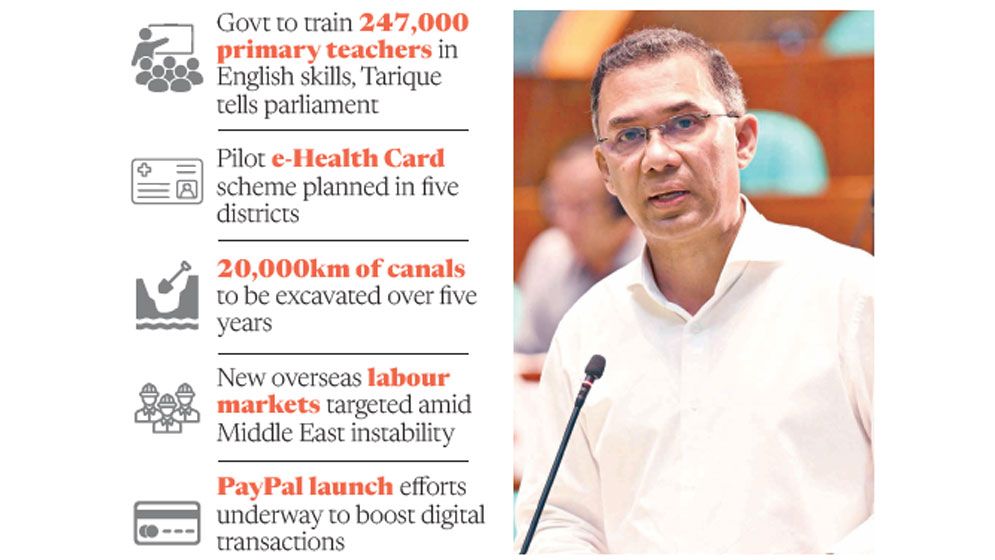
Prime Minister Tarique Rahman on Wednesday outlined an ambitious slate of reforms spanning education, healthcare, labour markets and infrastructure, signalling what he described as a “long-term, integrated development drive” aimed at strengthening Bangladesh’s economic resilience and public services.
Speaking during a question-answer session in parliament, PM Tarique set out a series of policy initiatives, including a nationwide teacher training programme, a pilot digital health scheme, expanded overseas employment strategies and a large-scale canal excavation project to support agriculture. The session, part of the 14th sitting of the first session of the 13th Parliament, was chaired by Speaker Hafiz Uddin Ahmed.
At the heart of the government’s education agenda is a five-year programme beginning on 1 July to train 247,000 primary school teachers in English.
Tarique said the initiative, under the Fifth Primary Education Development Programme, is designed to improve teaching standards and raise language proficiency nationwide.
Responding to a question from BNP MP Humam Quader Chowdhury, he noted that Bangladesh currently has 376,489 primary school teachers, of whom around 130,000 have already received English training under the ongoing Fourth Primary Education Development Programme.
The new scheme, he added, reflects the government’s manifesto commitment to bring all primary teachers under specialised training.
On healthcare, the prime minister announced plans to introduce an “e-Health Card” system on a pilot basis in five districts – Khulna, Noakhali, Bogura, Sirajganj and Narsingdi. The scheme, part of a 180-day priority programme, is awaiting final approval.
Tarique said the cards would connect patients to a digital referral and management system, streamlining access to treatment and improving record-keeping.
“Patients having the card would be linked to electronic patient referral and management systems,” he told MPs.
He added that broader efforts are underway to implement manifesto pledges through time-bound action plans.
These include the rollout of a “Family Card” scheme and a “Farmer Card” programme currently being implemented across 11 agricultural blocks in 10 districts.
In a separate update, Tarique said that under a Ministry of Religious Affairs initiative, stipends and festival allowances had already been transferred to the bank accounts of 9,102 religious workers across mosques, temples, Buddhist monasteries and churches under a pilot scheme. Plans are in place to expand the programme nationwide.
A major focus of the government’s infrastructure strategy is water management. Tarique said 1,204 kilometres of canals will be excavated or re-excavated by June this year, with a further 1,500 kilometres to be renovated under food-for-work and cash-for-work schemes.
“Our plan is to excavate and re-excavate a total of 20,000 kilometres of canals and rivers in the next five years,” he said, describing the initiative as critical for boosting agricultural productivity and mitigating flood risks.
The prime minister also highlighted environmental measures, noting that 1.5 crore saplings have already been produced as part of a broader goal to plant 25 crore trees over five years, a programme intended to create “green jobs” while enhancing climate resilience.
Turning to the digital economy, Tarique confirmed that the government is taking steps towards introducing PayPal in Bangladesh.
A committee has been formed to oversee the operation of hi-tech parks and ICT centres, alongside preparations for launching the global payment platform.
Analysts say PayPal’s entry could reduce reliance on intermediaries and improve confidence among international clients engaging with Bangladeshi freelancers and businesses.
On maritime policy, the prime minister said the government is considering establishing an institutional framework for the “blue economy” in the 2026-27 fiscal year.
The framework would coordinate marine resources, fisheries, tourism and environmental protection to ensure sustainable development.
He added that work is already underway on a Maritime Spatial Planning framework and reiterated manifesto plans to establish a National Blue Economy Authority.
“An extensive economic zone will emerge around the coastal region,” Tarique said, suggesting it would significantly strengthen the national economy.
Labour migration featured prominently in the session, particularly in light of geopolitical instability in parts of the Middle East.
Tarique said Bangladeshi missions abroad have been instructed to identify new labour markets and assess demand for specific skills.
“Bangladesh missions abroad were instructed to explore labour markets and assess profession-specific demand for Bangladeshi workers,” he said, adding that lobbyist firms are being appointed in several countries to support these efforts.
Negotiations are underway to expand employment opportunities in countries including Serbia, Greece, North Macedonia, Romania, Portugal, Brazil and Russia. The government is also seeking to reopen the Malaysian labour market and is in talks with Thailand.
Tarique said language and skills training programmes are being expanded to support overseas employment, particularly in Japan.
Japanese language instruction is now available at 53 Technical Training Centres, with plans to recruit instructors in multiple foreign languages, including Russian, Arabic, German and Italian.
He also noted efforts to retrain returning migrant workers, recognise their previous experience and provide certification to help them re-enter international labour markets.
In response to another question, the prime minister said Bangladeshi missions have been asked to assess opportunities for skilled professionals—such as doctors, engineers and bankers—in Middle Eastern countries experiencing workforce shortages due to ongoing conflicts.
On domestic infrastructure, Tarique said a committee is working to identify and develop playgrounds across the country, with plans to establish open fields of eight bighas in each union and 10 bighas in each upazila.
In the energy sector, he reported that 35 megawatts of electricity have been added to the national grid through rooftop solar and net metering schemes, part of a broader goal to generate 20% of electricity from renewable sources by 2030.
Finally, addressing employment, the prime minister confirmed plans to recruit 500,000 government workers.
The process has already begun for 2,879 positions within the Ministry of Public Administration and its affiliated bodies.
Tarique concluded by reaffirming his commitment to parliamentary engagement, describing the legislature as a platform for addressing “urgent national issues” through constructive dialogue.