






 For all latest news, follow the Daily Sun's Google News channel.


Bangladesh’s efforts to unlock critical foreign exchange support have hit a diplomatic bottleneck in Washington, with the International Monetary Fund (IMF) signalling a “wait-and-see” approach to the disbursement of a $1.3 billion loan tranche.
Despite high-level lobbying on the sidelines of the IMF-World Bank Spring Meetings, the multilateral lender has tied future funding to a “full review mission,” effectively placing Dhaka on notice over “sluggish reforms” in the banking and revenue sectors.
A 14-member delegation, led by Finance and Planning Minister Amir Khosru Mahmud Chowdhury and Bangladesh Bank Governor Dr Md Mostakur Rahman, has spent the week in the US capital attempting to secure the combined December and June installments.
However, the mood remains cautious. IMF officials indicated that while the political mandate for change is clear, the gulf between policy pledges and ground-level implementation remains too wide to bridge with rhetoric alone.
He noted that while Dhaka has been “receptive” to advice, the true test remains the execution of “ambitious reforms.”
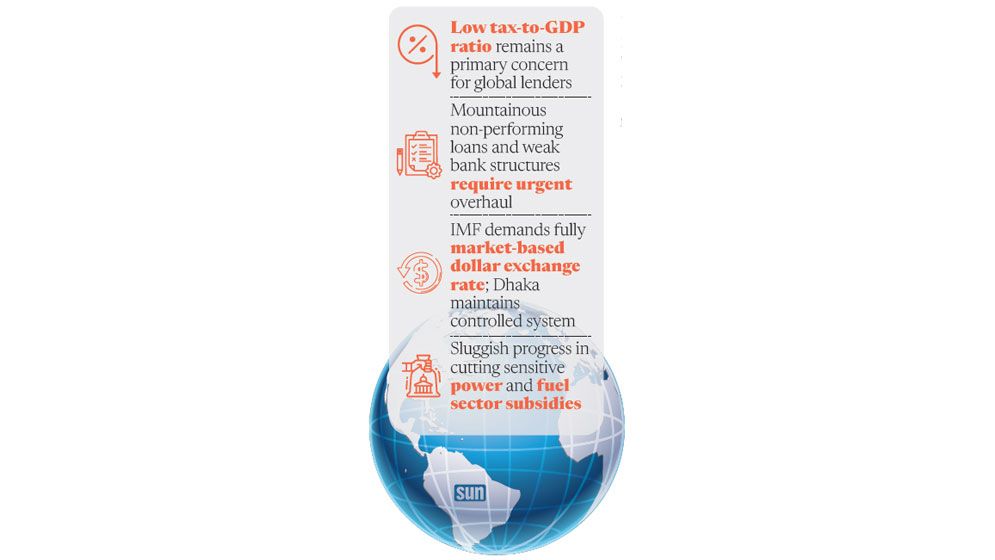
Chief among the IMF’s grievances is the chronic failure to widen the tax net. Bangladesh’s tax-to-GDP ratio remains one of the lowest globally, and structural overhauls, such as the long-promised separation of tax policy from the National Board of Revenue’s (NBR) administrative functions, have failed to materialise.
The financial sector presents an equally grim picture. Beyond the central bank’s increased oversight, there is a distinct lack of “visible progress” in tackling the mountain of non-performing loans (NPLs) or restructuring the country’s teetering insolvent banks.
The IMF continues to push for a fully market-based exchange rate for the Taka. Dhaka, however, remains wedded to a “managed” system, fearing the inflationary shockwaves of a total float.
This divergence remains a primary obstacle to the IMF’s “stamp of approval,” which is vital not only for the $5.5 billion programme but also for the $2 billion in additional budget support Dhaka is currently soliciting.
Dr Zahid Hussain, former lead economist at the World Bank’s Dhaka office, told the Daily Sun that a stalled IMF programme sends a damaging signal to other development partners.
“Pressure on foreign exchange reserves would intensify, making it harder to finance essential imports, particularly fuel,” Dr Zahid noted.
He warned that if the IMF pulls back, the government would be forced to lean on domestic borrowing, “crowding out” the private sector and stifling growth.
Dr Zahid also highlighted a potential policy trap ahead of the June budget.
“If the government presents one position in Washington but pivots to a different course during the budget, the programme could be completely stalled. Any additional financing sought thereafter will almost certainly come with far more draconian conditions.”
“If the IMF sticks to its conditions, Bangladesh may struggle to secure the next tranche or any additional financing. Crucially, it would signal a weakening of the resolve to boost domestic revenue,” he said.
With the Spring Meetings concluding today, the delegation returns to Dhaka facing a stark choice: accelerate the politically sensitive dismantling of subsidies and tax exemptions or risk an escalating balance-of-payments crisis.
For now, the IMF’s chequebook remains firmly closed.