


 For all latest news, follow the Daily Sun's Google News channel.


During pre-monsoon months, lightning becomes a deadly threat in Bangladesh, reflected in the fact that 37 people were killed in March alone.
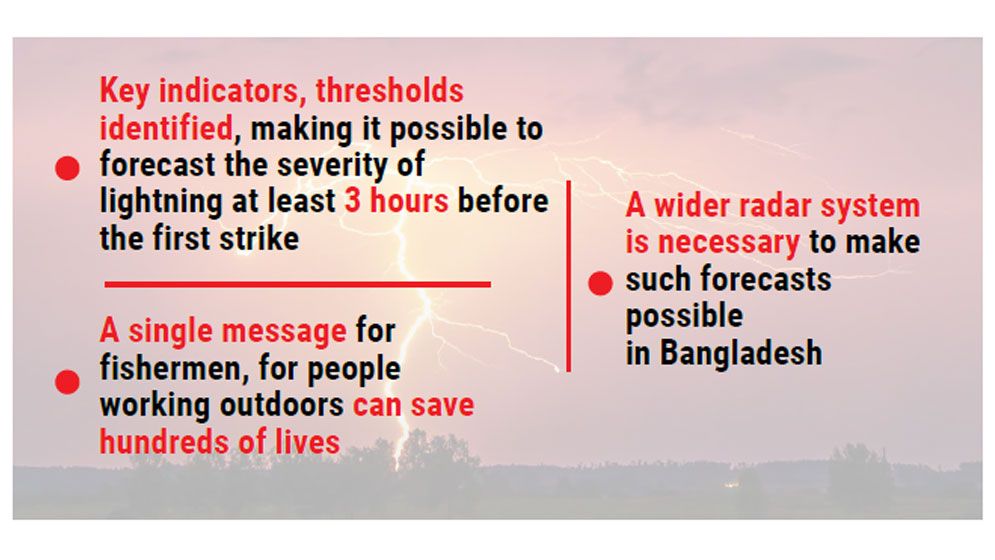
A recent research suggests that the risk of such deaths can possibly be reduced to a greater extent by analysing specific early-morning atmospheric indicators to accurately forecast the severity of lightning at least three hours before the first strike.
The study, titled “Pre-monsoon lightning in Bangladesh: Separating most from least active days with thermodynamic and synoptic composites,” was jointly conducted by Ashraf Dewan of Curtin University in Australia, M Rafiuddin and Nasreen Akter of Bangladesh University of Engineering Technology (BUET), Mohammed Sarfaraz Gani Adnan of Brunel University in London and Ronald L Holle of Holle Meteorology and Photography of Oro Valley in Arizona of the United States.
The paper was published in Atmospheric Research by Elsevier, one of the world's leading academic publishers.
A relieving measure for vulnerable people
An analysis of data on lightning fatalities from 2010 to 2016 shows that Bangladesh records 251 lightning-related deaths annually on average, with 79% occurring during the pre-monsoon months (March-June).
While most countries experience peak lightning in the afternoon, Bangladesh sees intense activity both in the morning and afternoon.
Researcher Ashraf Dewan said that the interaction between warm and moist air from the Bay of Bengal and hot and dry air from India’s Rajasthan creates a “dry line” over Bangladesh.
This is one of the factors responsible for lightning, not only in the afternoon but also in the morning.
The researchers identified a precise set of atmospheric signals that separate Bangladesh's most lightning-active days from the least – signals detectable from morning weather data alone, hours before the first strike occurs.
By comparing the 50 most active pre-monsoon lightning days against the 50 least active ones over a six-year period, they amplified these signals to their clearest form, producing what amounts to a measurable atmospheric fingerprint of a disaster, which can be used for accurate forecasts regarding thunderstorms.
“If we can develop an early warning system that can inform the general public at least three hours in advance, lightning-related deaths can be significantly reduced,” he noted.
Professor Dewan told the Daily Sun that about one in five active lightning days in Bangladesh may involve supercell-level storms, the most intense, organised, and dangerous type of thunderstorm, characterised by a deep, persistently rotating updraft, yet this risk remains largely unknown to the public.
“Lightning largely kills poor people. Measures taken till now are not in fact pro-poor,” he said.
The Bay connection
The study also helps explain a long-standing scientific question – why Bangladesh experiences peak lightning especially in the morning.
The answer lies in the Bay of Bengal. On active days, warm and moist south-westerly winds flow inland and collide with hot and dry air from Western India.
This creates a dry line – an area where thunderstorms are triggered. As this boundary is driven by large-scale atmospheric patterns rather than just daytime heating, storms can form in the morning as well as in the afternoon.
“Lightning in Bangladesh is not just a local thermal event. It is the result of a large-scale atmospheric interaction between the Bay of Bengal and the dry interior of Asia,” Dewan stated.
Researchers have identified nine specific threshold indicators that define a “safe day” profile. If early morning atmospheric data remain below these thresholds, the likelihood of severe lightning is low.
When these thresholds are exceeded – especially multiple thresholds at once – meteorologists can issue warnings. Conversely, when values remain low, farmers and fishermen may safely continue their daily activities.
A single message could save hundreds of lives
One key outcome of the research is that lightning in Bangladesh is now considered forecastable. The identified thresholds could be used in an automated SMS alert system to warn farmers, fishermen, and outdoor workers before they leave home each morning.
Such warnings could help people delay work, seek shelter, and avoid exposure—significantly reducing casualties.
Lead researcher M Rafiuddin said, “In Bangladesh, we are now seeing that cloud-to-ground lightning is increasing by nearly 50%.” Early warning systems could be an effective way to save lives.
The infrastructure gap
Despite the promise, challenges remain. Bangladesh currently has only one radiosonde station, located in Dhaka. There is no nationwide Doppler radar network capable of tracking storm development in real time. Additionally, the GLD360 lightning detection system used in the study captures only about 60% of actual lightning strikes.
Rafiuddin noted that, “Threshold values can vary every 150km, but our analysis relies on a single observational site in Dhaka.”
He added that expanding radar coverage and increasing the number of sounding stations would significantly improve forecast accuracy.
Professor Dewan also emphasised that increased human exposure is a key factor behind rising fatalities.
“If we properly use lightning data, we can reduce deaths by advising people to avoid outdoor activities during high-risk periods,” he said.
He also pointed out that while several projects have been undertaken in the past, implementation has often fallen short.
“To save lives, public awareness is just as important as technology,” he observed.
Dewan highlighted the widely used “30-30 rule” – if thunder is heard within 30 seconds of seeing lightning, people should immediately take shelter. After the last thunderclap, they should wait at least 30 minutes before going outside again.