


 For all latest news, follow the Daily Sun's Google News channel.


Fuel risks, central bank borrowing weigh on economy
Speakers warn at macroeconomic dialogue
Daily Sun Report, Dhaka
Published: 24 Apr 2026, 12:00 AM
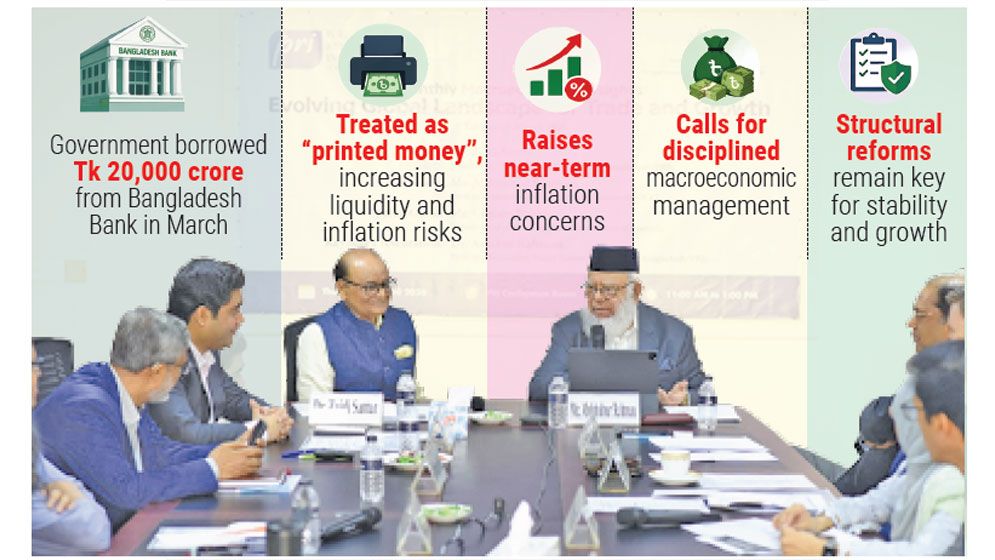
The economy is coming under increasing strain from rising fuel risks, global uncertainties and expansionary monetary measures, said economists at a dialogue.
They warned that recent central bank borrowing by the government could further stoke inflation and deepen macroeconomic vulnerabilities.
At the macroeconomic dialogue organised by the Policy Research Institute of Bangladesh (PRI), speakers expressed growing concern over the country’s economic stability amid both domestic weaknesses and external shocks.
Presenting the keynote paper titled “Evolving Global Landscape for Trade and Growth,” Dr Ashikur Rahman, a senior economist at PRI, said the government borrowed Tk20,000 crore from Bangladesh Bank in March alone, effectively injecting high-powered money into the economy.
“This is essentially printed money, which may push inflation upward,” he warned, cautioning against excessive reliance on monetary financing.
Rahman said Bangladesh’s economy is under pressure from multiple global uncertainties, including geopolitical tensions in the Middle East, policy unpredictability and the challenges of graduating from Least Developed Country (LDC) status.
“Stepping back from reforms at this stage would be self-defeating,” he said, urging authorities to remain committed to fiscal and financial sector reforms and avoid friction over the IMF programme.
He noted that although the economy has shown signs of recovery over the past 18 months, with foreign exchange reserves rising to around US$30 billion and inflation easing to 8%-9%, the recovery remains fragile.
Economic growth fell sharply to about 3% in the second quarter of the fiscal 2025-26, while the banking sector continues to struggle with nearly 30% non-performing loans. Private sector credit growth has also remained subdued at around 6%.
Rahman warned that fiscal space is nearly exhausted, forcing the government to rely on high-interest bank borrowing and central bank financing, raising long-term stability concerns.
External pressures are further complicating the outlook.
According to PRI, Bangladesh faces three major headwinds: the Middle East crisis, uncertainty over US tariff policies and its impending LDC graduation.
These factors are driving up energy costs, weakening trade flows and disrupting supply chains.
Highlighting fuel risks, Rahman said about 31% of Bangladesh’s energy imports come from the Middle East, largely passing through the vulnerable Strait of Hormuz.
Any disruption could increase the energy import bill by up to 40%, reaching $16-$17 billion, intensifying pressure on the balance of payments.
Business leaders echoed concerns over structural challenges.
Mahbubur Rahman, president of the International Chamber of Commerce, Bangladesh, said persistent gas and electricity shortages are discouraging investment.
“Entrepreneurs remain uncertain about whether they will get gas and electricity, which is slowing expansion,” he said, adding that high inflation is also raising the cost of living and squeezing households.
He also pointed to weaknesses in the banking sector, including rising non-performing loans and limited access to credit, prompting businesses to take a cautious approach to new investments.
He urged policymakers to avoid excessive money supply, cut unnecessary public spending and restore discipline in the financial sector, including considering bank mergers if needed.
Other speakers highlighted governance challenges.
Khondokar Shakhawat Ali of BRAC University warned that crony capitalism and lack of transparency are undermining the investment climate.
He cautioned that financing subsidies through excessive money creation would fuel inflation and hurt ordinary citizens, while stagnating employment is emerging as an additional concern.
PRI Chairman Dr Zaidi Sattar stressed that economic reforms should be treated as national imperatives rather than merely IMF conditions.
Failure to implement reforms, he said, would amount to “self-inflicted damage” to the economy.
He also pointed to past reform successes, suggesting that the current situation presents a similar opportunity for structural transformation.
Experts at the event concluded that Bangladesh’s macroeconomic outlook remains fragile, with external shocks feeding through energy prices, trade disruptions and financial pressures.
With limited policy buffers and growing reliance on central bank financing, they warned that disciplined macroeconomic management and accelerated reforms are essential to prevent further instability.