


 For all latest news, follow the Daily Sun's Google News channel.


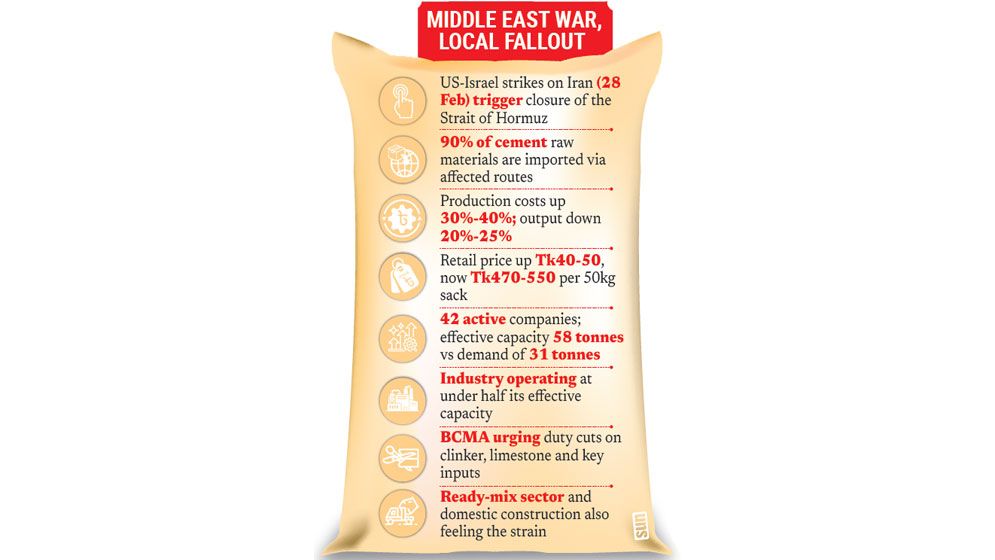
The cement industry in the country is grappling with a deepening crisis as the conflict involving the United States, Israel and Iran wreaks havoc on Middle Eastern supply routes, driving up production costs and squeezing manufacturers and consumers alike.
Industry insiders say the sector imports roughly 90% of its raw materials, including clinker, limestone, granulated slag, fly ash and gypsum, largely from the Middle East.
The crisis escalated after the US and Israel launched strikes against Iran on 28 February, prompting Tehran to close the Strait of Hormuz, the narrow waterway through which approximately 20% of the world’s oil and gas exports flow, primarily towards Asia and Europe.
Freight costs have soared as a result, compounding already elevated import expenses.
Weak domestic demand, meanwhile, has left producers unable to pass those costs on to buyers, trapping the industry between rising inputs and a fragile market.
Production costs have climbed an estimated 30% to 40% since hostilities began, while output has fallen by 20% to 25%.
A market survey found retail prices have risen by Tk40 to Tk50 per 50kg sack, with cement now selling for between Tk470 and Tk550 in city markets.
According to the Bangladesh Cement Manufacturers Association (BCMA), 76 companies are registered in the sector, though only 42 are currently active – seven of them stock-listed.
Their combined effective production capacity stands at 58 million tonnes against estimated demand of roughly 31 million tonnes.
Leading brands include Crown Cement, LafargeHolcim, Bashundhara Cement, Shah Cement, Fresh Cement, Premier Cement, Akij Cement, Mir Cement, Seven Rings Cement, Metrocem Cement and Aman Cement.
Squeezed from every direction
KM Zahid Uddin, deputy managing director (sales and marketing) at Safwan Bashundhara Global, spelled out the toll, “The cost of production increased 30 to 40% after the war between US-Israel and Iran. Even the industry’s production declined 20% to 25% in the period.”
He added that a diesel shortage stemming from the energy crisis has left the industry short of vehicles to transport raw materials and deliver finished goods – a problem compounded by the fact that over 90% of inputs are imported. Domestic sourcing offers little relief.
“We cannot even collect sand from local sources owing to environmental lobbying,” he said.
The pressures have rippled outward, hitting the ready-mix sector as well.
“Shipping charges have increased several times over. We need support from the government to survive in the industry,” Zahid Uddin said.
Calls for tax reform
The BCMA has responded by urging the government to introduce sweeping tax reforms ahead of the budget.
In proposals submitted to the National Board of Revenue, the association called for customs duty on clinker to be cut from 15% to a flat Tk500 per tonne, and for advance income tax on key inputs — clinker, slag, limestone and gypsum — to be reduced from the current two to 5% range to a uniform 0.50%.
The BCMA also demanded the removal of the 10% supplementary duty on limestone, arguing it adds unnecessary cost and suppresses demand in the construction sector.
Operating at less than half capacity
The industry’s longer-term picture is equally troubling. BCMA President Mohammed Amirul Haque said the sector had built an installed capacity of 100 million tonnes – over 82 million tonnes of which is considered effective – in anticipation of infrastructure growth.
Yet production in 2025 has not exceeded 40 million tonnes, leaving the industry operating at less than half its effective capacity, well below the 60% to 65% threshold needed for sustainability.
“Tax rationalisation would help the industry absorb the ongoing shocks,” Amirul Haque said, warning that without timely fiscal relief, the sector risks being unable to sustain growth despite its scale and its pivotal role in Bangladesh’s infrastructure development.