



 For all latest news, follow the Daily Sun's Google News channel.


BJP creates history in West Bengal ending Mamata era
Saffron spreads to Puducherry, retaining Assam; Vijay rises in Tamil Nadu, Congress wins Kerala
Daily Sun Report, Dhaka
Published: 05 May 2026, 12:00 AM
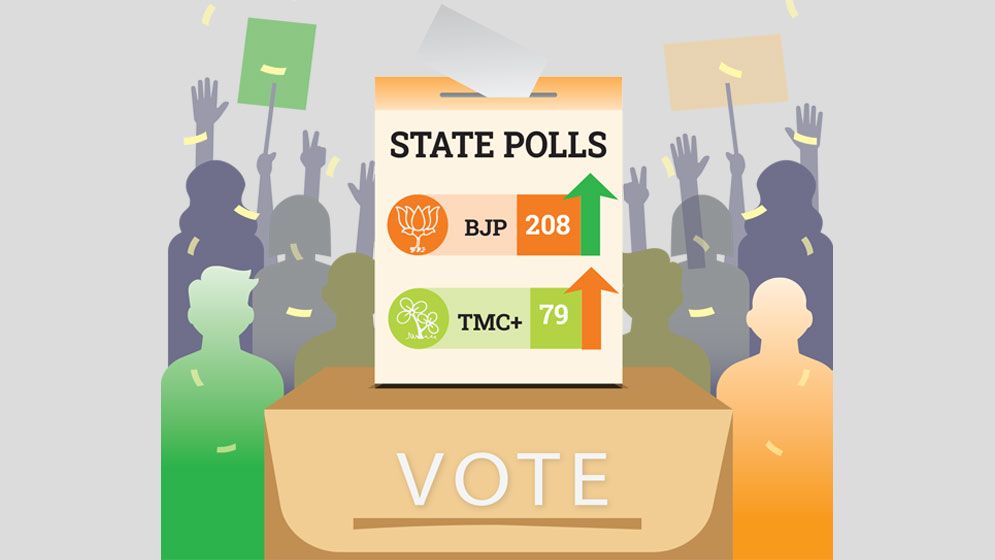
The Bharatiya Janata Party (BJP) has scripted history by breaching the “Bengal Wall”, expanding its eastern push, defeating the Trinamool Congress (TMC), and bringing an end to Mamata Banerjee’s 15-year dominance in the state.
Indian Prime Minister Narendra Modi’s party finally has grabbed the once “invincible” state of more than 90 million populations for his party, leading in 208 seats with 46 percent of votes, while Didi, nickname of Mamata, which translates to elder sister in Bangla, could manage her lead only in 79 seats though gained 41 percent of the state’s total vote, according to the results announced till filing this report at 10:45pm on Monday.
When the vote counting began at 8am, the results indicated to a close fight between BJP and TMC. But gradually the difference of seats increased, confirming fall of Mamata fortress in the state.
BJP confirmed victory in two more states as results of four more state elections were released on the day.
MK Stalin’s Dravida Munnetra Kazhagam was ousted by Chandrasekaran Joseph Vijay’s Tamilaga Vettri Kazhagam, reviving film-star politics in Tamil Nadu, while in Kerala the Indian National Congress-led United Democratic Front unseated the Left Democratic Front, ending the last Communist-led state government in India. Assam remained the only state where a party, the BJP, has succeeded to retain power, also holding Puducherry.
Despite winning three out of five state elections, Modi and his party colleagues had no hesitation to express that the joy of their victory in West Bengal is unmatchable with any other states as it was their long-cherished dream.
Wearing traditional Bengali dress Panjabi and dhoti, Modi addressed his party workers in front of the BJP headquarter in Delhi.
The Indian PM described the electoral outcome as a defining moment in India’s democratic journey, calling it both “historic” and “unprecedented.”
“With West Bengal win, ‘lotus’ is blooming from Gangotri to Gangasagar,” he said.
Emphasising the scale of the victory and the effort behind it, he said, “Today is a historic day. It is unprecedented. When years of efforts turn into success, the happiness that is seen on the faces of the people is the same happiness that I see on the faces of BJP workers across the country today.”
“It shows the direction in which a developing India wants to move. Today’s India seeks opportunity. It seeks development. It seeks trust, progress, and stability. Today’s India demands a brand of politics that moves the nation forward,” he added.
Expressing gratitude to the people of West Bengal, Modi said from now on the state will progress with the development of India.
“Today, a new sunrise has taken place on the sacred soil of Bengal. The people of Bengal have rejected politics of appeasement and fear. From today, Bengal will move forward in step with India’s development.”
Recalling authors like Bankim Chandra Chatterjee and Rabindranath Tagore and politician Shyama Prasad Mukherjee, he announced that the oath taking ceremony of the BJP’s West Bengal government will be held on Rabindra Jayanti, the birth anniversary of Tagore.
Mamata Banerjee, who was defeated by BJP’s Suvendu Adhikari from her very own Bhowanipore constituency, accused BJP for assaulting her and looting votes in 100 seats.
After leaving the Shakhawat Memorial School vote counting center, the TMC leader said, “CRPF and BJP both attacked me. They didn’t allow any of us into the counting center. They have rigged 100 seats. And the Election Commission is acting like the BJP’s commission. I have also lodged a complaint with the CEO of West Bengal. This is an unfair victory.”
She also announced that the TMC will return to power again to serve the people of West Bengal.
Reasons of TMC’s defeat
Political analysts in West Bengal have observed the defeat of TMC as the result of incumbency factor as people of the state were dissatisfied regarding the misrule of past 15 years.
Though the analysts predicted that the BJP will be backed by urban elites and middle class and TMC may retain the support of minority Muslims, women and working class people, results show that the saffron party did well outside Kolkata as Mamata’s party showed impressive performance in the city.They also said that women surprisingly voted BJP in big numbers. Besides, the party satisfied the government officials through announcing a salary commission. It also convinced voters saying that only a BJP government in the state can bring Central’s blessings for necessary development.
The large deployment of central forces in this politically violence-prone state has boosted the confidence of ordinary voters. Moreover, the Prime Minister and Home Minister’s campaign highlighting issues such as the RG Kar incident and the deterioration of law and order in the state has had a significant impact against the ruling party, according to them.
The BJP had poured resources into the Bengal election and Modi and his chief lieutenant, Home Minister Amit Shah, together addressed more than 80 rallies and roadshows in the state during the campaign. It also helped the party to win the race.
They, however, said the vote was influenced by the central government as the security forces arrested many people who are sympathisers of TMC. Apart from this Election Commission’s role was also under question as many voters were barred from their rights of voting.
Possible impact
The BJP lacks a two-thirds majority in Parliament to amend the Constitution at the federal level, but it can advance such policies in states it governs. Its infrastructure agenda is also expected to face less resistance in BJP-ruled states compared to opposition-governed ones.
Rahul Verma of the Centre for Policy Research noted that some BJP-led states have already proposed their own versions of a civil code, and suggested the party may also pursue initiatives like nationwide redrawing of constituencies and synchronising state and national elections, both of which could potentially benefit the ruling party.
“It is not like they will act on this immediately, in the next six months to a year. But you may hear these conversations again. It is definite that the party will get stronger and more confident to push these ideas again,” he said reacting to the results.
Read More