


 For all latest news, follow the Daily Sun's Google News channel.


BRICS talks end without joint statement, exposing divisions over war in Iran
Agencies, New Delhi
Published: 16 May 2026, 12:00 AM
Top diplomats from BRICS nations, including regional rivals Iran and the United Arab Emirates (UAE), failed to issue a joint statement after a two-day meeting in Delhi on Friday, prompting host India to release only a chair’s statement that highlighted their differences.
Foreign ministers from BRICS members Brazil, China, Egypt, Ethiopia, India, Indonesia, Iran, Russia, Saudi Arabia, South Africa, and the UAE met in New Delhi, India, for the conference, which began on Thursday.
During the meeting, host India warned of “considerable flux” in a world facing conflict, economic uncertainty, and energy insecurity.
War in Iran and the resulting fuel crisis dominated discussions during the two-day gathering, amid the ongoing conflict triggered by joint US and Israeli strikes on Iran on 28 February. Tehran had wanted the grouping of emerging economies to condemn the US-Israeli war on Iran and accused the US ally the UAE of direct involvement in military operations against it.
Iran has struck the UAE with missiles and drones several times since the war began.
“There were differing views among some members as regards the situation in the West Asia/Middle East region,” India said in the statement and outcome document.
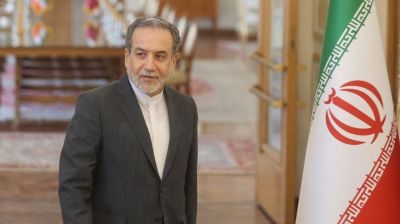
Without naming the UAE, Iranian Foreign Minister Abbas Araqchi told a news conference that a BRICS member blocked some parts of the statement.
“We have no difficulty with that specific country; they have not been our target in the current war.” We only hit American military bases and American military installations, which are unfortunately on their soil,” he said, adding that he hoped things would change when BRICS leaders meet later this year.
“I hope by the time that we come for the summit, they come to a good understanding that Iran is a neighbour, we have to live with each other; we have lived for centuries, and we have to live for centuries to come.”
The Iranian minister also said that Tehran has “no trust” in the US and is interested in negotiating with Washington only if it is serious.
“We received messages again from the Americans saying that they are willing to continue the talks and continue the interaction,” Araghchi told reporters in the Indian capital.
“We appreciate any country who has the ability to help, particularly China,” Araghchi said, AFP reported.
Araqchi added that all vessels can pass through the Strait of Hormuz except those “at war” with Tehran, if they coordinate with Iran’s navy.
But the situation around the waterway, vital to global energy and commodities markets, was “very complicated,” he said, Reuters reported.
Iran effectively shut the strait, which normally handles about one-fifth of the world’s seaborne oil and gas supply, to most shipping after the US and Israel began their war on Iran in February.
The UAE’s foreign ministry did not immediately respond to a request for comment.
Members of the grouping had expressed respective national positions and shared a range of perspectives, India’s statement said.
These ranged from the need for an early resolution of the crisis and the value of dialogue and diplomacy to respect for sovereignty and territorial integrity, it said.
Also figuring in the talks were the importance of upholding international law, ensuring safe and unimpeded maritime commerce through international waterways, and protecting civilian infrastructure and lives, it added.
Call for developing world to stick together
The statement said that BRICS ministers “recalled that the Gaza Strip is an inseparable part of the Occupied Palestinian Territory.” They also flagged the importance of unifying the West Bank and the Gaza Strip under the Palestinian Authority and reaffirmed the right of the Palestinian people to self-determination and an independent State of Palestine.
One member had reservations about some aspects of the section on Gaza, the statement said, without naming anyone.
India’s statement, as the bloc’s chair for 2026, said member countries called for the developing world to stick together to tackle global challenges.
“They highlighted the importance of the Global South as a driver of positive change,” it added.
The region faces international challenges from growing geopolitical tension to economic downturns, technology shifts, protectionist measures, and migration pressures, it said.
Impact of middle east conflict on India
As the world’s third-biggest oil importer and consumer, India has been hit hard by Iran’s effective blockade of the Strait of Hormuz, through which a fifth of global supplies of oil and liquefied natural gas travel in normal times.
Iranian attacks have been linked to the deaths of at least three Indian personnel in the waterway, and an India-flagged ship was sunk this week as Araqchi flew to Delhi.
During a brief visit to the UAE on Friday, Indian Prime Minister (PM) Narendra Modi condemned the attacks on the Gulf nation.
“The way the UAE was targeted is unacceptable in any form,” he said. “In these difficult circumstances, the restraint and courage you demonstrated are highly commendable.”
During the PM’s visit, India and the UAE agreed on a framework for a strategic defence partnership, and signed pacts on strategic petroleum reserves and the supply of liquefied petroleum gas, the Indian foreign ministry said, as they seek to deepen ties amid the Iran war.
Meanwhile, India’s state-run oil companies raised petrol and diesel prices by more than three percent on Friday as disruption to energy supplies due to the Iran war mounts pressure on the economy.
In Delhi, petrol prices rose to 97.77 rupees ($1.02) per litre from 94.77 rupees, while diesel climbed to 90.67 rupees from 87.67, according to data from the Indian Oil Corporation, AFP reported. Recommended Stories